You’re staring at a practice management screen showing forty-seven files marked “In Progress.” The T2 deadline is three weeks out. Everything looks fine, right up until you open the first file and realize the bank statements never arrived, the PBC list went unanswered, and nobody on your team owns the follow-up. That file has been “In Progress” for six weeks. It was never progressing.
By the end of this piece, you’ll have a practical framework for distinguishing files that are genuinely moving from files that are quietly becoming problems, before the statutory deadline forces the discovery for you.
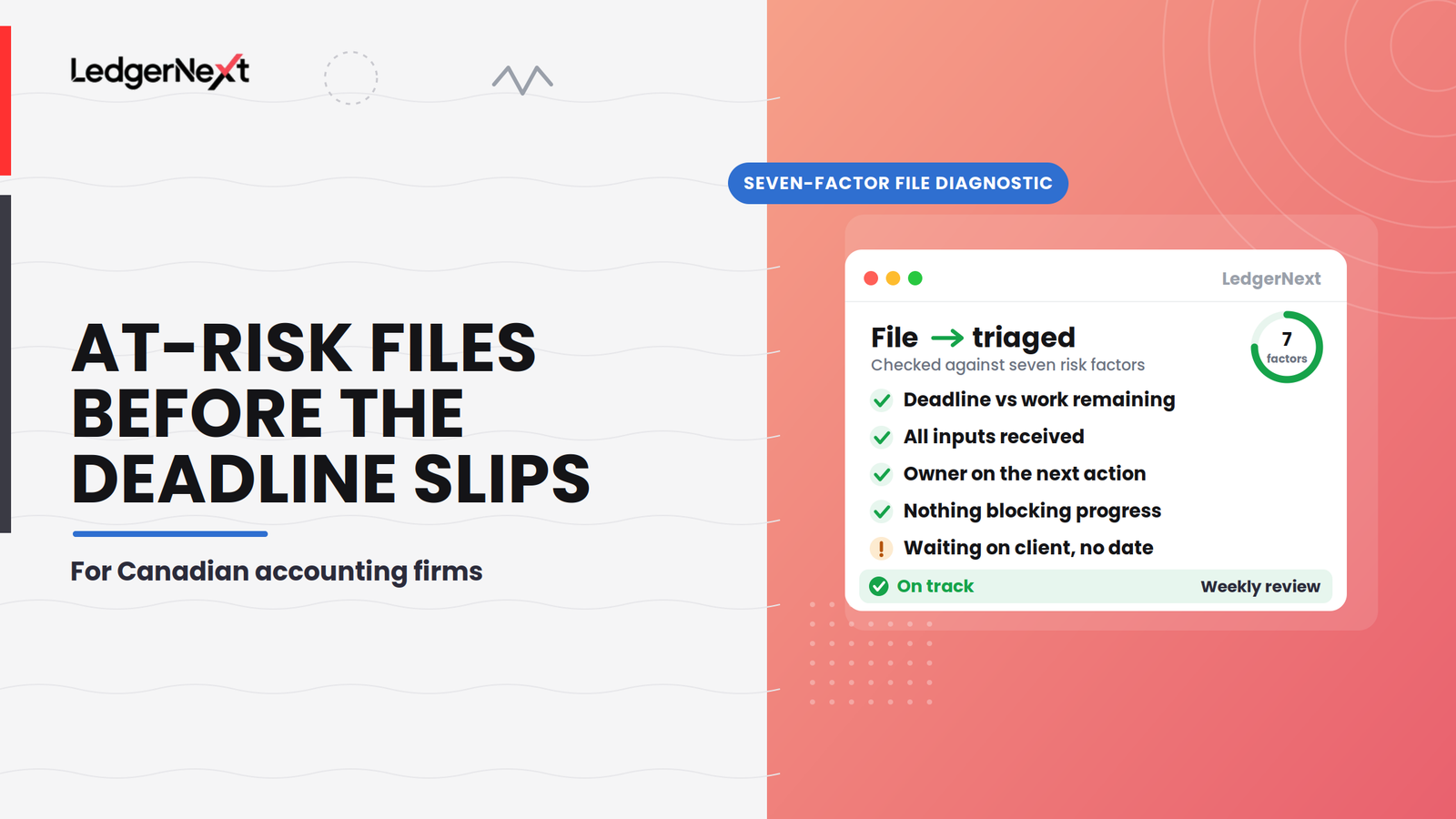
A client file is at risk when something, a missing document, an unresolved blocker, unclear ownership, stalled progress, or a pending review, could stop it being completed, approved, or filed before its deadline. You find these files by checking each active engagement against seven factors (deadline, readiness, blocker, ownership, age, review, dependency) in a weekly portfolio review, instead of trusting status labels like “In Progress” or “Waiting on client.”
File health is not the same as task status. A file can read “In Progress” while its dependencies are broken, so you need a diagnostic that looks past the label.
- Run every active file against seven risk factors: deadline, readiness, blocker, ownership, age, review, dependency.
- A file flagging amber or red on two or more factors needs intervention; a red on dependency alone may need it first.
- “Waiting on client” is not a final status. It hides what is missing, who owns the chase, and what deadline it affects.
- When the same signal appears across several files, you have a workflow problem, not a file problem.
Who this applies to
If you manage more than a handful of client engagements across bookkeeping, payroll, tax, or recurring compliance work, and you’ve ever been surprised by a file that looked active but wasn’t, this is for you. Practice managers, firm owners, senior bookkeepers running multiple files, partners overseeing review queues.
If you’re a solo practitioner with fewer than ten clients and you can hold every file’s status in your head, you probably don’t need a diagnostic framework. You need a calendar. For workflow standardization itself, LedgerNext’s guide to standardized workflows covers that ground.
What is an at-risk client file?
Definition
An at-risk client file is an active engagement where one or more conditions, missing documents, unresolved blockers, unclear ownership, stalled progress, or pending review, could prevent the work from being completed, reviewed, approved, or filed before its deadline.
That definition matters because it separates file health from task status. A file can carry the label “In Progress” while three of its dependencies are broken.
When a file is active but not actually on track
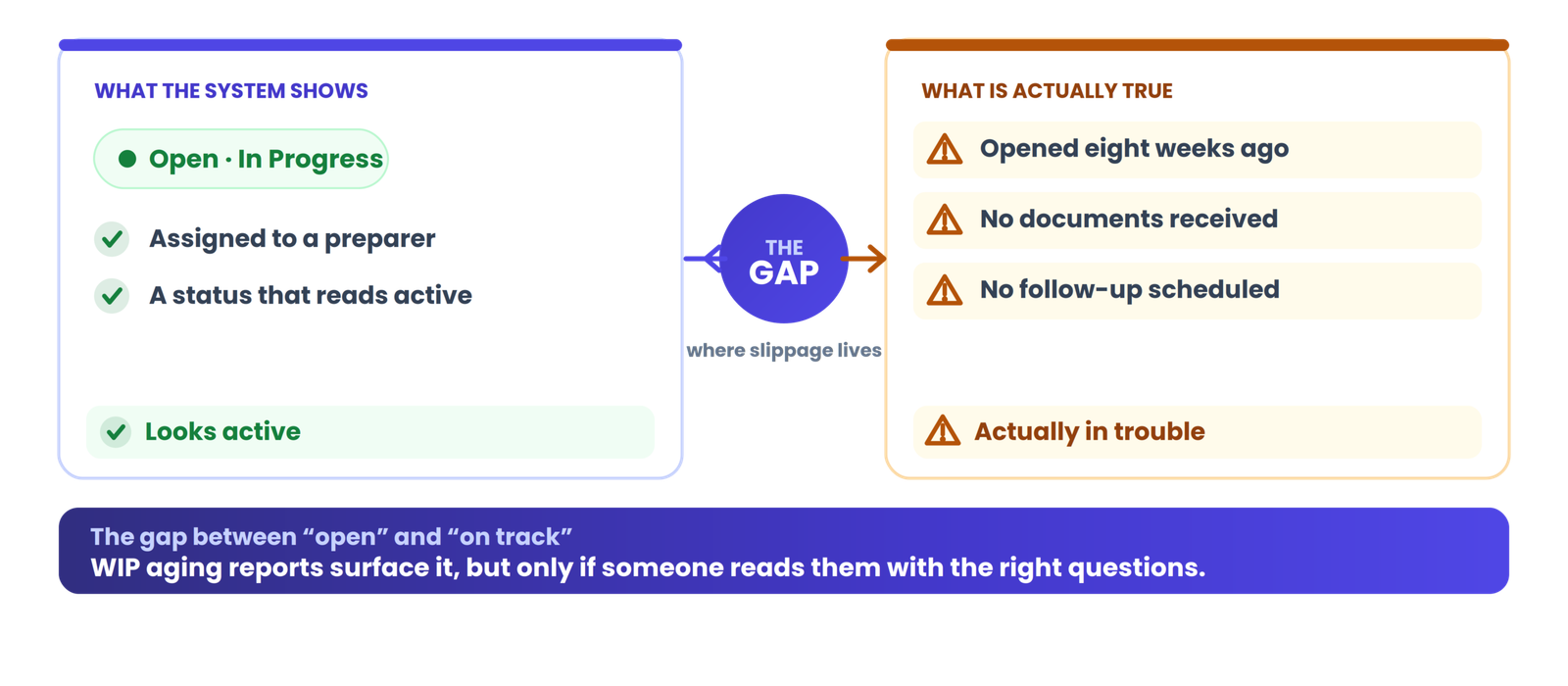
Most practice management systems track whether a file is open. Fewer track whether anything meaningful has happened to it recently. A file opened eight weeks ago, assigned to a preparer, with no documents received and no follow-up scheduled is technically active. It’s also in trouble.
The gap between “open” and “on track” is where deadline slippage lives. WIP aging reports sometimes surface this, but only if someone is reading them with the right questions.
Why at-risk files are easy to miss
Status labels hide reality. “Waiting on client” can mean a document request was sent yesterday or six weeks ago. “In review” can mean the reviewer opened it this morning or that it’s been sitting in a queue behind fourteen other files.
Fragmented communication compounds the problem. The request went out by email, the client responded by text, the follow-up lives in someone’s personal task list. Nobody updated the file. Wolters Kluwer’s recent workflow analysis argues that bottlenecks often originate well before they become visible, typically at intake or handoff stages where readiness wasn’t confirmed before the file moved forward.
When you multiply that across a portfolio of fifty or a hundred clients, the files that need attention become invisible until they’re urgent.
The signals that tell you a client file may be at risk
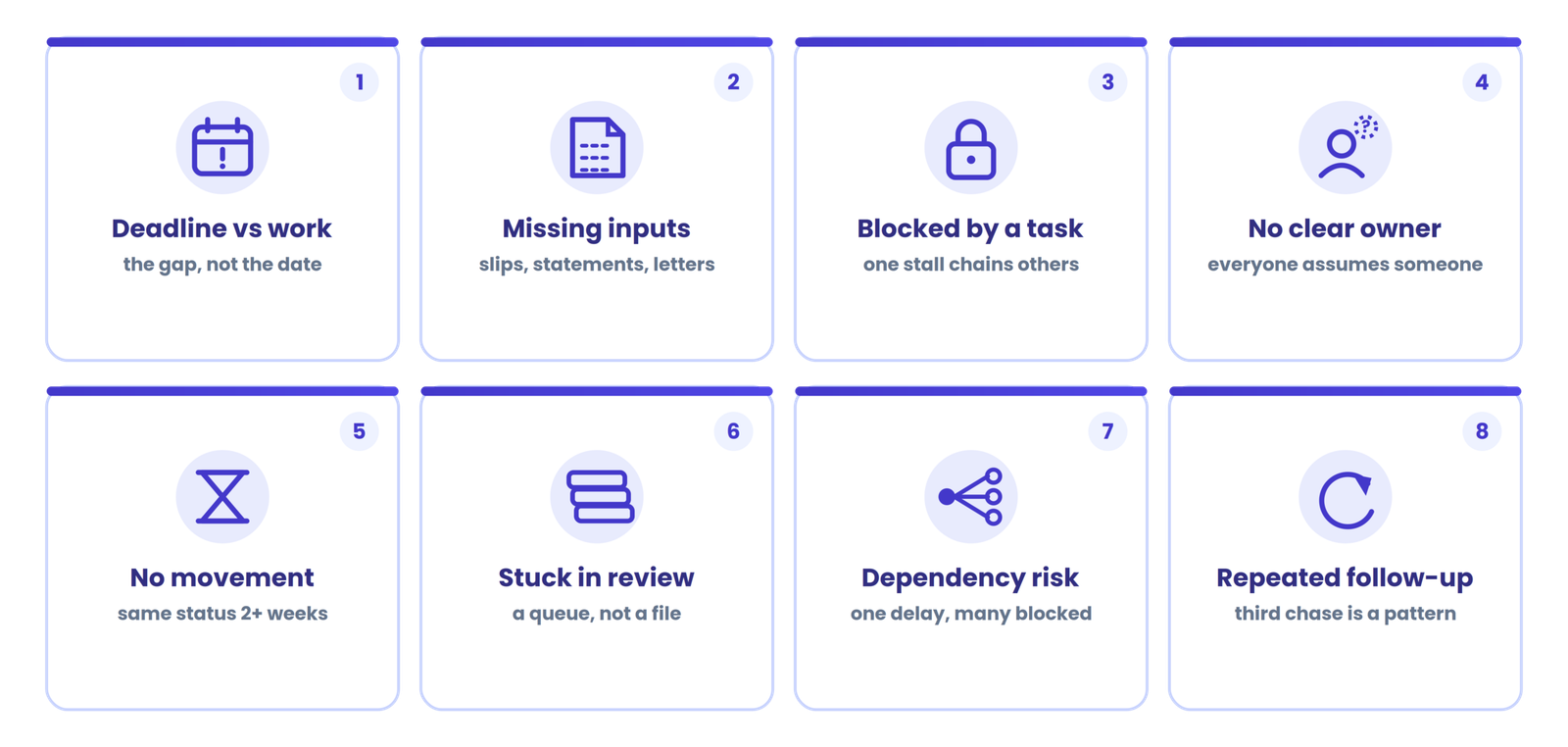
The deadline is approaching but key work is incomplete
This seems obvious. It isn’t always. A T1 filing due April 30 looks fine on March 1. But if the bookkeeping isn’t finished, the prior-year carryforward is broken, and the client hasn’t provided their T-slips, March 1 is already late. Check the gap between the deadline and the actual remaining work, not just the calendar date.
Required client information is missing
Missing slips, unsigned engagement letters, outstanding bank statements. The file can’t move until these arrive, and every day they don’t is a day closer to the statutory deadline. If your firm has a structured client collaboration process, the gap is visible. If requests live in scattered emails, it isn’t.
Work is blocked by another task or person
A GST/HST return can’t be filed until the bookkeeping is reconciled. The bookkeeping can’t be reconciled until unposted items in the bank feed are resolved. One stalled task creates a chain of stalled tasks.
Nobody owns the next action
This one is quieter than the others and often more damaging. The preparer thinks the manager is following up with the client. The manager thinks the preparer already has the documents. The file sits. Your existing content on scaling bookkeeping operations flags unclear client ownership as a scaling bottleneck, and it shows up here too.
Work has been sitting without meaningful progress
If a file hasn’t changed status in two weeks during a busy period, something is wrong. Maybe the assigned person is overloaded. Maybe the file is waiting on something nobody documented. Either way, age without movement is a signal.
Completed work is waiting too long for review
Prep is done. Review notes haven’t been cleared. The file is EFILE-ready in theory but stuck in a queue. If five files are waiting on the same reviewer, that’s not a file problem. That’s a capacity problem wearing a file-shaped mask.
One delayed task is blocking several others
A single client’s payroll reconciliation delay might not seem urgent, until you realize the month-end close, the GST filing, and the T2 prep all depend on it. Dependency risk is the one most firms discover last.
The file requires repeated follow-up
Three follow-ups for the same missing document is a pattern. It means the current approach to collecting that information isn’t working, and the file will keep aging until something changes. Low portal adoption is often the underlying issue: if the client isn’t habituated to using the portal, every request becomes a manual chase.
The client file risk diagnostic
This is a seven-factor framework for assessing whether an active client file is on track, at risk, or critical.
| Risk factor | Question to ask |
|---|---|
| Deadline | How much time remains relative to the work outstanding? |
| Readiness | Does the team have everything needed to proceed right now? |
| Blocker | Is something or someone preventing forward progress? |
| Ownership | Is it clear who owns the next action? |
| Age | How long has the file been sitting without meaningful change? |
| Review | Is completed work waiting in a review queue? |
| Dependency | What other deliverables depend on this file? |
And here’s how those factors map to a status:
| Risk area | On track | At risk | Critical |
|---|---|---|---|
| Deadline | Comfortable margin remains | Approaching, limited buffer | Immediate concern |
| Readiness | All inputs received | Some items outstanding | Cannot proceed |
| Blocker | None identified | Minor, workaround possible | Work stopped |
| Ownership | Clear, confirmed | Needs confirmation | No owner identified |
| Review | On schedule | Waiting | Overdue |
| Age | Moving as expected | Slower than expected | Stalled |
| Dependency | None or minimal | Some downstream impact | Multiple tasks blocked |
A file flagging amber or red on two or more factors probably needs intervention. A file flagging red on dependency alone might need it before anything else on your list.
This isn’t an industry-standard scoring model. It’s a practical diagnostic any practice manager can apply during a weekly file review.
Green: on track. All inputs received, work progressing, owner clear, deadline comfortable. No intervention needed.
Amber: at risk. Something requires attention. Maybe documents are partially received, or the file has been sitting a few days longer than expected. The window to resolve it without pressure still exists.
Red: critical. The file cannot move, the deadline is close, or multiple downstream deliverables are affected. Immediate action required.
Why “waiting on client” should not be a final status
This is one of the most common status labels in any accounting firm’s workflow. It’s also one of the least useful.
“Waiting on client” tells you the ball is in someone else’s court. It doesn’t tell you what’s missing, when it was requested, who requested it, when the next follow-up is scheduled, what deadline it affects, whether another part of the engagement can continue, or who owns the next follow-up.
A file marked “waiting on client” with no follow-up date, no documented request, and no owner for the chase is functionally abandoned. It will reappear when the deadline is too close to recover. A firm with a clear client collaboration framework tracks each of those dimensions. Without that, “waiting on client” becomes a parking lot for files nobody wants to think about.
A practical client file triage example
All names and details below are illustrative.
T2 deadline is eight weeks away. All source documents received. Bookkeeping is in progress, no blockers, preparer assigned. File hygiene is clean.
GST/HST quarterly filing is ten weeks out. Three of seven bank statements are missing. PBC list sent three weeks ago with no response. Two downstream tasks (reconciliation and GST prep) can’t start.
T2 deadline is nine days away. Bookkeeping is complete but review notes from two weeks ago are unresolved. One suspense account still carries an uncleared exception. Client approval for the final statements hasn’t been requested.
Deadline alone didn’t determine risk. Client B, with the most time remaining, is arguably in worse shape than Client A because nothing can move until the missing inputs arrive.
See every at-risk file at a glance
LedgerNext centralizes client data, exceptions, and workflow status in one place, so missing documents, stalled files, and review queues surface before a deadline forces the discovery.
How to spot a bottleneck before it affects the deadline
When you see the same signal across multiple files, you’ve found a workflow-level problem.
Several files waiting on one reviewer means review capacity is the constraint. Several files stalled on missing client documents means your document-collection process has a gap. Several files stuck at reconciliation means something in the bookkeeping workflow is breaking down. Several files repeatedly returned for corrections means quality checkpoints need attention, and your bookkeeping quality control process may need a closer look.
The shift from “which file is at risk?” to “why are multiple files becoming at risk?” is where operational improvement starts.
Internal deadlines vs Canadian filing deadlines
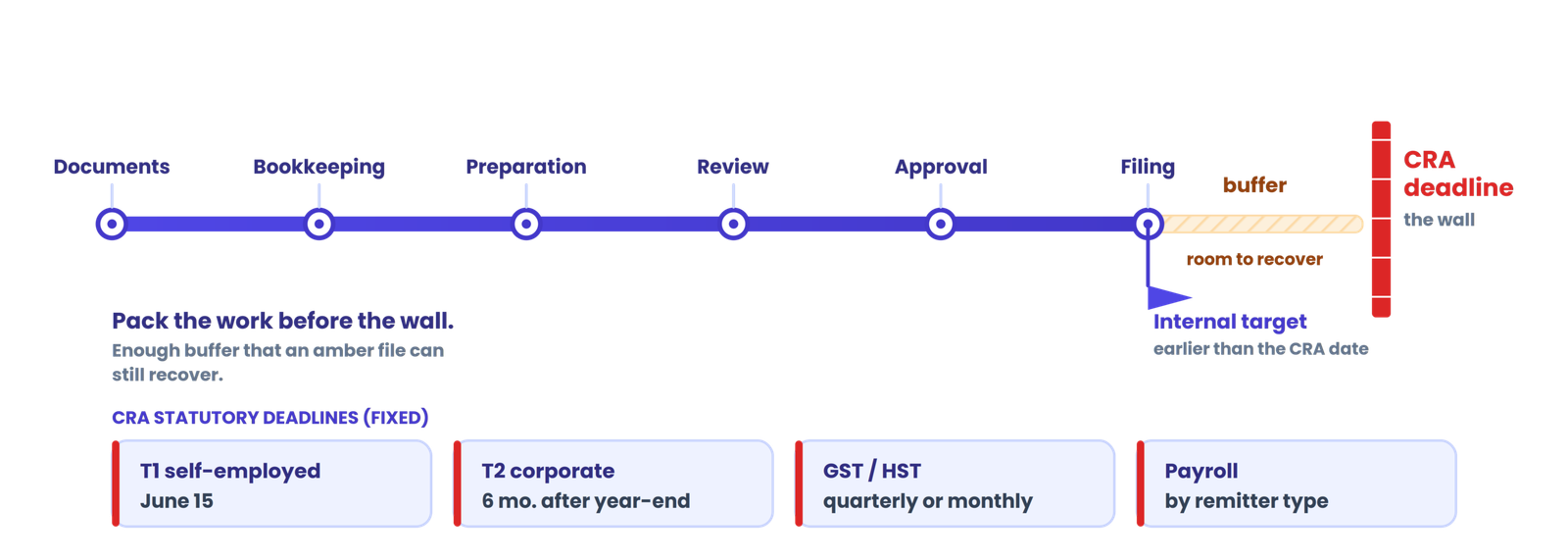
The CRA sets statutory deadlines: June 15 for self-employed T1 filers, six months after fiscal year-end for T2 corporate returns, specific quarterly or monthly dates for GST/HST remittances, and payroll remittance dates that vary by remitter type. These are fixed, and the CRA publishes them directly.
Your firm’s working deadline needs to be earlier. If the T2 is due June 30, the firm needs internal milestones for document collection, bookkeeping completion, preparation, review, client approval, and filing. How much earlier depends on the file’s complexity, the client’s responsiveness, and your team’s capacity.
I won’t prescribe a universal buffer. A “three weeks before deadline” rule works until it doesn’t. The point is that your internal timeline should create enough room that a file flagging amber still has time to recover before it hits the statutory wall.
Building an at-risk file review
One approach that works for many firms:
Daily (five minutes)
Scan for files flagged critical. Who owns the next action? Is it happening today?
Weekly (thirty minutes)
Review all at-risk files. Update statuses. Reassign ownership where needed. Identify any files that moved from green to amber since last week.
Monthly (one hour)
Look for patterns. Which signals are recurring? Where are files clustering? Is the same bottleneck appearing across multiple clients?
These aren’t universal best practices. They’re a starting cadence you can adjust based on your firm’s volume and season.
At-risk client file review checklist
Deadline
Readiness
Workflow
Review
Risk
How technology can improve client-file visibility
The core problem is that file status lives in too many places: email, spreadsheets, chat messages, someone’s memory. Practice management tools from Xero, QuickBooks, and Canadian platforms like Clerra and Docket are all converging on the same idea, giving firms a centralized view of deadlines, blockers, ownership, and client-file status across the entire portfolio.
The capabilities that matter most for identifying at-risk files:
- Surfacing missing client information automatically.
- Showing which files haven’t moved.
- Flagging approaching deadlines against actual progress.
- Making review queues visible to the whole team.
Connect file-level visibility to the actual accounting work
If your firm handles bookkeeping, reconciliation, and tax prep across multiple clients and you need that file-level visibility connected to the work itself, see how LedgerNext centralizes client data, exceptions, and workflow status in one place.
Frequently asked questions
What makes a client file at risk?
A client file is at risk when one or more conditions, such as missing source documents, unresolved blockers, unclear ownership of the next action, stalled progress, or a pending review, could prevent the engagement from being completed, approved, or filed before its applicable deadline. Risk depends on multiple factors, not deadline proximity alone.
How can accounting firms identify files that are falling behind?
Check each active file against seven factors: deadline proximity, readiness, blockers, ownership, age, review status, and dependencies. Any file flagging concern on two or more factors warrants closer attention. A weekly portfolio review surfaces these before they become urgent.
What is the difference between an overdue task and an at-risk file?
An overdue task has already missed its target date. An at-risk file hasn’t missed anything yet but shows signals, stalled progress, missing inputs, unclear ownership, that suggest it could. The diagnostic value is in catching the file before it becomes overdue.
Why isn’t “waiting on client” enough as a workflow status?
Because it answers who the file is waiting on without answering what’s missing, when it was requested, when follow-up is scheduled, or whether other work can continue in the meantime. Without those details, “waiting on client” becomes an indefinite hold with no accountability.
How should firms prioritize blocked client work?
Weigh deadline proximity alongside blocker severity, readiness, dependency impact, and ownership clarity. A file due in three weeks with no documents and four dependent tasks may need attention before a file due tomorrow that’s fully prepared and simply awaiting a final signature.
The next problem you’ll hit
Once you start identifying at-risk files consistently, you’ll notice the same root causes appearing across multiple clients. That’s the point where this stops being a file-level diagnostic and becomes a workflow design question. The framework above tells you which files need attention right now. What it won’t tell you is why your firm keeps producing at-risk files in the first place. That’s the harder, more valuable question, and it usually lives in your intake process, your document-collection habits, or your review capacity.
Start with the diagnostic. The patterns will show you where to look next.