Last month I pulled up a client file and found $14,200 sitting in a suspense account. The oldest item was eleven months old. Nobody could tell me what it was. The bookkeeper who had parked it there had left the firm. The client had no idea. And the year-end was three weeks away.
That moment, staring at a suspense balance with no documentation and no owner, is familiar to anyone running a multi-client bookkeeping practice. Each transaction went into suspense for a perfectly reasonable temporary purpose: the books needed a debit and a credit before the correct classification was known. Then it stayed.
The real problem is rarely the suspense account itself. It is the transactions inside it that cannot yet be confidently classified, and the workflow that lets them sit unresolved. For a Canadian accounting firm, unresolved suspense items are not a cosmetic issue. They distort financial statements, they carry into tax filing positions, and they surface at the worst possible time, usually at year-end when the evidence trail has gone cold.
This guide is built around what actually matters: investigating suspense items, clearing them with evidence, reviewing the resolution, and preventing the same items from coming back across your client base. It is not another definition-and-sample-journal-entry article.
The short version
A suspense account holds a transaction temporarily when the books need a debit and credit but the correct classification is not yet known. The account is not the problem; the discipline is in the follow-up. Every item needs an owner, supporting evidence, and a documented resolution traced to a source. A zero balance forced by dumping items into miscellaneous expense is not a resolution.
What is a suspense account?
Definition
A suspense account is a temporary general-ledger account that holds a transaction pending its ultimate disposition, when the bookkeeper has enough information to record the amount but not enough to determine its final classification. The Government of Canada’s terminology database defines it as an account where transactions are recorded temporarily pending their ultimate disposition.
That definition describes the container. It does not explain the mechanism. A suspense account exists because double-entry bookkeeping demands that every transaction land somewhere on the general ledger. When the bookkeeper does not yet know where a transaction belongs, the system still needs a debit and a credit. Suspense absorbs that uncertainty so the books stay balanced while the investigation happens.
Why accounting teams use suspense accounts
The value of a suspense account is that it lets you keep the books balanced and posted without guessing. A transaction may need temporary treatment when a deposit arrives with no remittance advice, when an amount is known but the account is not, or when a difference surfaces during error correction or trial-balance preparation. In each case, parking the item in suspense is more honest than forcing it into an account you are not sure about.
The important distinction is between temporary holding and final classification. Suspense is a waiting room, not a destination. A transaction should sit there only while a specific piece of information is being obtained, and it should leave the moment that information arrives.
What a suspense account does not mean
Three misreadings cause most of the trouble:
It is not a permanent dumping ground. A suspense account is not a place to hide transactions you would rather not deal with. An item that has been there for months is a signal, not a resting state.
It does not automatically mean the transaction is an error. Many suspense items are perfectly valid transactions that are simply waiting for documentation. Treating every suspense item as a mistake leads to unnecessary reversals.
A zero balance does not prove the bookkeeping is correct. A suspense account can be cleared to zero with unsupported entries and still leave the financial statements wrong. The number is not the proof; the documentation behind each clearing entry is.
Why do transactions end up in suspense?
The published guidance makes it sound straightforward: something unknown arrives, you park it, you clear it later. In practice, suspense items accumulate for reasons that have less to do with accounting knowledge and more to do with workflow friction. Understanding the reason behind a suspense item is what tells you how to clear it.
Unidentified bank transactions
A deposit or withdrawal appears on the bank feed with no supporting detail. The classic example is a batched deposit where the bank description says only “DEPOSIT.” I once spent two hours tracing a $3,400 deposit that turned out to be three separate customer payments the bank had combined. Until the source is identified, the amount has to sit somewhere.
Missing or incomplete supporting documentation
The transaction is visible, but the receipt, invoice, or contract that would confirm its treatment has not arrived. This is common with client-dependent information: an expense that could be capital or operating, or a payment that could be a loan or revenue, cannot be classified until the paperwork shows up.
Unclear transaction descriptions
Vague bank-feed descriptions and clients who send e-transfers with no memo leave the bookkeeper guessing. A line that reads only as a reference number or a generic label carries no information about what the money was for.
Uncertain account classification
Sometimes the source is known but the correct account is genuinely ambiguous. Is a software purchase an expense or a prepaid asset? Does an inter-account movement belong to one entity or another? When the answer depends on judgment or on facts not yet confirmed, suspense holds the item until the classification is settled.
Timing or processing differences
POS systems that split settlements across multiple deposits, payment processors that batch and delay, and cut-off differences at period-end all create transactions that do not yet match cleanly. The item is real; it simply cannot be reconciled to its counterpart until the timing resolves.
Incorrect or incomplete journal entries
A difference surfaced during error correction or trial-balance preparation often lands in suspense while the original posting is investigated. A one-sided entry, a transposed figure, or a missing line can all produce a balancing difference that suspense absorbs temporarily.
Opening balances or historical bookkeeping issues
Balances brought forward from a prior period or a predecessor firm can arrive without working papers. These inherited items are among the hardest to resolve because the people and documents that would explain them may no longer be available.
When your firm handles six, ten, twenty client books, these small gaps multiply. The suspense account does not grow because bookkeepers are careless. It grows because the upstream information is incomplete.
How to review and clear a suspense account
The SERP is full of advice that amounts to “move the transaction to the correct account.” That is the equivalent of telling someone with a flat tire to “put air in it.” The real work is the investigation. Here is the workflow, end to end:
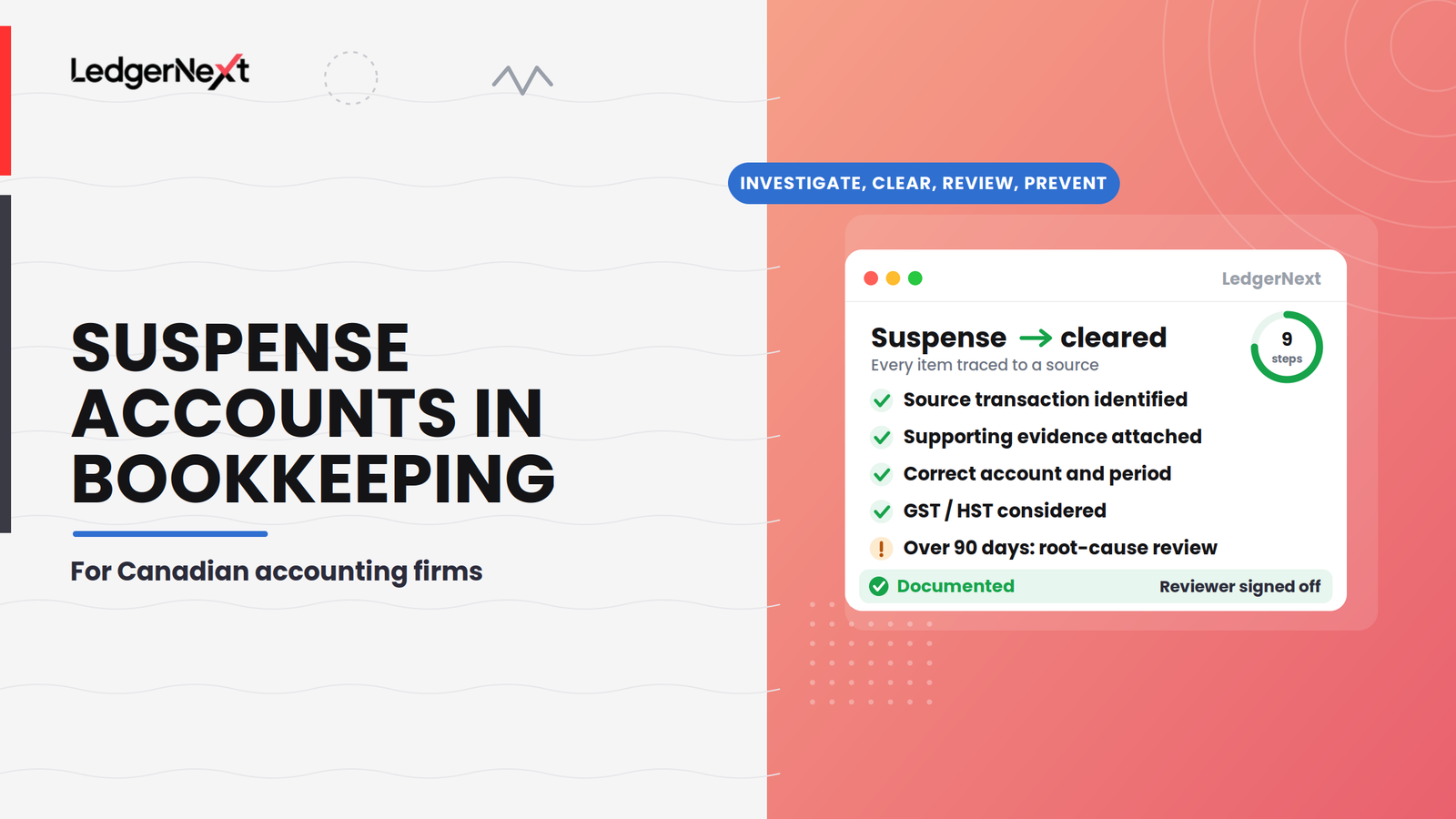
Step 1: Identify the suspense transaction
Start with the item itself. Confirm the date, the amount, and the period it was posted in. Isolate a single transaction rather than a net balance, because a suspense balance is often several unrelated items that need separate investigation.
Step 2: Trace it back to the original source
Follow the item to where it entered the ledger: a bank feed line, an imported batch, a manual journal entry, or an opening balance. The entry point usually tells you what kind of evidence will resolve it.
Step 3: Gather supporting evidence
Pull the bank detail, remittance advice, vendor statement, customer ledger, or contract that explains the transaction. Where the evidence sits with the client, request it specifically rather than generally: name the date, the amount, and what you need confirmed.
Step 4: Determine what the transaction represents
Only once the evidence is in hand, decide what the transaction actually is: revenue, a receivable, a loan, an expense, an asset, a transfer, or a correction. This is the step most rushed resolutions skip.
Step 5: Determine the appropriate accounting treatment
Translate what the transaction represents into the correct account, period, and tax treatment. Consider GST/HST where relevant, and confirm the destination account is appropriate for the transaction type rather than convenient.
Step 6: Post the correction or reclassification
Record the reclassification with a clear memo that references the source document. The clearing entry should be traceable by anyone who reviews it later, without needing to ask you what it was for.
Step 7: Confirm the suspense balance after the correction
Check that the suspense balance changed by exactly the amount you moved, and that clearing this item did not create a new reconciling difference elsewhere. A correction that fixes one account and breaks another is not finished.
Step 8: Document the resolution
Attach or reference the evidence, note the reasoning, and record who resolved it. If the same type of transaction has appeared before, document the root cause so the pattern can be addressed at intake.
Step 9: Escalate items that cannot be resolved
When the evidence genuinely cannot be obtained, do not force the balance. Escalate the item to a reviewer or manager with the investigation status attached, so any write-off decision is made deliberately and with documentation, not silently at the keyboard.
That last discipline is where most firms stop short. Clearing the item feels like solving the problem. It isn’t, if the same type of transaction shows up again next month.
Suspense account investigation matrix
This matrix is designed for the bookkeeper doing the actual triage. For each situation, the first check and the evidence source differ. The matrix tells you where to look, not where to post.
| Suspense situation | First check | Evidence | Possible next step |
|---|---|---|---|
| Unidentified bank deposit | Who sent it? | Bank details, remittance advice, client confirmation | Reclassify to revenue, receivable, or loan based on confirmed source |
| Unknown payment/withdrawal | What was it for? | Vendor records, purchase orders, bank memo | Reclassify to the appropriate expense or asset account |
| Unmatched customer payment | Which invoice does it apply to? | Customer ledger, open invoice list, payment reference | Apply to the correct receivable |
| Unclear vendor payment | Which vendor and which bill? | AP subledger, vendor statements, cheque images | Apply to the correct payable |
| Transfer between accounts | Which accounts were involved? | Bank statements for both accounts, transfer records | Post the offsetting entry |
| Incomplete source documentation | What is missing? | Client follow-up, original receipt, contract | Hold until documentation arrives, then classify |
| Incorrect journal entry | What was the original intent? | Journal entry detail, preparer notes, trial balance | Reverse and repost correctly |
| Opening balance brought forward | Why was it carried? | Prior-period working papers, predecessor firm notes | Investigate origin, clear or write off with documentation |
Do not prescribe a final account for any of these until the underlying facts are confirmed.
Suspense account investigation checklist
A quick-reference checklist for working a single suspense item from first look to sign-off. Run it in order; each stage assumes the one before it is complete.
Before investigating
During investigation
Before clearing
After clearing
Common suspense account problems
When suspense goes wrong, it usually shows up as one of these patterns. Each one points to something the bookkeeping team should investigate, not just a number to adjust.
Suspense balance does not clear
The balance will not resolve to what you expect, usually because the account holds several items and one of them is misidentified. Break the balance into individual transactions and investigate each separately rather than chasing the net figure.
Old transactions remain in suspense
Items that have aged for months indicate a control failure, not a difficult transaction. Something in the follow-up loop stopped: an unanswered client request, an item with no owner, or a review step that never happened.
Transactions are repeatedly sent to suspense
If the same type of transaction lands in suspense every period, the fix is not faster clearing. It is a recurring intake problem: a bank-feed rule that does not match the client’s pattern, or documentation that never arrives on time.
Suspense is cleared with unsupported adjustments
A zero suspense balance does not mean the bookkeeping is correct.
I have seen files where someone cleared $8,000 of old suspense items into miscellaneous expense two days before year-end. The balance looked clean. The financial statements were wrong, the tax return was wrong, and the audit trail showed an unsupported journal entry with the memo “clear suspense.” If a reviewer cannot trace the clearing entry back to a source document, the resolution is no better than the original problem.
Transactions are moved to miscellaneous accounts without enough evidence
Dumping unknown transactions into miscellaneous expense hides the uncertainty instead of resolving it. Miscellaneous should be a rare, documented destination, not a second suspense account by another name.
A correction creates another reconciliation difference
Clearing a suspense item can move the problem rather than solve it. Always confirm that the correction did not open a new difference in the bank reconciliation, a subledger, or a related control account.
Suspense items carry forward from one period to the next
Items that roll from month to month, or across a year-end, compound in difficulty because the evidence trail cools. Carried-forward items should be flagged and prioritized before they become inherited balances nobody can explain.
How to handle old or unresolved suspense items
Why the age of a suspense item matters
Age changes the meaning of a suspense item. A two-week-old item waiting for a client’s remittance advice is normal. A nine-month-old item with no owner and no documentation is a control failure. The older an item gets, the less likely the source data is still retrievable, which is why age drives both priority and escalation.
How to prioritize outstanding items
When you are facing a backlog, prioritize by more than age. Weigh the amount, how frequently the item type recurs, its financial-statement impact, the documentation available, the likelihood of a client response, and any tax or accounting implications. A small, well-documented item can wait; a large item with statement impact and cold evidence cannot.
Here is an example aging framework a firm might adopt internally. These are example internal firm-policy thresholds, not regulatory requirements. There is no CRA rule requiring suspense accounts to be cleared within a specific number of days.
| Age (example policy) | Suggested review action |
|---|---|
| Current (under 30 days) | Standard investigation by assigned bookkeeper |
| 30 to 60 days | Follow-up with client or source, escalate if no response |
| 60 to 90 days | Reviewer attention, document the investigation status |
| Over 90 days | Root-cause review, consider whether a controlled write-off is appropriate with full documentation |
What to do when the transaction cannot be resolved immediately
Transactions can temporarily remain in suspense while information is being obtained. That is the account’s purpose. When you cannot resolve an item now, assign it an owner and a deadline, record what you are waiting for, and set a follow-up date rather than leaving it open-ended.
How to document an outstanding item
An outstanding item should carry a short written record: what it is, what has been checked, what is still needed, who owns it, and when it will be revisited. That record is what lets a reviewer, or a future you, pick the item up without starting over.
When an item should be escalated to a reviewer or manager
Escalate when an item crosses your firm’s aging threshold with no response, when the amount is material to the financial statements, or when a write-off is the only remaining option. Community practice for large inherited balances is consistent: split by year, investigate the newest items first where source data is most likely retrievable, and document the oldest items for a controlled write-off decision if the evidence is genuinely unrecoverable. The Treasury Board of Canada’s guidance notes that a significant suspense balance may indicate a major error in cost or allocation logic; written for government accounting, but the principle applies broadly.
What should a reviewer check before clearing a suspense item?
This is the QC layer. If your firm’s bookkeeping quality control checklist already includes suspense review, the questions below add specificity to that process. Each is a yes/no a reviewer should be able to answer from the file, not from memory.
Is the original transaction identifiable?
The reviewer should be able to see exactly which transaction was cleared, its date, and where it came from, without asking the preparer.
Is there sufficient supporting evidence?
Supporting documentation should be attached or referenced. A clearing entry with no evidence behind it is not reviewable.
Is the proposed account appropriate?
The destination account should fit the transaction type based on the evidence, not be a convenient catch-all.
Is the amount correct?
The dollar amount cleared should agree with the source document, to the cent.
Is the accounting period correct?
The correction should land in the right period, especially near month-end and year-end cut-offs.
Has the correction been properly documented?
The memo should explain the reasoning clearly enough that the entry stands on its own in the audit trail.
Does the correction create another reconciliation issue?
The reviewer should confirm the clearing entry did not open a new difference in a related account or reconciliation.
Is this a recurring problem?
If the same item type keeps appearing, the reviewer should flag it for root-cause review rather than approving another one-off fix.
Do not review only whether the suspense account became zero. Review whether the underlying transaction was correctly resolved.
Suspense accounts at month-end and year-end
Suspense review fits naturally into your month-end close process. The goal shifts as the stakes rise from a monthly close to a year-end.
Suspense review during month-end close
At month-end, the goal is to clear what can be cleared and document what cannot. Review outstanding items and their aging, give material items priority, chase unresolved client questions, post the corrections that are supported, and complete reviewer sign-off on anything cleared. The month-end pass is what keeps items from quietly aging into year-end problems.
Suspense review before year-end
At year-end, the stakes are higher because unresolved suspense items affect financial-statement accuracy and tax-filing positions. Focus on old balances, unresolved transactions, and the supporting documentation behind each remaining item, weigh the financial-statement implications, and escalate anything that cannot be supported. Government of Canada accounting materials describe year-end suspense balances as representing only transactions whose treatment remains genuinely uncertain. Private-sector firms are not bound by that guidance, but the principle is sound: if it is still in suspense at year-end, you should be able to explain why, in writing.
How accounting firms can prevent recurring suspense items
Clearing a suspense item without asking why it landed there is like fixing a leak without checking the pipe. Recurring suspense activity is a workflow signal. The move is from fixing individual items to improving the firm’s intake.
Standardize transaction review procedures
Give every client file the same review steps so the same type of transaction is handled the same way regardless of who is working it. Consistency is what makes quality repeatable at volume.
Improve client documentation requests
Standardize documentation requests during onboarding and ask for remittance detail as a default, not an exception. Automation helps with matching and categorization, but it will not fix a client who does not send remittance advice. That is a relationship problem, not a software problem.
Use consistent account-mapping rules
Chart-of-accounts templates and consistent mapping across clients reduce the ambiguity that sends transactions to suspense in the first place. The same cost type should post to the same kind of account across your client base.
Track recurring suspense causes
Record why items land in suspense so the pattern becomes visible. If one client generates the same suspense item every month, that is a fixable intake problem, not a monthly clearing task.
Review suspense aging regularly
Run a recurring suspense aging report at the firm level, not just per file, so old items and growing balances surface before year-end. Assign ownership for every unresolved item.
Use exception-based review
Spend review time on the items that do not tie rather than re-verifying amounts that already agree. Exception-based review keeps a multi-client practice focused on the transactions that actually carry risk.
Reduce unnecessary manual data transfer
Every manual re-entry between systems is a chance for a transaction to lose its context and end up in suspense. Reducing manual transfer reduces the gaps that create suspense items in the first place.
Get centralized visibility into unresolved items
If your firm manages reconciliation across multiple client files and needs centralized visibility into suspense items, aging, and ownership, see how LedgerNext supports that workflow.
Suspense account vs clearing account
These two get confused because both are temporary. The difference is whether you know where the money is going when you post it. A clearing account handles expected transactions that will be matched; a suspense account holds transactions whose final destination is genuinely unknown. Terminology is not used identically across every accounting system or firm, so confirm how your software labels each.
| Suspense account | Clearing account | |
|---|---|---|
| Purpose | Hold a transaction whose correct classification is unknown | Hold expected transactions that will be matched and cleared |
| Typical use | Unidentified deposits, unclassified items, balancing differences | Payroll clearing, undeposited funds, inter-system transfers |
| How items are resolved | Investigate the source, then reclassify with evidence | Match to the expected counterpart, then clear |
| Example | A $3,400 bank deposit with no remittance advice | Net payroll routed through a payroll clearing account before it hits the bank |
Frequently asked questions
Why does a transaction go into a suspense account?
A transaction enters suspense when the bookkeeper has enough information to record it in the general ledger but not enough to determine its final classification. Common triggers include bank deposits with no remittance advice, payments with vague descriptions, and transactions where the correct account depends on information the client hasn’t yet provided.
Should a suspense account have a balance?
Temporarily, yes. A suspense account with a small, documented, current balance tied to items under active investigation is functioning correctly. A suspense account with a large, old, undocumented balance is functioning as a dumping ground. The distinction is documentation and follow-up, not the number itself.
How long should a transaction remain in suspense?
There is no universal regulatory deadline. Firms should establish their own review cadence. Many practitioners use 30-day follow-up and 90-day escalation thresholds as internal policy. The right timeline depends on the transaction type and how quickly source documentation can be obtained. What matters is that every item has an owner and a deadline.
What’s the difference between a suspense account and a clearing account?
A clearing account is used for transactions that are expected and will be matched, like payroll clearing. A suspense account holds transactions where the final destination is genuinely unknown. Both are temporary; the difference is whether you know where the money is going when you post it.
How do firms reduce bookkeeping errors related to suspense?
Fix the intake, not just the output. Standardize client documentation requirements, review bank-feed mapping rules regularly, and build suspense aging into your monthly review. If you are seeing the same transaction types enter suspense repeatedly, that is a categorization workflow issue to address at the source.
Can a suspense balance indicate deeper problems in a client file?
Yes. Treasury Board of Canada guidance notes that a significant suspense balance may point to errors in cost allocation or posting logic. For private-sector client files, a growing suspense balance often signals disconnected systems, poor chart-of-accounts design, or a client whose reconciliation process needs attention.
Final takeaway
Suspense is temporary by design. Investigation matters more than simply clearing the balance, supporting evidence should drive every classification, and unresolved items should be tracked and escalated rather than forced to zero. When the same items keep appearing, that is not a clearing problem, it is a workflow problem worth fixing at the source.
If your firm doesn’t currently age suspense items or assign ownership to unresolved balances, that is the single highest-value change you can make this month. Pull the suspense report for your three highest-volume clients, sort by date, and ask one question about each item over 60 days old: does anyone know what this is? The answer will tell you whether you have a suspense problem or a workflow problem. Usually it is both.
Stop suspense items from piling up across client files
See how LedgerNext gives multi-client firms centralized visibility into unresolved items, aging, and ownership, so nothing sits in suspense without an owner.