
The Monday Morning That Broke the System
The bank statements were supposed to arrive Friday. By Monday at 10 a.m., the senior accountant had one PDF from the client’s controller, a different CSV from their bookkeeper, and a reply-all thread where someone named “Dave” asked what format was needed — three days after the original request went out.
The reconciliation was already behind. The PBC list sat half-complete. And the accountant spent the next 45 minutes not doing accounting, but archaeology — digging through email threads to figure out which file was current.
I’ve watched this exact scenario play out at firms of every size across Canada. It usually starts small: one missed attachment, one delayed reply. But as client portfolios grow from 20 to 50 to 150 engagements, these micro-failures compound into something much harder to fix. Client communication often becomes more complex before firms realize it’s happening.
By the end of this guide, you’ll be able to identify exactly where email-based collaboration is costing your firm time, and what a structured alternative actually looks like in practice.
Why Don’t Email Chains Scale for Accounting Firms?
Email chains don’t scale for accounting firms because they create fragmented document management, version confusion across multiple attachments, delayed client responses with no tracking, zero visibility into request status, and compounding workflow inefficiencies that slow reconciliation, reporting, and filing deadlines. Email is a communication tool — not a collaboration system — and treating it as one creates operational bottlenecks that grow with every new client added to the firm’s portfolio.
Why Accounting Firms Still Rely on Email
Let’s be fair to email for a second. It’s familiar. Every client already has it. There’s no onboarding friction, no login portal to explain, no training call to schedule. For a firm managing a handful of clients, email works fine.
Most firms built their early workflows around email because that’s what clients expected. The engagement letter goes out via email. Source documents come back via email. Questions, clarifications, approvals — all email. The historical process was designed around it, and for years, it held up.
The problem isn’t that firms chose email. The problem is that firms kept choosing email long after their operations outgrew it. And that distinction matters, because the fix isn’t about abandoning a tool — it’s about recognizing when a tool stops matching the complexity of the work.
The Hidden Problems With Email-Based Client Collaboration
Here are the biggest reasons email becomes difficult to manage as firms grow:
1. Important Documents Get Buried
Attachments scatter across threads. A client sends their Q3 bank statement in a reply to a Q2 thread. Someone else forwards a corrected version to a different staff member. Now there are two copies of the file in two inboxes, and neither is labeled clearly.
Searching for a specific document across 200+ client email threads isn’t document management — it’s guesswork. Many firms underestimate the administrative burden of chasing documents until staff are spending hours each week just locating files that were already sent. This is one of the hidden costs of manual bookkeeping for Canadian accounting firms that rarely shows up on a timesheet.
2. Teams Lose Visibility
When a staff member leaves or goes on vacation, their inbox goes dark. Shared inboxes help, but they introduce their own chaos — who’s handling which client? Did someone already reply? Is that thread still active or was it resolved last week?
If you sample 5 open client requests and 3 are missing from any central tracker, you’ve got a visibility problem that email alone can’t solve.
3. Client Requests Fall Through the Cracks
An RFI goes out for missing source documents. The client partially responds. The accountant means to follow up but gets pulled into another file. A week passes. Now the aging request is holding up the entire engagement, and nobody flagged it because there’s no status dashboard — just an inbox with 400 unread messages.
Follow-up fatigue is real. When more than half of your open requests still require manual reminder emails, the process is working against you.
4. Month-End Work Slows Down
Here’s what I’ve seen repeatedly: month-end delays rarely originate from the accounting work itself. They originate from missing documentation. The reconciliation can’t close because the bank feed doesn’t match the GL, and the GL can’t be updated because the client hasn’t sent the supporting records.
This cascades. Bookkeeping stalls. Bank reconciliation takes longer than it should. Transaction categorization gets pushed back. Payroll processing — which depends on accurate books — starts running up against remittance deadlines. One missing email attachment at the top of the chain creates a domino effect that touches every downstream workflow.
5. Audit Trails Become Difficult
Who approved the adjusted journal entry? When did the client confirm the expense classification? Was there sign-off on the revised financial statements?
Email threads can technically contain this history, but finding it requires scrolling through dozens of replies, forwards, and CC chains. For compliance purposes — especially during reviews or audits — this is a liability. There’s no structured approval tracking, no timestamped collaboration history, and no reliable way to prove the sequence of decisions.
How Poor Collaboration Impacts Accounting Operations
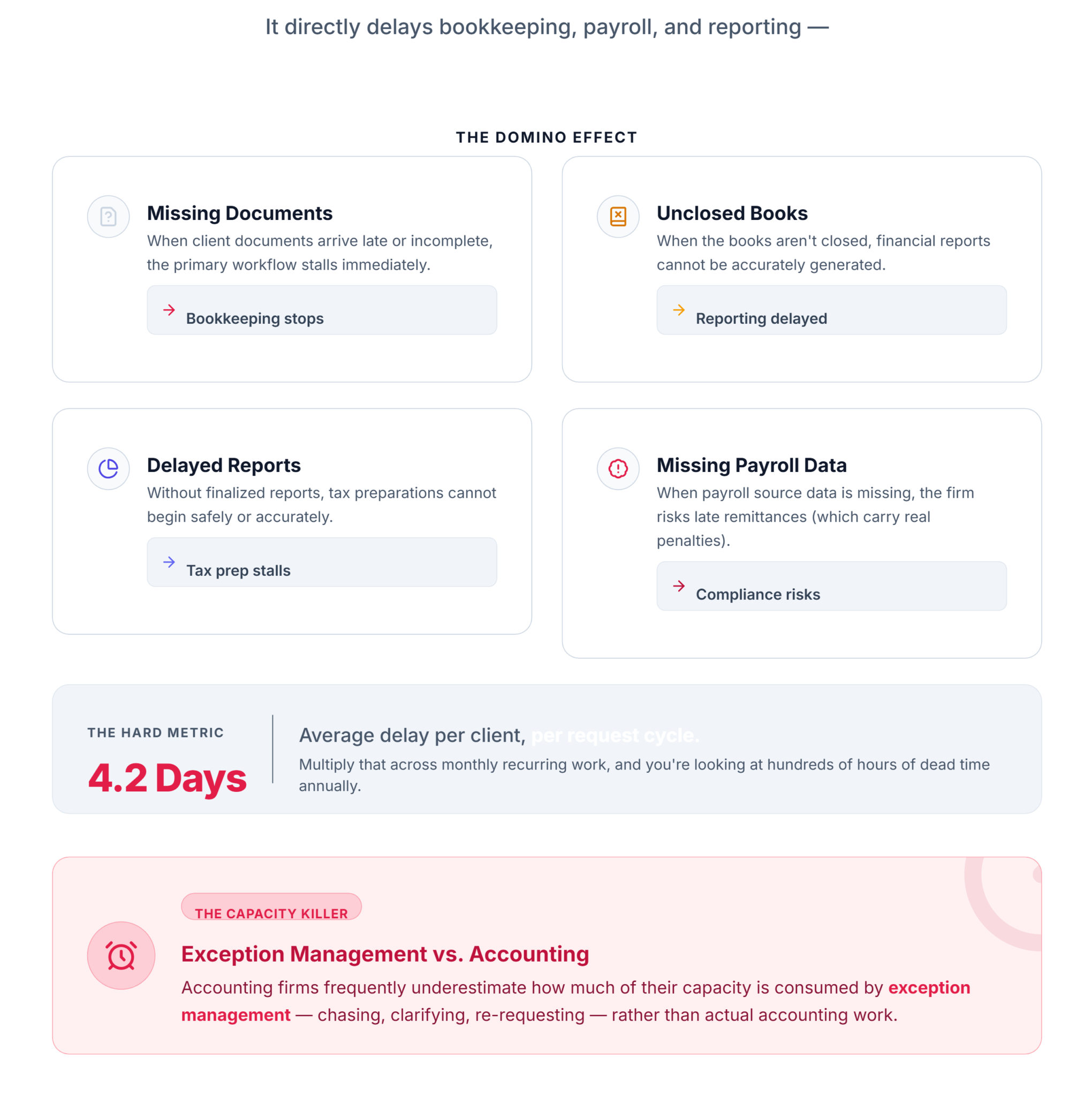
Poor collaboration directly delays bookkeeping, payroll, and reporting — the three workflows that define a firm’s operational rhythm.
When client documents arrive late or incomplete, the bookkeeping team can’t close the books. When the books aren’t closed, financial reports aren’t ready. When reports aren’t ready, tax prep stalls. When payroll source data is missing, the firm risks late remittances — which in Canada carries real penalties.
I worked with a firm that tracked their “waiting on client” time across 60 engagements over one quarter. The average delay per client was 4.2 days per request cycle. Multiply that across monthly recurring work, and you’re looking at hundreds of hours of dead time annually — not because the accountants were slow, but because the collaboration workflow had no structure.
Accounting firms frequently underestimate how much of their capacity is consumed by exception management — chasing, clarifying, re-requesting — rather than actual accounting work.
Signs Your Firm Has Outgrown Email-Based Collaboration
If more than two of these sound familiar, email isn’t scaling with your firm:
- ✓ Staff spend hours each week searching for client documents across threads
- ✓ Clients repeatedly resend files because the original got lost or was the wrong version
- ✓ New client onboarding feels disorganized and inconsistent
- ✓ Reporting deadlines slip because of missing information, not missing expertise
- ✓ Follow-up emails keep increasing as the client base grows
- ✓ Multi-entity clients require separate email threads that nobody can keep straight
- ✓ Reviewers ask for workpapers that were already submitted — just in a different thread
Quick stop/go test: if a client can’t tell where to upload a bank statement in under 30 seconds, the process needs to be simpler.
What Modern Client Collaboration Looks Like
This isn’t about any specific product. It’s about what the workflow should feel like when it’s working.
- Centralized document storage
Every client file — bank statements, source documents, PBC items — lives in one place. Not scattered across inboxes. - Secure file exchange
Sensitive financial data moves through encrypted channels with access controls, not as email attachments that can be forwarded to anyone. - Structured request tracking
Each request has a status: pending, submitted, under review, complete. A status dashboard replaces the mental tracking that currently lives in someone’s head. - Report delivery
Financial statements and tax-ready reports go to clients through a secure portal, not as PDFs bouncing through email. - Collaboration history
Every interaction — request, upload, approval, question — is logged and searchable. The audit trail builds itself. - Team visibility
Any staff member can see where a client engagement stands without asking the person who “owns” the inbox.
As client portfolios grow, communication processes become just as important as accounting processes. Firms that recognize this early tend to manage more clients without proportionally increasing headcount.
How Better Collaboration Improves Firm Efficiency
When document collection is structured, onboarding gets faster. Clients know exactly what to provide, where to upload it, and when it’s due. The PBC list doesn’t live in an email — it lives in a shared workspace where both sides can see progress.
Workflow automation handles the repetitive nudges. Instead of a staff member manually emailing reminders for aging requests over seven days, the system sends deadline notifications automatically.
Reporting timelines tighten because the bottleneck — missing documentation — gets addressed earlier in the cycle. And the client experience improves because they’re not getting the same request three times from three different people.
The operational math is straightforward: less time chasing means more time doing the actual accounting work your firm bills for.
Ready to reduce document chasing and speed up your workflows?
LedgerNext centralizes client document collection, reconciliation, and reporting into one platform built for Canadian accounting firms. We built it alongside CPAs who were tired of the exact problems this article describes.
Best Practices for Improving Client Collaboration
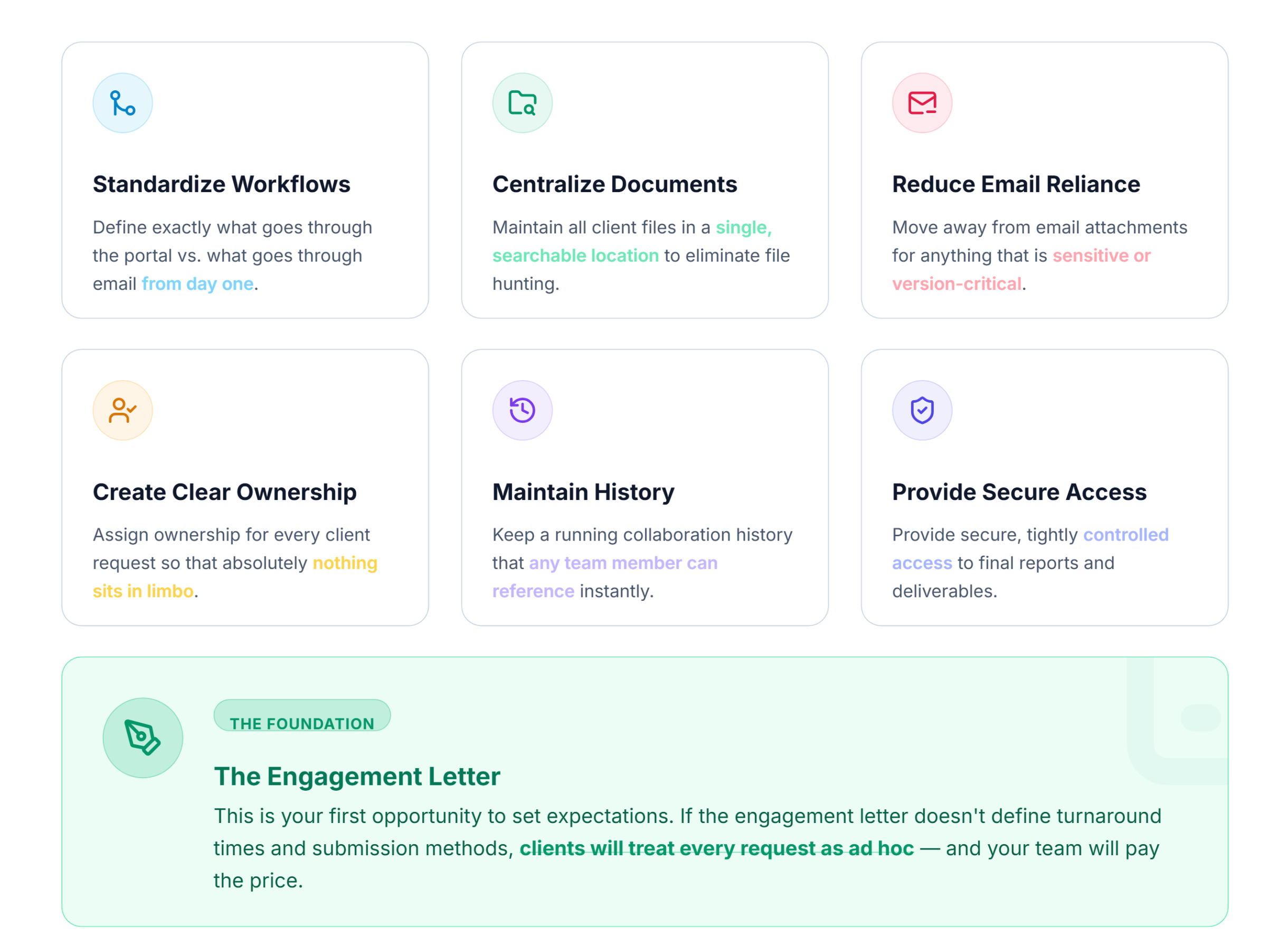
- ✓ Standardize communication workflows — define what goes through the portal vs. email from day one
- ✓ Centralize client documents in a single, searchable location
- ✓ Reduce reliance on email attachments for anything sensitive or version-critical
- ✓ Create clear ownership of every client request so nothing sits in limbo
- ✓ Maintain a collaboration history that any team member can reference
- ✓ Provide secure, controlled access to reports and deliverables
The engagement letter is your first opportunity to set these expectations. If it doesn’t define turnaround times and submission methods, clients will treat every request as ad hoc — and your team will pay the price.
Frequently Asked Questions
Why do accounting firms struggle with client communication?
Firms struggle because client communication scales poorly through unstructured channels. As engagements multiply, email threads fragment, document requests get duplicated, and staff lose visibility into what’s been received, what’s outstanding, and who’s responsible for follow-up.
What are the risks of using email for document sharing?
Email attachments bypass encryption controls, create version confusion when multiple copies circulate, and lack audit trails for compliance. Sensitive financial data forwarded through email chains introduces security and regulatory risk that structured secure file exchange eliminates.
How can firms improve client collaboration?
Firms should centralize document collection in a single platform, automate request reminders, define clear submission workflows during onboarding, and maintain searchable collaboration histories. The goal is replacing manual follow-up with structured, visible processes.
What is a client collaboration portal?
A client collaboration portal is a centralized workspace where accounting firms and their clients exchange documents, track request status, deliver reports, and communicate — replacing scattered email threads with a single, secure system of record.
How does collaboration affect bookkeeping workflows?
Delayed or incomplete client documents directly stall transaction categorization and reconciliation. When source documents arrive late, the entire bookkeeping cycle compresses, forcing rushed work near deadlines and increasing error risk.
How does collaboration affect payroll processing?
Payroll depends on timely, accurate data. When collaboration workflows delay source documents, payroll processing gets compressed against Canadian remittance deadlines — creating compliance risk that originates not from payroll errors, but from upstream document collection failures.
The Bottom Line
Email is a communication tool. It was never designed to manage multi-client accounting workflows, track document versions, or maintain compliance-ready audit trails. The firms that figure this out early don’t just work faster — they build operations that actually hold up as the client list grows.
See what structured collaboration looks like in practice.
LedgerNext replaces scattered email threads with centralized document collection, structured request tracking, and secure report delivery — built for Canadian accounting firms.
✅ Structured Request Tracking
✅ Secure Report Delivery