
Two bookkeepers. Same client. Same month-end close.
Sarah reconciles the bank account first, categorizes transactions using the firm’s rule-based templates, then flags exceptions for review. Mike starts with categorization, skips the reconciliation until he’s “done enough,” and emails the client directly when something looks off.
Both finish. Both submit. And when the senior reviewer opens those files side by side, the numbers match—mostly—but the documentation trail, the categorization logic, and the review checkpoints look like they came from two different firms.
This isn’t a quality problem. Not yet. It’s a consistency problem. And it stays invisible until the firm tries to grow.
Add five more clients. Hire a junior. Suddenly, nobody knows which process to follow because there isn’t one process. There are six—one per team member. Training takes three times longer than it should. Month-end bottlenecks pile up. Client deliverables slip.
Scalable firms don’t run on individual talent. They run on systems. And this guide gives you a practical, layered framework to build standardized workflows across every client engagement in your firm.
What Are Standardized Workflows in Accounting Firms?
Standardized workflows are documented, repeatable processes that every team member follows for each client engagement—from intake through reporting. They define how tasks are completed, in what order, by whom, and with what review checkpoints. For Canadian accounting firms managing multiple clients across bookkeeping, payroll, tax, and advisory services, standardization means every engagement follows the same operational structure regardless of which team member is assigned. This reduces errors, accelerates onboarding, improves audit readiness, and creates predictable client experiences across the entire portfolio.
Why Workflow Standardization Matters for Growing Accounting Firms
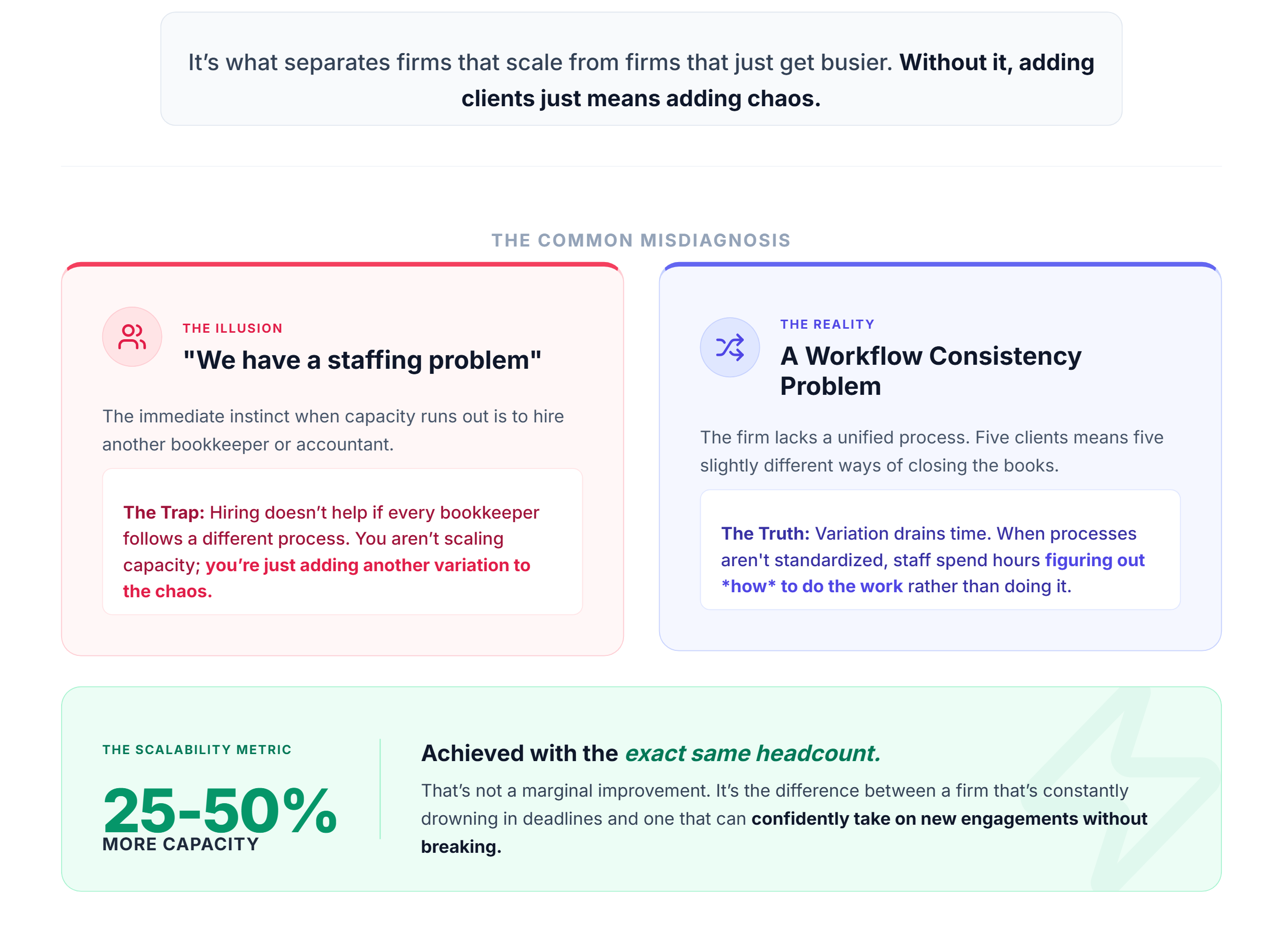
Workflow standardization is what separates firms that scale from firms that just get busier. Without it, adding clients means adding chaos.
Here’s the operational insight most firms miss: they believe they have a staffing problem when they actually have a workflow consistency problem. Hiring another bookkeeper doesn’t help if every bookkeeper follows a different process. You’re just adding another variation.
Multi-client firms that standardize achieve 25–50% more capacity with the same headcount. That’s not a marginal improvement—it’s the difference between a firm that’s constantly behind and one that takes on new engagements without breaking.
What standardization actually affects:
| Area | Without Standardization | With Standardization |
|---|---|---|
| Quality | Varies by team member | Consistent across all clients |
| Onboarding | 3–4 weeks of shadowing | Documented processes, faster ramp-up |
| Scalability | Capacity ceiling regardless of hiring | Predictable capacity per engagement |
| Client satisfaction | Inconsistent deliverable timelines | Predictable, repeatable experience |
| Profitability | Hidden rework costs | Reduced write-offs and corrections |
| Audit readiness | Scramble to reconstruct documentation | Every file follows the same structure |
Key takeaway: Standardization isn’t about rigidity. It’s about making the default path the right path—so your team spends energy on exceptions, not on figuring out the basics every time.
Signs Your Firm Lacks Standardized Workflows
If you’re unsure whether your firm has a standardization gap, this diagnostic checklist will tell you fast. Most firms experiencing growth pains will check at least four of these.
Operational insight: Different team members following different bookkeeping processes creates reporting inconsistencies long before errors become visible. By the time you catch it, the damage has compounded across multiple reporting periods.
- ✓ Every accountant follows a slightly different process for the same task
- ✓ Client files are organized differently depending on who set them up
- ✓ Month-end close timelines vary by employee, not by client complexity
- ✓ Payroll approvals happen through inconsistent channels—email, Slack, verbal
- ✓ Financial reports require repeated corrections before delivery
- ✓ New hires spend weeks figuring out “how we do things here”
- ✓ Client-specific exceptions live in one person’s head
- ✓ You’ve automated tasks but the outputs still feel inconsistent
Stop/Go test: Can you hand any client file to any team member and have them complete the next task without asking a colleague how? If not, your workflows aren’t standardized—they’re improvised.
The Five Layers of Workflow Standardization
This is the framework I use with firms that are serious about building repeatable operations. Each layer builds on the one below it. Skip a layer and the ones above it wobble.
Layer 1: Client Intake & Onboarding
Everything starts here. A standardized onboarding process is the single highest-leverage investment a firm can make.
Operational insight: Consistent onboarding has a greater long-term impact on efficiency than automating isolated tasks. If you collect documents differently for every client, you’ll reconcile differently, report differently, and communicate differently.
In practice: Build a single intake checklist that requests T4, T5, and T5007 slips, engagement letters, prior-year NOAs, and bank access credentials—before the first month-end. Use a client portal instead of email. Set a firm-wide upload deadline.
Verification: Run the “5-Random” test. Pull five recent client onboarding files. If three are missing a required document, your intake checklist is broken.
Layer 2: Bookkeeping & Transaction Processing
This is where most inconsistency hides. One bookkeeper categorizes owner draws as “Miscellaneous.” Another uses “Shareholder Loans.” Both think they’re right.
Operational insight: Workflow variation between clients increases training time for new hires because there’s no single “correct” process to learn—just a collection of individual habits.
Standardize your chart of accounts templates, transaction categorization rules, and reconciliation procedures across all clients. Client-specific adjustments should be documented exceptions, not the default. The methodology is clear: document first, standardize second, automate third. Firms that automate broken workflows accelerate problems rather than solving them.
Layer 3: Payroll & Compliance Workflows
Payroll is where missed steps create real liability. Inconsistent approval chains, missed remittance deadlines, or undocumented provincial variations (especially QST for Quebec clients) turn small oversights into CRA issues.
Build a payroll workflow that defines who approves, who processes, who reviews, and when remittances are submitted. Multi-client payroll management requires a template that handles the common 95% and documents the unique 5% per client.
Layer 4: Financial Reporting & Review
Operational insight: Lack of standardized review checkpoints causes month-end bottlenecks more often than bookkeeping volume itself. The bottleneck isn’t how much work there is—it’s how much rework the reviewer has to do.
Define what “review-ready” means. Create a pre-submission checklist: reconciliation complete, categorization reviewed, adjusting entries posted, supporting documents attached. When every file hits the reviewer in the same condition, review time drops dramatically.
Layer 5: Client Communication & Continuous Improvement
Operational insight: Firms that standardize processes often improve client experience because expectations become predictable. Clients know when to expect deliverables, what format they’ll arrive in, and how to provide information.
Replace scattered email threads with structured communication through a client collaboration platform. Define communication cadences—monthly check-ins, quarterly reviews, annual planning sessions—and template them.
Common Workflow Mistakes That Slow Accounting Firms Down
Even firms that think they’ve standardized often make these operational errors:
- 1. Undocumented processes.
Staff develop efficient shortcuts that never get formalized. When that person leaves, the knowledge walks out with them. - 2. Spreadsheet dependency.
Tracking client status, deadlines, and task assignments in spreadsheets creates version control nightmares and zero audit trail. - 3. Inconsistent naming conventions.
“Smith_Jan2024_Reconciliation” vs “reconciliation_smith_january.” Multiply this across 80 clients and finding anything becomes a treasure hunt. - 4. Missing review checkpoints.
Work goes from “in progress” to “delivered” without a structured review step. Errors reach the client. - 5. Scattered client communication.
Some updates go by email, some by phone, some by text. Nothing is centralized. Email chains don’t scale. - 6. Relying on institutional knowledge.
Client-specific exceptions should be documented rather than becoming unwritten knowledge held by one employee. This is the single biggest risk factor when scaling.
Key takeaway: Most of these aren’t technology problems. They’re documentation and discipline problems. Fix those first.
How Technology Supports Standardized Workflows
Technology doesn’t create standardization—it enforces and scales it. But only after you’ve documented what “standard” actually means for your firm.
What to look for in a platform:
- Centralized client workspaces where every document, communication, and task lives in one place
- Workflow visibility so managers can see which clients are on track and which are behind
- Task consistency through templates that assign the same steps to every engagement
- Multi-client management from a single dashboard rather than logging into separate environments
- Audit trail that captures every change, every approval, every document version
- Role-based access so team members see exactly what they need—nothing more, nothing less
Operational insight: Firms that hit capacity ceilings often try to solve the problem by hiring. But without workflow infrastructure, every new hire just adds another variation of “how we do things.” The ceiling doesn’t lift—it just gets more expensive to maintain.
Building Your Workflow Infrastructure?
LedgerNext provides Canadian accounting firms with centralized multi-client workspaces, bookkeeping automation, payroll management, client collaboration, and financial reporting—all from one platform designed around how firms actually operate.
Best Practices for Standardizing Work Across Every Client
- 1. Build a service library before building SOPs.
Define your service tiers—”Bookkeeping Level 1,” “Payroll Standard,” “Tax Prep Self-Employed”—so 95% of each engagement is pre-defined. Only write client-specific SOPs for the remaining 5%. - 2. Create functional teams around services, not clients.
Teams dedicated to one service type (like bank reconciliation) develop speed and consistency that generalist teams can’t match. - 3. Standardize your file structure before anything else.
One naming convention. One folder hierarchy. Every client, every time. This single change reduces search time and review friction immediately. - 4. Define “done” for every task.
If “reconciliation complete” means different things to different people, it means nothing. Create explicit completion criteria with visual checkpoints—a green status badge, a checked-off review template, a signed-off deliverable. - 5. Document exceptions instead of memorizing them.
When a client has a unique requirement, write it down in a standardized exception log. This protects the firm when team members rotate. - 6. Review and update workflows quarterly.
Processes drift. What worked six months ago may have three unnecessary steps now. Schedule quarterly workflow reviews like you schedule client reviews. - 7. Use your year-end checklist as a standardization audit.
If your team struggles during year-end, it’s usually because monthly workflows weren’t consistent enough to produce clean annual data.
How Standardized Workflows Improve Client Experience
Clients don’t care about your internal processes. They care about outcomes. But here’s the thing—standardized workflows directly produce the outcomes clients value most.
Operational insight: Client satisfaction in accounting firms correlates more strongly with predictability than with speed. Clients would rather receive a report on the same day every month than receive it “fast” but at random intervals.
| Client Experience Factor | Impact of Standardization |
|---|---|
| Response times | Faster, because team members don’t waste time figuring out process |
| Deliverable quality | Consistent, because every file goes through the same review |
| Timeline predictability | High, because workflows define when each step happens |
| Error frequency | Lower, because categorization rules and reconciliation checks catch issues early |
| Trust | Stronger, because clients experience a professional, repeatable service |
When your firm operates consistently, clients feel it—even if they can’t articulate why.
Preparing Your Firm for Sustainable Growth
Scalable growth depends on systems, not on heroic effort from individual employees pulling late nights during T1 season.
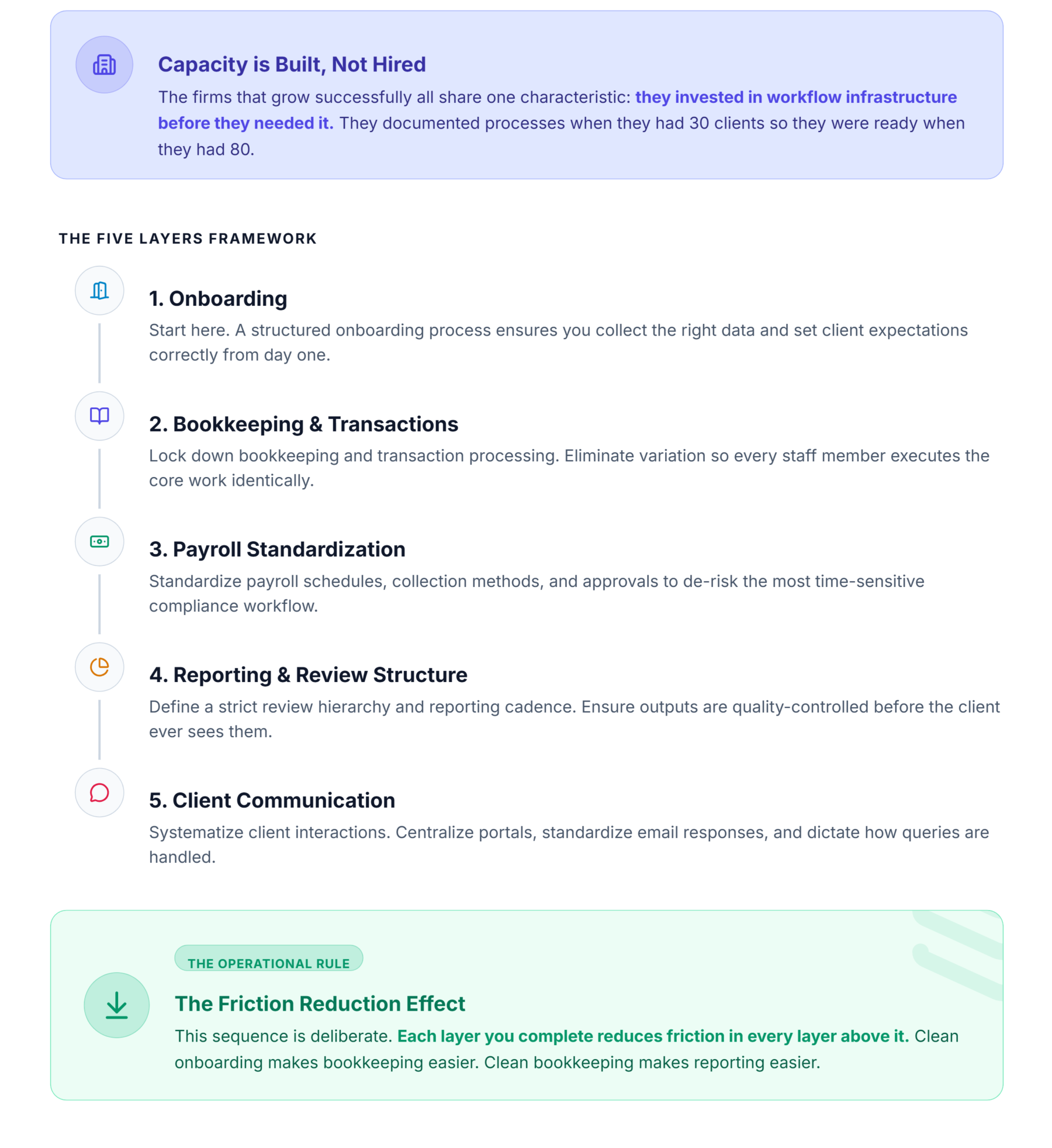
The firms I’ve seen grow successfully all share one characteristic: they invested in workflow infrastructure before they needed it. They documented processes when they had 30 clients so they were ready when they had 80. They built service libraries and functional teams and standardized review checkpoints—not because it was urgent, but because they understood that capacity is built, not hired.
The Five Layers framework gives you a sequence. Start with onboarding. Lock down bookkeeping and transaction processing. Standardize payroll. Define your reporting and review structure. Then systematize client communication.
Each layer you complete reduces friction in every layer above it.
FAQs
How long does it take to standardize workflows across an accounting firm?
Most firms can document and implement core workflows within 60–90 days if they dedicate a small team to the project. Start with one service line, refine it, then expand. Trying to standardize everything simultaneously usually stalls. Prioritize the workflows that affect the most clients first.
Should we standardize before or after adopting new technology?
Always before. Document your ideal workflow on paper first. Then evaluate whether your current tools support it. Firms that adopt technology before standardizing often just digitize their inconsistencies—which accelerates problems rather than solving them.
What’s the biggest risk of not standardizing?
Single points of failure. When processes live in one person’s head, that person’s absence—vacation, illness, resignation—creates immediate operational disruption. Standardization distributes knowledge across the firm.
Ready to centralize your firm’s operations?
Explore LedgerNext to see how Canadian accounting firms manage bookkeeping, payroll, reporting, and client collaboration from one platform.
✅ Payroll & Reporting
✅ Client Collaboration