Most bookkeeping errors don’t announce themselves. They accumulate. A transaction coded to the wrong account in January gets copied forward by a bank-feed rule in February. A duplicate import sits unnoticed until the reconciliation difference grows large enough to flag. A client sends a receipt two weeks after the books were reviewed, and the team has to decide whether reopening the period is worth the disruption.
Multiply those small problems across forty or sixty client files and the real cost becomes visible: not one catastrophic mistake, but hours of rework that eat into the firm’s capacity every month.
Accounting firms can reduce bookkeeping errors without slowing down by standardizing routine processes, automating repetitive tasks, using exception-based review, reconciling accounts regularly, and focusing human attention on unusual or judgment-based transactions. The rest of this guide explains how to build that process.
Why bookkeeping errors increase as accounting firms grow
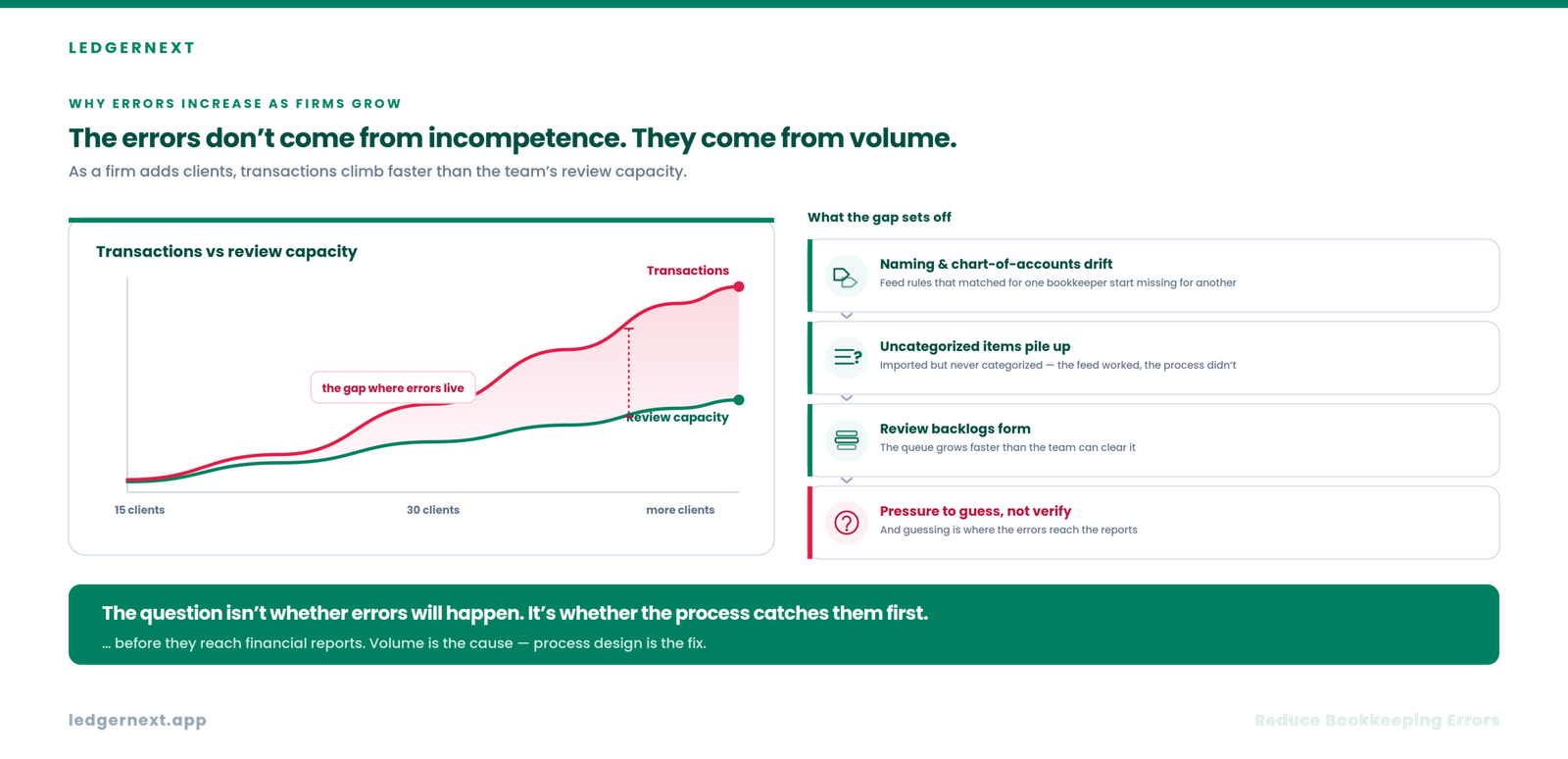
The errors rarely come from incompetence. They come from volume.
When a firm adds clients, the number of transactions increases faster than the team’s review capacity. Staff members start making faster judgment calls. Vendor naming conventions drift between client files. A chart of accounts that worked fine for fifteen clients starts producing inconsistent categorization across thirty.
One pattern I’ve seen repeatedly: a firm connects bank feeds for a new client, assumes the feed handles the import layer, and moves on. Weeks later, the reconciliation surfaces unreviewed transactions that were imported but never categorized. The feed worked. The process around it didn’t.
Growth also introduces more people touching the same files. Without locked chart-of-accounts rules and consistent vendor naming conventions, bank-feed rules that matched reliably for one bookkeeper start missing for another. That creates uncategorized items, which creates review backlogs, which creates pressure to guess rather than verify.
The operational question isn’t whether errors will happen. It’s whether the firm’s process catches them before they reach financial reports.
What causes most bookkeeping errors?
These categories cover the majority of what firms encounter. For each one, the useful question is how a firm detects it and prevents recurrence.
Transaction categorization errors happen when a transaction hits the wrong account, receives inconsistent treatment across periods, or lacks enough context for the bookkeeper to classify it confidently. Consistent categorization rules reduce downstream reporting problems and reduce the amount of manual review required. If your firm hasn’t formalized those rules yet, the guide on transaction categorization for accurate bookkeeping covers the operational detail.
Missing transactions are transactions that should be in the accounting system but aren’t. Common when clients use multiple payment methods and only one feed is connected.
Duplicate transactions show up especially when data enters through multiple sources: a bank feed, a manual import, and a client-uploaded CSV all capturing the same purchase. Automated duplicate-flagging helps, but someone still needs to review what gets flagged.
Bank reconciliation differences often aren’t math problems. The bottleneck is finding the source of a variance when the books and the statement disagree. Reconciliation functions as an error-detection control inside a larger workflow, not just a month-end task. Firms that struggle with this step can find specific guidance on why bank reconciliation takes so long and how to fix it.
GST/HST treatment errors include incorrect tax coding, missing supporting documentation for input tax credit claims, and inconsistent application across similar transactions. CRA’s GST/HST record-keeping guidance requires that records allow businesses to calculate GST/HST collected and eligible amounts, and that supporting invoices and receipts back every ITC claim. Quarterly review of tax treatment across client files helps prevent the kind of error that later triggers CRA review risk.
Accounts receivable and payable errors involve incorrect balances, missing invoices, or duplicated entries that distort the client’s financial position.
Manual journal entries carry higher risk because they bypass the normal transaction-import process. Wrong amounts, wrong accounts, or missing support documentation are common.
Client communication gaps are underestimated. When the accounting team doesn’t have enough information to correctly classify or verify something, the choice is between guessing and waiting. Both have costs.
Period-end errors occur when items are carried incorrectly into month-end or year-end reporting, often because upstream data quality was weak.
The five-step approach to reducing bookkeeping errors
This framework gives firms a repeatable structure: Prevent, Detect, Review, Correct, Improve.
Prevent
Prevention means reducing the conditions that produce errors before transactions are even processed.
Standardized workflows, a locked chart of accounts with a designated administrator, clear client onboarding requirements, consistent vendor naming conventions, and documented month-end procedures all reduce variation across staff. A firm that has built standardized workflows will produce fewer exceptions downstream.
One hidden dependency: if bank-feed rules are expected to match reliably across multiple client books, vendor naming conventions need to be consistent. When three staff members spell the same vendor three different ways, the rules break silently.
Requiring a dedicated business bank account and credit card from every client is another prevention step that’s easy to skip and expensive to ignore. Mixed personal and business transactions are a root cause of categorization errors that no automation can fully resolve.
Detect
Detection means identifying errors efficiently, before they reach financial reports.
Bank and account reconciliation are the primary detection mechanisms. Exception reports, duplicate detection, uncategorized transaction queues, variance analysis, and missing-document checks all serve this function.
A useful detection signal: if the review queue after an automated import run contains only a handful of exceptions, the rules are working. If the queue is long, something upstream needs attention.
Review
This is where the framework matters most. Not every transaction needs the same level of human review.
Routine transactions that match established rules, hit expected accounts, and fall within normal ranges can follow the automated path with periodic spot checks. Higher-risk items deserve focused attention.
CPA Ontario’s June 2026 guidance reinforces this point directly: new technology does not replace professional judgment, and AI-generated outputs need to be reviewed and verified before use. The goal of automation is to free up review capacity for the transactions that actually need it.
Correct
Correcting an error properly means understanding what went wrong, why it happened, whether other transactions are affected, whether the same issue could recur, and whether documentation is required.
CRA’s guidance on electronic records and audit trails is relevant here. Corrected numbers alone aren’t enough; support for the correction must also be retained. Adjustment notes attached to every correcting entry create the audit trail CRA expects.
Improve
If the same error shows up every month, fixing it every month isn’t a solution. It’s a symptom.
The improvement step asks: why does the process keep producing this error? Then it changes the rule, the workflow, the client instructions, the documentation requirement, or the staff training so the error stops recurring.
This is what separates a firm that’s busy from a firm that’s getting faster.
Which bookkeeping tasks should be automated (and which still need human review)?
Automation can reduce repetitive manual entry and create a more consistent process, but it does not remove the need for review. The appropriate level of automation depends on transaction complexity, client circumstances, materiality, risk, and the quality of source data.
| Task | Automation potential | Human review needed |
|---|---|---|
| Importing bank transactions | High | Exception-based |
| Recurring transaction categorization | High | Periodic review |
| Transaction matching | High | Exceptions only |
| Duplicate detection | High | Review flagged items |
| Bank reconciliation | High to medium | Review differences |
| Unusual transactions | Low to medium | High |
| Complex GST/HST treatment | Medium | High |
| Manual journal entries | Medium | High |
| Financial statement review | Medium | High |
| Client-specific accounting decisions | Low | High |
The firms getting the most from automation aren’t automating everything. They’re automating the predictable work so their review time goes to the unpredictable work. If your firm is evaluating where rule-based categorization is faster than manual processing, that comparison is worth reading alongside this table.
How exception-based review helps firms work faster
Exception-based review is the operational concept that makes speed and accuracy compatible.
Instead of reviewing every imported transaction line by line, the firm defines what “normal” looks like for each client: expected vendors, typical transaction sizes, standard categories, usual payment patterns. Transactions that match those parameters flow through. Transactions that don’t get flagged.
Red flags that deserve a closer look:
A mostly-empty exception queue after an import run is the visible sign that the rules are working. A long queue means the rules need refinement, not that the team needs to work harder.
A practical bookkeeping accuracy workflow
This is a workflow firms can adapt to their own tools and client base.
Steps 1 through 4 should take minutes, not hours, when the rules are well established. Steps 5 through 8 are where accounting judgment earns its value. Step 10 is what makes next month faster than this month.
For firms processing high volumes across multiple clients, platforms like LedgerNext support this kind of workflow by handling transaction imports, rule-based categorization, and exception flagging so the review step starts with a shorter queue. That’s the practical difference between automation that helps and automation that just moves the bottleneck.
How CRA recordkeeping requirements fit into the process
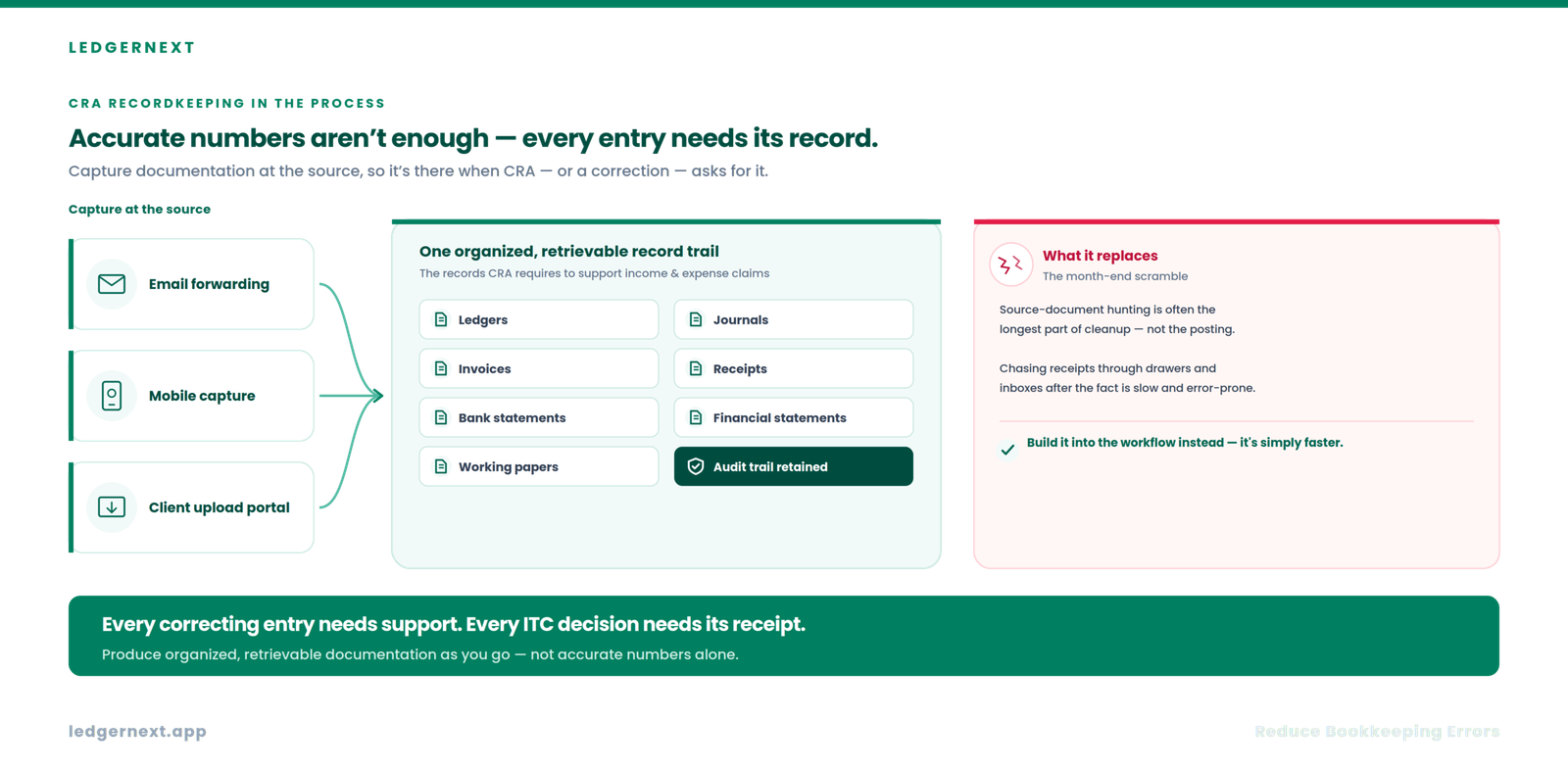
CRA requires that business records support income and expense claims. Those records include ledgers, journals, invoices, receipts, bank statements, financial statements, and working papers. CRA’s guidance also specifically discusses maintaining audit trails for computerized records.
For firms, this means the bookkeeping process needs to produce not just accurate numbers but organized, retrievable documentation. Every correcting entry needs support. Every categorization decision for GST/HST-sensitive transactions needs a receipt or invoice that meets CRA’s requirements for input tax credit claims.
Building documentation requirements into the workflow, rather than collecting them after the fact, is faster. Source-document hunting is often the longest part of cleanup work, not the posting itself. A digital intake system that captures receipts at the point of transaction, through email forwarding, mobile capture, or client upload portals, eliminates the month-end scramble through drawers and inboxes.
Where this approach doesn’t work
Exception-based review assumes that “normal” can be defined for a client. For a new client with no transaction history, a client going through a major business change, or a file with years of uncorrected errors, the firm needs to start with a full review before building rules. Trying to automate a messy file just automates the mess. In those cases, begin with the bank and credit card accounts to establish whether the balance sheet is reliable, then work outward from there.
Frequently asked questions
What causes bookkeeping errors in accounting firms?
Most errors come from volume and inconsistency rather than lack of knowledge. Inconsistent categorization rules, duplicate imports from multiple data sources, missing client documentation, and rushed period-end processing are the most common causes. As firms grow and add clients, these small inconsistencies multiply faster than the team’s capacity to catch them manually.
Can bookkeeping be automated without losing accuracy?
Automation can handle repetitive, rule-based tasks like transaction imports, recurring categorization, and duplicate detection with high reliability. It does not replace accounting judgment for unusual transactions, complex GST/HST treatment, or client-specific decisions. The combination of automated routine processing with focused human review of exceptions is what maintains accuracy at higher volume.
Should every bookkeeping transaction be manually reviewed?
No. Routine transactions that match established rules and fall within normal parameters can follow an automated path with periodic spot checks. Manual review should focus on exceptions: unusual amounts, unfamiliar vendors, manual journal entries, and transactions with unclear tax treatment.
How does bank reconciliation help prevent bookkeeping errors?
Reconciliation is an error-detection checkpoint. It surfaces missing transactions, duplicates, and incorrect amounts by comparing the accounting records against an independent source. The longer reconciliation differences remain unresolved, the more likely they are to flow into financial reports and create additional cleanup work.
What should accountants review before finalizing a client’s books?
Review outstanding reconciliation differences, uncategorized transactions, manual journal entries and their supporting documentation, unusual account movements, GST/HST treatment on higher-risk transactions, and any items flagged during exception-based review. Confirm that adjustment notes and audit trails are attached to every correcting entry.
How can accounting firms manage more clients without increasing bookkeeping errors?
Standardize workflows, lock chart-of-accounts rules, enforce consistent vendor naming conventions, automate repetitive import and categorization tasks, and use exception-based review to focus human attention where it matters. The firms that scale bookkeeping without adding more manual work are the ones that invest in process design, not just additional staff hours.
The next problem most firms hit after tightening their bookkeeping accuracy process is month-end close speed. Once the error rate drops, the bottleneck shifts to how quickly the team can move from reconciled books to finalized reports. That’s a different operational problem, and it starts with how the workflow in steps 8 and 9 above is structured.
Catch errors before they reach financial reports
LedgerNext handles transaction imports, rule-based categorization, and exception flagging so your review step starts with a shorter queue — accuracy at higher volume, without slowing down.