A client receives their monthly P&L. Revenue is up 12% over the same quarter last year. Expenses look reasonable. Nothing jumps off the page. The report gets emailed. The client files it away.
Nobody asks why gross margin has fallen for three consecutive months. Nobody notices that two customers now represent 40% of total revenue, or that accounts receivable has grown faster than sales since January. The report was accurate. It just was not interpreted.
Reporting tells the client what happened. Advisory starts when the accountant helps explain what changed, why it matters, and what the client may need to consider next.
That gap between delivering a report and helping a client understand what it means is where most Canadian accounting firms lose advisory value they have already earned. This guide covers the reasoning process that closes it: how to move from bookkeeping data to a meaningful signal, to a client question, to a business conversation.
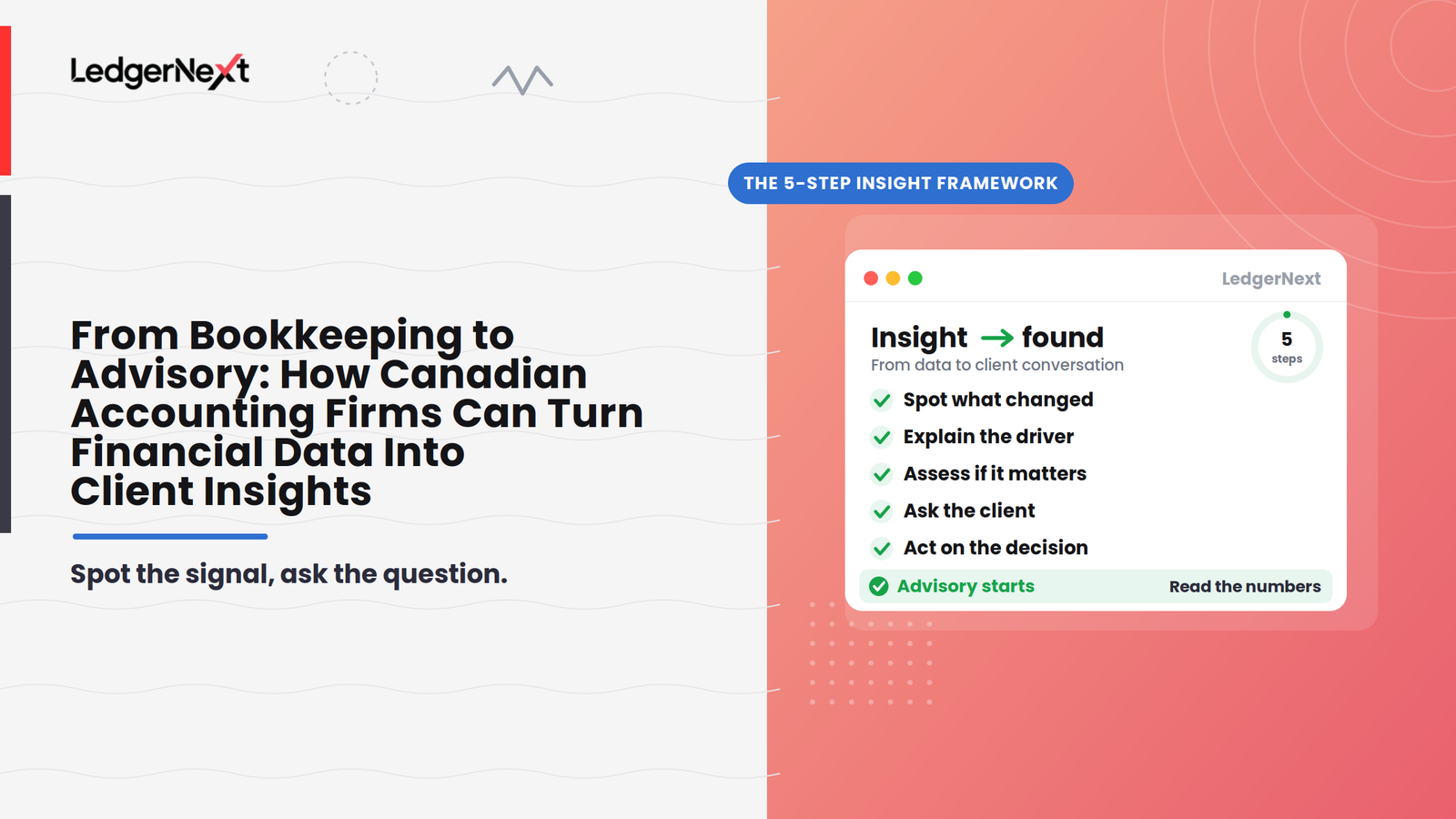
Turning bookkeeping data into client insight means interpreting the financial information you already produce, so the client understands what changed, why it may have changed, and what deserves attention. The method is a repeatable sequence: spot what changed, explain the likely driver, assess whether it matters, turn it into a specific client question, and connect the answer to a decision.
An accurate report is the starting point, not the finished product. Advisory value comes from the interpretation layer on top of reliable books.
- A number tells you what happened. An insight explains why it happened and why the client should care.
- Use a five-step sequence: Spot, Explain, Assess, Ask, Act.
- Watch eight financial signals, but treat them as things to investigate, not conclusions to announce.
- Turn observations into questions, not accusations, and only escalate the changes that actually connect to a decision.
Who this is for (and who it isn’t)
This applies to Canadian CPA firm partners, bookkeeping firm owners, practice managers, and senior accountants who already produce monthly or quarterly financial information for clients. You have clean books. You send reports. You are wondering how to make those reports do more work.
If you are still sorting out reconciliation or struggling with accurate transaction categorization, start there. The interpretation layer this article covers depends on reliable underlying data.
And if you want the structural view of how financial reporting connects to advisory in the first place, LedgerNext already covers that in its piece on financial reporting and client advisory. This article goes one level deeper: what to actually look for once the reports exist, and how to turn observations into conversations.
What turning bookkeeping data into client insights actually means
Bookkeeping data is the raw material: transactions, balances, reconciled accounts, payroll runs, receivables, expenses, GST/HST collected and remitted. It answers the question “what happened.”
An insight is an interpretation of that data in the context of the client’s business. It answers “why did it change, and does it matter?” The difference is easiest to see in three levels.
Reporting level: “Revenue increased 15%.”
Observation level: “Revenue increased 15%, but most of the growth came from two customers while gross margin declined.”
Insight level: “Revenue is growing, but we should determine whether the growth is profitable and repeatable before the client increases spending.”
A number tells you what happened. An insight helps explain why it happened and why the client should care.
The accountant’s job in advisory is not to produce more numbers. It is to identify the numbers that deserve a conversation.
Why accurate bookkeeping doesn’t automatically create advisory value
Accurate data is necessary, but it isn’t sufficient
Clean books are the foundation, and the profession has been shifting steadily toward advisory for years. But accuracy alone does not tell a client what changed, why it changed, whether it matters, or what to do about it. A bank reconciliation can tie out perfectly while revenue, owner draws, and sales tax remain misclassified. “Reconciled” and “correct” are different things. Firms that want to reduce bookkeeping errors without slowing the team down should address data quality before layering interpretation on top.
More metrics don’t automatically mean more insight
The temptation is to build a dashboard with 20 KPIs and send it alongside the P&L. That is volume, not relevance. The client needs three operational signals that connect to decisions they are actually facing, not twenty disconnected ratios.
Context changes the meaning of a number
A 15% increase in payroll could mean new hiring, wage increases, overtime, seasonal staffing, expansion, or inefficiency. The financial data identifies the signal. The business context explains the cause. This matters because the biggest advisory mistake is not getting the math wrong. It is drawing a conclusion from a number without understanding the business around it.
The books can tell you where to investigate. They don’t always tell you why the business changed.
The 5-step financial insight framework
This is the reasoning sequence that turns a financial observation into an advisory conversation.
| Step | Question | Result |
|---|---|---|
| 1. Spot | What changed? | Identify the signal |
| 2. Explain | Why might it have changed? | Investigate the driver |
| 3. Assess | Does it matter? | Put it into context |
| 4. Ask | What should we clarify? | Create a client question |
| 5. Act | What decision could follow? | Move toward action |
Step 1: Spot what changed
Compare the current period against a relevant baseline: month over month, quarter over quarter, year over year, budget versus actual, or a client-specific baseline. Choose the comparison that makes sense for the client’s business and reporting cycle. A landscaping company in Ontario looks very different in February versus July, so comparing January to December may create false signals. Look at revenue, gross margin, operating expenses, cash, A/R, payroll, debt, and working capital, and find the three to five movements that look meaningfully different from what you would expect.
Step 2: Explain why it changed
This is where the accountant moves from observation to investigation. Was the change caused by volume, pricing, customer mix, a cost increase, a one-time transaction, seasonality, a timing issue, a classification issue, or business expansion? Do not present the first assumption as fact. Use “this may indicate,” “one possible explanation is,” and “the next step is to validate the cause with the client.” The books can reveal where to investigate. Client context often explains why.
Step 3: Assess whether it matters
Not every variance deserves a client meeting. Sort changes into three buckets. Monitor: small or expected. Investigate: unexpected or potentially meaningful. Discuss: potentially relevant to a business decision. Materiality is not only about dollar size. A small recurring problem can matter more than a large one-time transaction.
Step 4: Turn the observation into a client question
Do not say “your expenses increased.” That is a conclusion without context. Ask: “Software and contractor costs have increased for three months. Were those costs related to a planned project, and should we expect them to continue?” A good question is specific, uses actual financial evidence, does not assume the answer, invites client context, and can lead to a decision.
Step 5: Connect the insight to a potential decision
The accountant does not have to make the decision. The goal is to help the client see it clearly: pricing, hiring, spending, collections, cash reserves, financing, budgeting, expansion, or cost control. The framework ends when the client can see the choice in front of them.
8 financial signals worth investigating
These are signals to investigate, not conclusions to announce. For each one, the pattern is the same: notice the signal, consider what it might indicate, investigate the driver, and turn it into a client question.
1Revenue is growing but gross margin is falling
Revenue growth is not automatically good news if profitability is weakening.
What to investigate: higher direct costs, pricing pressure, discounts, or a shift toward lower-margin work
Ask the client: What is driving the additional revenue, and is the new revenue as profitable as your existing work?
2Accounts receivable is growing faster than revenue
Rising A/R can mean more sales, or it can mean slower collections. Don’t assume it is a problem.
What to investigate: the aging report, longer payment cycles, customer mix, and the cash-conversion cycle
Ask the client: Are customers taking longer to pay, or is the increase mainly because sales have grown?
3Cash is falling while profit remains positive
Profit and cash are not the same thing. A healthy P&L can sit on top of a shrinking bank balance.
What to investigate: A/R growth, debt repayment, inventory buildup, capital expenditure, and owner distributions
Ask the client: The business is profitable, but cash has declined. What has been using the cash?
4One expense category keeps increasing
Trend matters more than a single spike. Don’t jump to “cut the spending.”
What to investigate: new subscriptions, expansion, duplicate tools, a planned investment, and recurring versus one-time costs
Ask the client: Is this increase part of a planned investment, or has the recurring cost structure changed?
5Gross margin keeps moving
Repeated margin movement deserves attention even when each individual change is small.
What to investigate: pricing, direct costs, discounting, supplier costs, and product or service mix
Ask the client: What has changed in the mix or cost of what you are selling?
6Payroll costs are rising faster than revenue
This is not automatically negative. Firms often hire ahead of growth.
What to investigate: hiring, wage increases, overtime, seasonal staffing, and expansion, often visible in payroll-to-general-ledger reconciliation data
Ask the client: Is the additional payroll supporting additional capacity or revenue?
7Overdue receivables are concentrated among a few clients
The insight is not just “A/R is high.” It is that a small number of customers account for most of the overdue balance.
What to investigate: customer concentration risk, collection patterns, payment terms, and cash-flow exposure
Ask the client: Are these customers strategically important, and are their payment patterns changing?
8The same variance keeps appearing
One unusual month may be noise. Three or four similar variances suggest a pattern, and a repeated small change can deserve more attention than a large one-time movement.
What to investigate: whether there is a structural reason behind the recurring change, and who owns resolving it
Ask the client: This expense has been above its normal level for three consecutive periods. Is there a structural reason for the change?
Automated exception-flagging can surface these patterns faster, but it still needs a human deciding which patterns actually matter for the client.
From financial signal to client question
Don’t turn observations into accusations. Turn them into questions.
| Financial signal | Avoid saying | Ask instead |
|---|---|---|
| Revenue increased | “Sales are doing great.” | “What’s driving the growth?” |
| Margin declined | “Your pricing is wrong.” | “What’s changed in pricing or direct costs?” |
| A/R increased | “Customers aren’t paying.” | “Are payment times changing?” |
| Cash declined | “Cash flow is bad.” | “What’s consuming the cash?” |
| Expense increased | “You’re overspending.” | “Is this increase planned or recurring?” |
| Payroll increased | “Payroll is too high.” | “Is the additional payroll supporting growth?” |
A strong client question has five traits: it is specific, evidence-based, open enough to invite context, free from premature conclusions, and connected to a business decision. The pattern is the same every time. Replace the conclusion with a question, let the client provide context, then work toward the decision together.
How to decide which insights deserve a client conversation
Not every observation earns a place on the agenda. A simple four-tier filter keeps the conversation focused on what matters.
Monitor: expected or low-impact changes. A seasonal dip you have seen before. Keep watching, do not escalate.
Investigate: unexpected movements that need more information before the next conversation.
Discuss: changes with meaningful financial or operational implications. These go on the meeting agenda.
Escalate to strategic advisory: changes connected to cash risk, a major investment, pricing, hiring, expansion, financing, or recurring profitability shifts.
The purpose isn’t to give the client more observations. It’s to give them the right observations.
How often should firms review client financial insights?
There is no universal cadence. It should match how quickly the client’s financial situation changes and how much decision support they need.
Monthly: useful for active, higher-volume, cash-sensitive businesses, or those with frequent changes.
Quarterly: fits where financial movement is slower, monthly changes are not meaningful, or the client prefers periodic strategic reviews.
Event-driven: triggered by expansion, a major hire, financing, an acquisition, a large cost change, or a significant cash movement.
The real question is not “when do we send the report?” It is “when does an insight deserve attention?”
Build a repeatable client insight process
The framework becomes useful when it turns into a workflow the firm runs the same way every period. This is not another general workflow-standardization exercise. It is a specific routine for turning financial data into recurring client insight.
1Make sure the bookkeeping is current
Interpretation built on stale data produces unreliable insight. Confirm the period is closed and the books reflect reality before you look for signals.
2Identify meaningful movements
Use the comparison that fits the client’s cycle, and surface the handful of changes that look different from what you would expect.
3Select the top three to five signals
Do not overwhelm the client. Narrow to the observations most likely to connect to a decision.
4Investigate before concluding
Gather context for each signal. Treat your first explanation as a hypothesis to validate, not a finding to report.
5Prepare the client questions
Turn each observation into a specific, evidence-based question that invites the client’s context.
6Discuss the implications
Walk through what each change might mean for the business, not just what the number did.
7Agree on next steps
Decide what, if anything, the client wants to do, and who owns the action.
8Revisit the issue
Check whether the metric moved in the next period, so the conversation becomes a loop rather than a one-off.
Don’t turn every financial variance into an advisory conversation
Accountants who flag every 2% change will exhaust their clients and themselves. Advisory value comes from relevance, not volume. Do not overwhelm clients with every small variance, every unusual transaction, every KPI, or every month-to-month movement.
Signal first. Context second. Conversation third.
The goal is not to explain every number. It is to identify the numbers that deserve a conversation, and to leave the rest quietly monitored.
How technology can support the insight process
Technology should help accountants keep bookkeeping current, maintain consistent categorization through bookkeeping quality control, reconcile efficiently, access client financial information, generate reports, reduce manual data preparation, and surface the items that need attention. It should reduce the time spent assembling information so more of it goes to interpreting it.
Technology can surface patterns and reduce manual preparation work, but professional interpretation and client context remain essential. QuickBooks is positioning Intuit Intelligence around real-time AI-powered insights, and Xero is pushing connected data and analytics for advisory. Those tools can help. They cannot replace the accountant who knows the client’s business well enough to ask the right question. The stronger position for a firm is human-led interpretation of reliable financial data.
Where LedgerNext fits
LedgerNext handles the infrastructure underneath the insight process: bookkeeping, transaction categorization, reconciliation, payroll, financial reporting, GST/HST reporting, and multi-client workspace management. The point is not that software replaces advisory judgment. It is to reduce the manual effort required to get from raw bookkeeping activity to reliable financial information, leaving more room for interpretation and client conversations. You can see how LedgerNext supports that workflow.
Monthly client insight checklist
Before the client conversation
After the conversation
Frequently asked questions
How can accountants turn bookkeeping into advisory services?
By moving beyond recording and reporting to interpreting the financial data they already produce: identifying meaningful changes, understanding their likely drivers, discussing the implications with clients, and helping them make informed decisions. The shift is not about adding a new service line. It is about reading the numbers you already deliver.
What is the difference between bookkeeping data and financial insight?
Bookkeeping data records what happened: transactions, balances, revenue, expenses, A/R, payroll. Financial insight interprets that data in context, explaining what changed, why it may have changed, why it matters, and what deserves attention. One is delivery. The other is interpretation.
What financial information should accountants review for client insights?
Revenue, gross margin, operating expenses, cash, accounts receivable, payroll, liabilities, and any client-specific metrics that connect to decisions. Relevance varies by business, so the goal is to review the handful of figures that actually matter for that client rather than every available line.
How often should accountants review financial insights with clients?
Monthly, quarterly, or event-driven, depending on the client’s needs, business complexity, and financial volatility. The trigger should be “something meaningful changed,” not just “another month passed.”
Do accounting firms need special software to provide advisory?
No. Software can make data collection, reporting, and analysis more efficient, but advisory depends on reliable information, interpretation, context, and client communication. You can start with the tools you already have.
Can a bookkeeping firm provide advisory without becoming a virtual CFO firm?
Yes. Advisory can begin with focused conversations around cash, margins, expenses, receivables, and budgeting. Not every firm needs a full virtual CFO model. A well-prepared question about a client’s margin trend is advisory. It just does not require a new title.
Final takeaway
The value isn’t in producing another report. It’s in helping the client understand what the report is telling them.
Spot what changed. Explain the likely driver. Assess whether it matters. Ask the client a specific question. Connect the answer to a decision. Accurate bookkeeping provides the foundation, meaningful changes provide the signal, context provides the explanation, questions create the conversation, and decisions create the advisory value.
That sequence is the difference between a firm that delivers bookkeeping and a firm that delivers insight. The data is already in your hands. A connected environment such as LedgerNext can reduce the manual effort of getting to reliable numbers, but the interpretation, and the client conversation it enables, is the part only the accountant can provide.