
Two bookkeeping clients each pay the firm $1,500 a month. On the revenue report, they look identical. But one takes roughly eight hours of team time per month. The other routinely consumes 18 hours, generates follow-up questions, requires corrections, and needs a partner on the phone at least twice a cycle.
Same revenue. Completely different economics.
That gap is the entire problem with measuring clients by revenue alone. And most firms do exactly that, because revenue is the number that’s easiest to see. The number that actually matters, per-client margin after delivery cost, WIP, write-offs, and admin overhead, usually lives nowhere. Or it lives in a partner’s gut feeling that a file “feels bad.”
This article breaks down how to measure the economics of individual client relationships so you can make real decisions about scope, pricing, staffing, and whether a client belongs in your book at all. Not pricing theory. Not fee benchmarks. The operational question: after everything it takes to serve this client, how much money are we actually making?
Who this is for (and who should stop here)
If you run or manage a Canadian accounting firm, CPA practice, bookkeeping firm, or outsourced accounting operation, and you’ve ever looked at a client generating solid monthly revenue and wondered why it still feels like the file is underwater, this is directly relevant.
If you’re looking for a guide on what to charge for bookkeeping or how to set hourly rates, that’s a pricing question. This is a profitability question. The distinction matters: pricing asks what we should charge; profitability asks what we’re actually keeping after delivery. Profitability data can inform pricing decisions, but the two aren’t the same exercise.
What client profitability actually measures
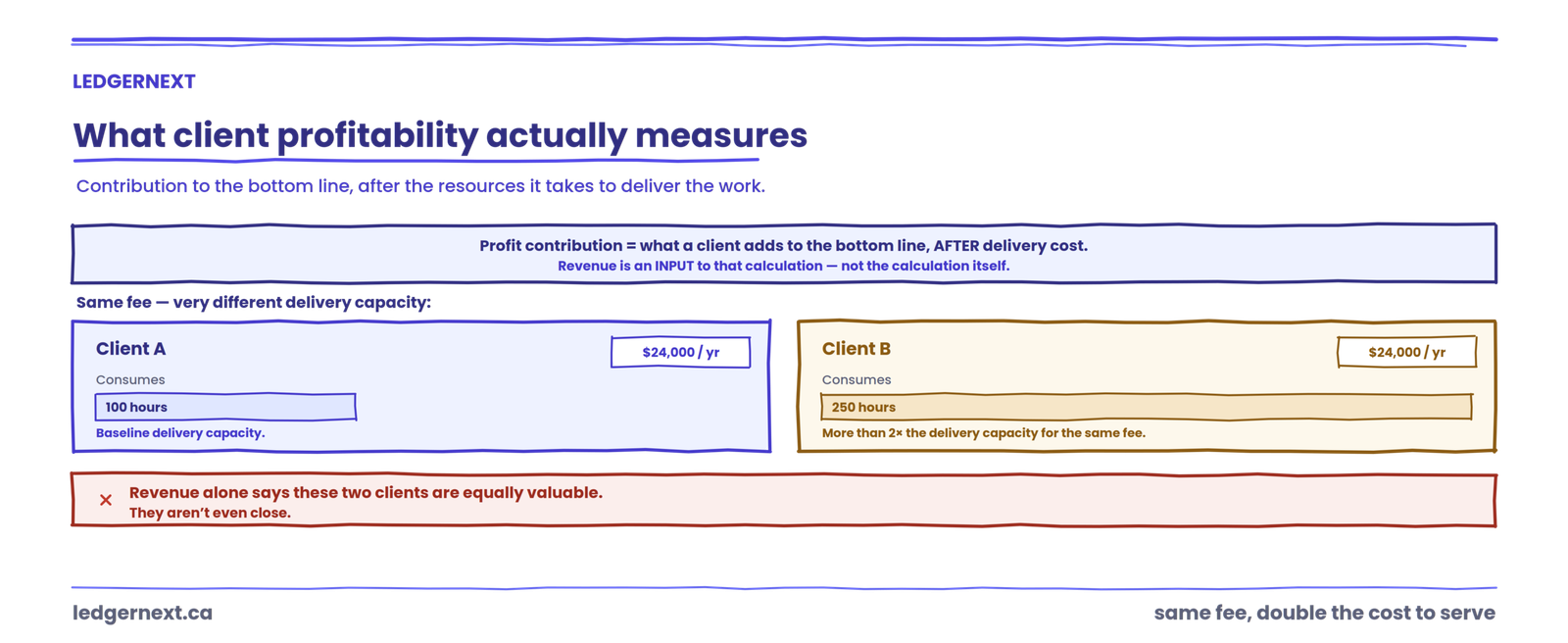
Client profitability is the contribution a client makes to the firm’s bottom line after you account for the resources consumed to deliver the work. Revenue is an input to that calculation. It is not the calculation.
A client paying $24,000 a year could consume 100 hours of staff time. Another client paying the same $24,000 could consume 250 hours. The second client requires more than double the delivery capacity for the same fee. Revenue alone would tell you these clients are equally valuable. They aren’t even close.
Revenue is not profitability
This is where most firms get stuck, and it’s worth seeing in a table.
Illustrative figures only:
| Annual revenue | Hours consumed | Delivery cost | Profit contribution | |
|---|---|---|---|---|
| Client A | $24,000 | 100 | $8,000 | $16,000 |
| Client B | $24,000 | 250 | $20,000 | $4,000 |
Client B generates a quarter of the profit contribution despite identical revenue. If you’re allocating capacity, making hiring decisions, or deciding which clients to grow, revenue rankings will mislead you. Practice management platforms like Karbon and Financial Cents frame profitability reporting around exactly this kind of client-level margin view, not top-line revenue, because the two diverge so often in real firms.
Key takeaway: a high-revenue client isn’t automatically a high-profitability client.
The 5-part client profitability test
I’d build any client profitability analysis around five components. This isn’t a formal accounting standard. It’s an operational framework for management decisions.
The real cost of serving a client
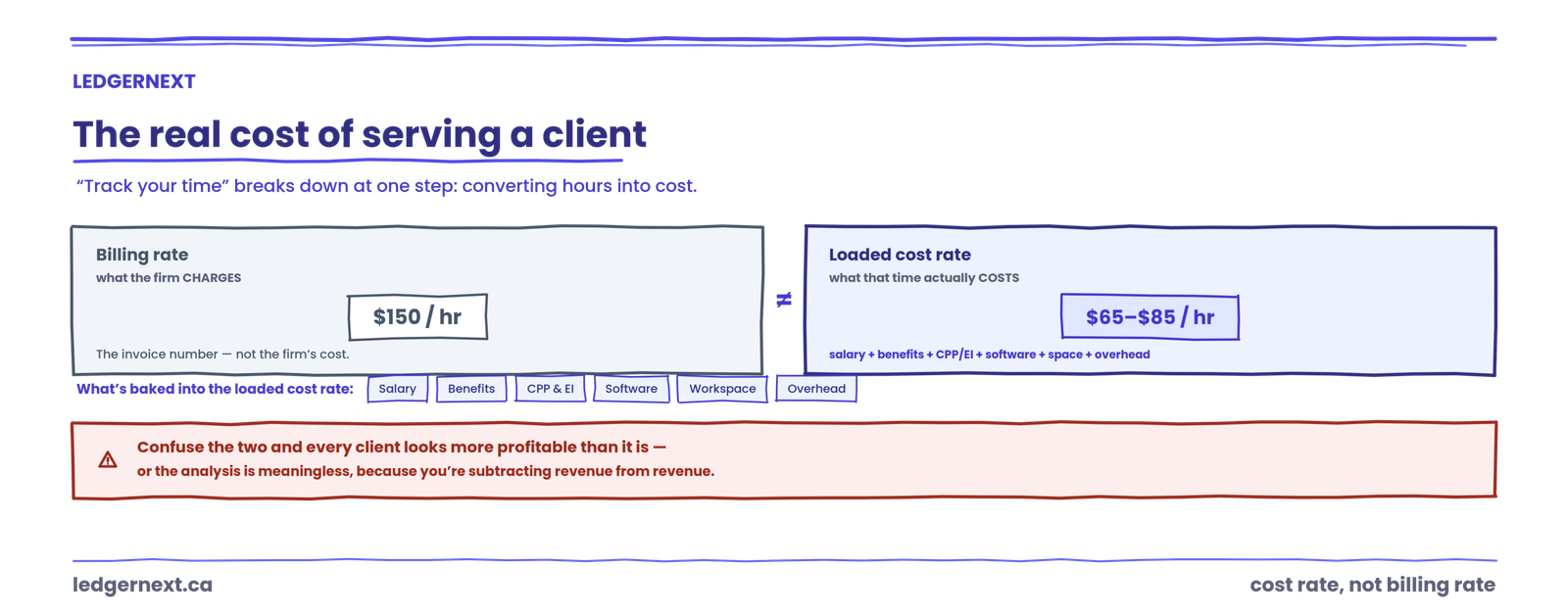
“Track your time” is advice every firm has heard. Where it breaks down is in converting hours into cost.
An accountant with a $150/hour billing rate doesn’t cost the firm $150 per hour. The firm’s actual cost for that person’s time includes salary, benefits, CPP and EI contributions, software licenses, workspace, and a share of overhead. That loaded cost rate might be $65 or $85 per hour, depending on the firm.
The billing rate is what the firm charges. The cost rate is what the firm’s resources actually cost. Confusing the two will make every client look more profitable than they are, or will make the profitability analysis meaningless because you’re subtracting revenue from revenue.
Partner time distorts everything
This is one of the fastest ways to get a wrong answer on client profitability. I’ve seen it happen repeatedly: a file shows 12 hours of staff time, and the analysis stops there. But the partner spent four hours on calls and two hours on review. Those six hours vanish because nobody tracked them against the client.
Partner time is expensive capacity. If it’s not in the client model, the model is wrong. You don’t need to allocate every minute of general firm overhead to every client. Start with a practical model, capture the material time, and improve data quality over time.
The hidden cost of unbilled work
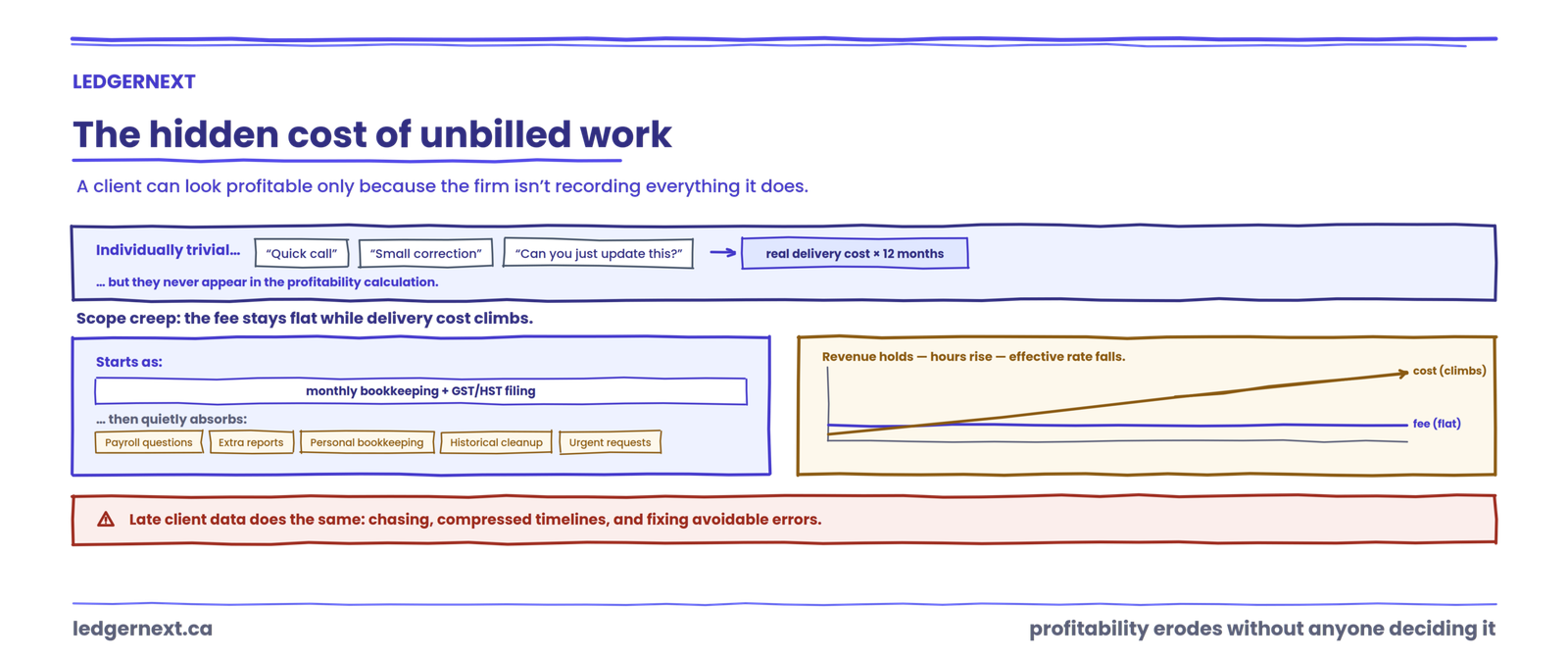
A client can appear profitable simply because the firm isn’t recording everything it does for them.
“Quick call.” “Small correction.” “Can you just update this?” Each one is individually trivial. Across 12 months, those untracked tasks become real delivery cost that never appears in the profitability calculation.
This connects directly to scope creep reducing client profitability. When a fixed-fee client’s engagement starts at monthly bookkeeping plus GST/HST filing and gradually absorbs payroll questions, extra reports, personal bookkeeping, historical cleanup, and urgent requests, the monthly fee stays flat while delivery cost climbs. Revenue holds steady, hours increase, effective hourly rate falls, and profitability erodes without anyone making a conscious decision to let it happen.
Late client data creates the same dynamic. When source documents arrive late, staff spend extra time chasing, reconciling compressed timelines, and fixing errors that wouldn’t exist with timely information, all of which adds hidden bookkeeping costs to the engagement.
Effective hourly rate
Effective hourly rate is one of the most useful diagnostic metrics available: actual revenue divided by actual hours spent.
If annual fees are $18,000 and total client-related time is 150 hours, the effective rate is $120/hour. If you quoted the engagement assuming 100 hours, the economics have shifted by a third and nobody changed the price.
But effective hourly rate alone isn’t the whole picture. A client could have excellent hourly economics and terrible payment behaviour, high concentration risk, or excessive partner dependency. Effective hourly rate is a diagnostic signal. It’s not the entire profitability decision.
Five types of client profitability problems
Not every unprofitable client needs a price increase. The cause matters.
The diagnosis determines the action. Raising the fee on a Type 3 problem just makes the firm more money for continuing to be inefficient.
Before raising the fee, find out why
Is the scope larger than expected? Re-scope. Is the firm doing work outside the agreement? Control scope. Is the workflow itself inefficient? Fix the process, potentially by reducing manual work. Is client behaviour creating unnecessary rework? Establish clearer client responsibilities. Is the engagement genuinely more complex than anticipated? Price for complexity. Is the client simply underpriced after all other factors are addressed? Then consider repricing.
This sequence matters. “Unprofitable client, charge more” is a reflex, not a strategy.
Build a client profitability scorecard
A single number rarely tells the whole story. A scorecard puts the signals side by side, so you can see whether a margin problem is really a scope problem, a partner-time problem, or a collections problem. Pull these together for any client you’re reviewing:
| Metric | What it tells you |
|---|---|
| Revenue | Client-generated income |
| Actual hours | Capacity consumed |
| Effective hourly rate | Revenue relative to time |
| Delivery cost | Resource cost |
| Scope variance | Whether work exceeds expectations |
| Write-downs / write-offs | Revenue leakage |
| Partner time | Senior-resource consumption |
| Complexity | Delivery difficulty |
| Client responsiveness | Operational friction |
| Profit contribution | Overall economics |
Don’t rely on one metric. A client with a healthy effective hourly rate can still be a headache if partner time and responsiveness are dragging the engagement down. The scorecard is there to show the whole picture, not a single score.
Segment clients by profitability, not by judgement
Avoid labelling clients “good” or “bad.” Use categories that lead to decisions.
High-value, high-fit clients have strong economics and good strategic alignment.
Profitable but operationally difficult clients contribute financially but create workflow friction.
Low-margin but fixable clients could improve through process changes, automation, scope clarification, or repricing.
Structurally unprofitable clients remain uneconomic even after reasonable improvements.
Strategic or growth clients may have weak current profitability but legitimate future value through cross-service opportunities or referral potential.
That last category is critical. An unprofitable engagement isn’t automatically a bad client. The question is whether the economics can change, and whether they should.
Use profitability data to improve the firm
Aggregate client profitability data reveals patterns that individual client reviews miss. Maybe payroll services are consistently underpriced across the book. Maybe cleanup work consumes excessive hours because the onboarding process doesn’t set expectations. Maybe very small clients create disproportionate admin cost. Maybe senior staff routinely do work that could be standardized and delegated.
Client profitability analysis isn’t just “which client should we charge more.” It becomes: what does our client portfolio teach us about how we should run the firm? That’s where the real return on this exercise lives.
Surface the time and cost data profitability depends on
Firms that want better visibility into delivery economics across their client book can see how centralized bookkeeping workflows capture the time and cost data profitability analysis depends on.
Profitability vs. revenue vs. realization vs. utilization
| Metric | What it answers |
|---|---|
| Revenue | How much did we bill or earn? |
| Profitability | How much did the client contribute after delivery costs? |
| Effective hourly rate | What did we earn relative to time spent? |
| Realization | How much of the work’s potential billing value was actually collected? (Firms define this differently.) |
| Utilization | How much of available staff capacity went to productive client work? |
Be careful with realization. CPA.com’s research on value pricing found that 64% of accountant participants cited transparency between buyer and provider as a benefit, and 59% cited lack of billing surprises, but fewer than half cited profitability as the top benefit. Realization means different things in different firms, and treating it as a standardized metric when it isn’t will create confusion.
A simple client profitability review process
You don’t need a formal system to start. This is a practical management workflow, not a mandatory industry process:
→
Improve
→
Re-scope
→
Reprice
→
Restructure
→
Exit
Client profitability checklist for accounting firms
Run this checklist for any client you’re reviewing, grouped by the four inputs and the decision:
Revenue
☐ Fees
☐ Discounts
☐ Write-downs
☐ Write-offs
☐ Collections
Time
☐ Bookkeeping
☐ Payroll
☐ Tax
☐ Advisory
☐ Meetings & review
☐ Rework
☐ Partner time
Delivery
☐ Staff cost
☐ Direct technology costs
☐ Complexity
☐ Special handling
Leakage
☐ Scope creep
☐ Unbilled work
☐ Rework
☐ Collection effort
Decision
☐ Maintain
☐ Improve
☐ Re-scope
☐ Reprice
☐ Restructure
☐ Exit / review
When to review, and what to do after
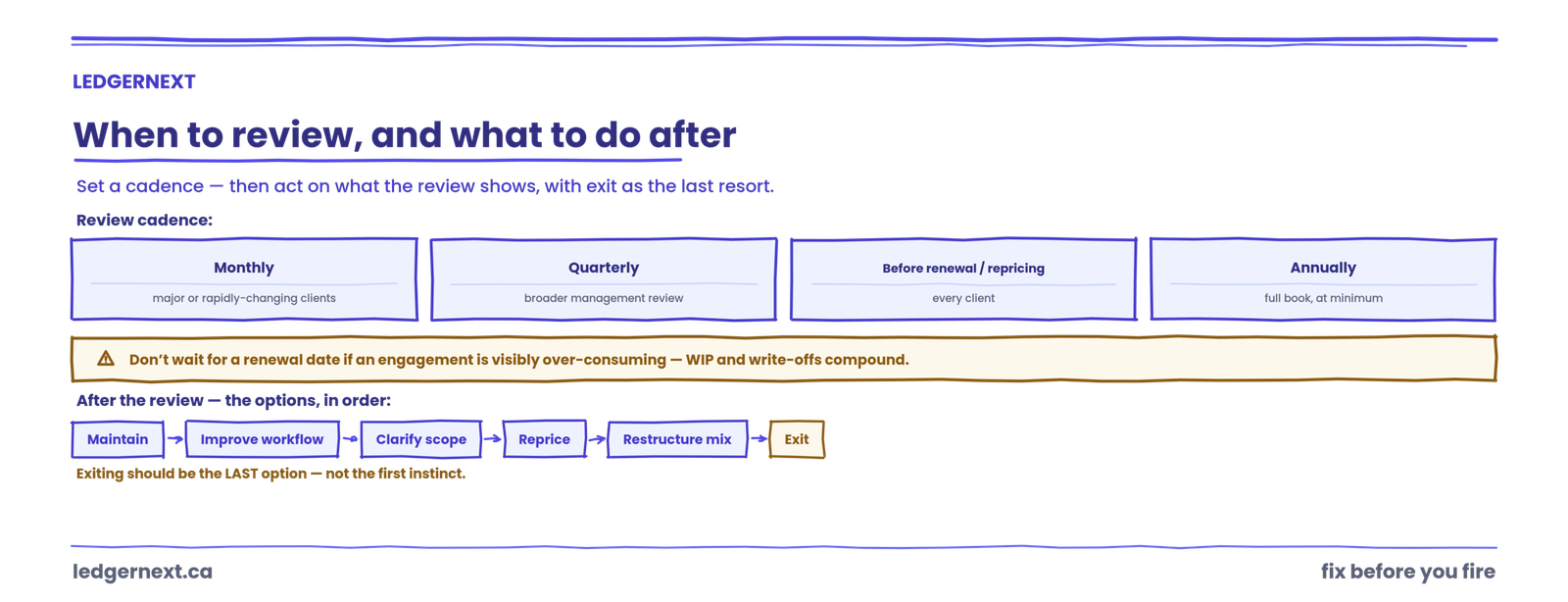
Review major or rapidly changing clients monthly. Run a broader management review quarterly. Review every client before renewal or repricing. At minimum, look at the full book annually. Don’t wait for a renewal date if the engagement is visibly consuming more resources than expected, because WIP growth and write-offs tend to compound.
After the review, the options are: maintain, improve workflow, clarify scope, reprice, restructure the service mix, or exit the relationship where appropriate. Exiting should be the last option, not the first instinct.
Frequently asked questions
What is client profitability for an accounting firm?
Client profitability measures the financial contribution a specific client makes to the firm after accounting for the staff time, delivery costs, and other resources consumed to serve that client. It differs from revenue because it considers what the firm spends, not just what it earns.
How do accounting firms calculate client profitability?
Compare collected revenue against the fully loaded cost of delivery, including staff time at internal cost rates, partner time, rework, and directly attributable overhead. The gap is the client’s profit contribution.
What costs should be included when measuring client profitability?
Include the fully loaded cost of every resource the client consumes: staff time at internal cost rates (not billing rates), partner and manager time, rework and corrections, directly attributable technology or software, and a reasonable share of overhead. Revenue leakage, such as discounts, write-downs, write-offs, and collection effort, should be netted against revenue so the contribution reflects what the firm actually keeps.
What is an effective hourly rate?
Actual revenue from a client divided by total hours spent serving that client. A $24,000 client consuming 240 hours produces an effective rate of $100/hour.
Can a high-revenue client still be unprofitable?
Yes. If the engagement consumes disproportionate staff time, generates significant rework, or requires extensive partner involvement, delivery costs can exceed the revenue collected. Revenue alone doesn’t determine profitability.
Should partner time be included in client profitability?
It should. Partner time is expensive capacity, and excluding it understates the true resources a client consumes. Even a rough allocation is better than ignoring it entirely.
How does scope creep affect client profitability?
Scope creep increases delivery hours without increasing revenue. Over time, the effective hourly rate falls and the client’s profit contribution shrinks, often without anyone noticing until the margin is already gone. Firms dealing with this pattern will find practical approaches in our guide on expanding advisory services to restructure what’s included.
Should accounting firms fire unprofitable clients?
Not automatically. First determine whether the problem is pricing, scope, workflow, complexity, or collections. Many unprofitable clients become profitable after operational improvements or scope clarification. Exit the relationship only when the economics remain incompatible after reasonable adjustments.
Conclusion
The goal isn’t to maximize revenue per client. It’s to build client relationships where the revenue, scope, complexity, and resources required to deliver the work make sense together. A $1,500-a-month client that takes eight clean hours is a very different relationship from a $1,500-a-month client that takes eighteen and a partner on the phone, even though the invoice is identical.
The path is the same every time: measure, diagnose, improve, and reprice or restructure where necessary. Revenue is easy to see, which is exactly why so many firms stop there. The economics that actually decide whether a client belongs in your book live one layer down, in the time and cost data most practices never fully capture.
The next problem most firms hit after running this analysis is that they don’t have clean time data to work with. If your practice management system captures billable hours but misses the partner calls, the rework cycles, and the “quick questions,” start there. The profitability model is only as good as the inputs feeding it.
Capture the time data your profitability model depends on
LedgerNext centralizes bookkeeping workflows so the partner calls, rework cycles, and quick questions get captured, giving your client profitability analysis the inputs it actually needs.