
Last year, I helped a 45-employee manufacturing company in Ontario migrate off Payworks. Not because Payworks was broken — it wasn’t. Their payroll ran fine. But they’d opened a second location in BC, hired a fractional CFO who wanted consolidated financial reports, and their accounting firm was tired of exporting payroll data into a separate bookkeeping tool every two weeks.
That’s the pattern I see repeatedly. Organizations don’t leave payroll software because it fails. They leave because their operations outgrow what the platform was designed to handle. Multi-province compliance gets complicated. Reporting requirements stack up. The accounting firm asks for something the system can’t produce without a workaround.
If you’re evaluating Payworks alternatives right now, you’re probably in a similar spot. The payroll itself works, but something adjacent — reporting, bookkeeping integration, HR, multi-client management — doesn’t.
This guide is built to help you find the right fit based on how your business actually operates, not based on feature checklists.
What Are the Best Payworks Alternatives in Canada?
The top Payworks alternatives for Canadian businesses in 2026 are Wagepoint (best for small businesses wanting simple payroll), LedgerNext (best for accounting firms and businesses wanting payroll and bookkeeping in a single platform), ADP Workforce Now (best for larger organizations needing HR and payroll together), Rise People (best for mid-sized companies wanting an integrated HR platform), and Dayforce (best for enterprises with complex workforce management). Each serves a different operational profile, so the right choice depends on your size, compliance needs, and workflow requirements.
TL;DR: Quick Verdict Matrix
- Simple payroll for small teams — Wagepoint
Clean payroll runs with minimal setup overhead. - Payroll + bookkeeping for firms — LedgerNext
Payroll, bank reconciliation, and financial reporting in one workspace. - Enterprise HR + payroll — ADP Workforce Now
Broad module library for complex organizations. - Mid-market HR + payroll — Rise People
Canadian-built with benefits administration baked in. - Large-scale workforce management — Dayforce
Real-time payroll calculations tied to scheduling.
Why Businesses Look for Alternatives to Payworks
Businesses typically look for alternatives to Payworks when their payroll, reporting, HR, or accounting workflow requirements become more complex than what a payroll-focused platform can support on its own.
Here’s what I see trigger the switch most often:
Growth across provinces. A company with employees in Alberta and Ontario has different provincial tax obligations, and managing multi-province compliance inside a payroll-only tool starts creating manual work. Understanding the difference between employee and contractor classifications becomes more urgent as the team grows.
Reporting demands change. The owner used to glance at payroll summaries. Now there’s a controller or CFO who wants payroll journal entries mapped to the general ledger, CRA remittance summaries reconciled monthly, and year-end reporting that doesn’t require re-keying data.
Accounting firms need more. When a CPA firm manages payroll for 30 clients, they evaluate software completely differently than a single business owner. Multi-client workflows, team assignments, client collaboration portals — these aren’t nice-to-haves, they’re operational requirements. Firms dealing with payroll remittance deadlines across dozens of clients can’t afford manual tracking.
HR requirements emerge. A 15-person company doesn’t need an HRIS. A 75-person company with benefits, time tracking, and onboarding workflows probably does.
None of these reasons mean Payworks is a bad product. They mean the organization’s needs changed.
How We Evaluated These Alternatives
I evaluated each platform against the criteria that actually matter when a Canadian business or accounting firm is making this decision:
- CRA compliance depth — source deductions, CPP/CPP-2, EI, T4 generation, ROE handling
- Reporting quality — payroll registers, financial statements, CRA-ready output
- Scalability — what happens at 10 employees vs. 100, or 5 clients vs. 50
- Accounting workflow support — does the platform connect to or replace bookkeeping workflows
- Accountant friendliness — multi-client management, team access, client workspaces
- 3-year total cost of ownership — not just the monthly fee, but what you’ll pay as you add modules, employees, or clients
I weighted accounting workflow support and multi-client management higher than most comparison guides because that’s where I see the most friction in practice.
Payworks Alternatives Comparison
Best Payworks Alternatives in Canada
1. Wagepoint
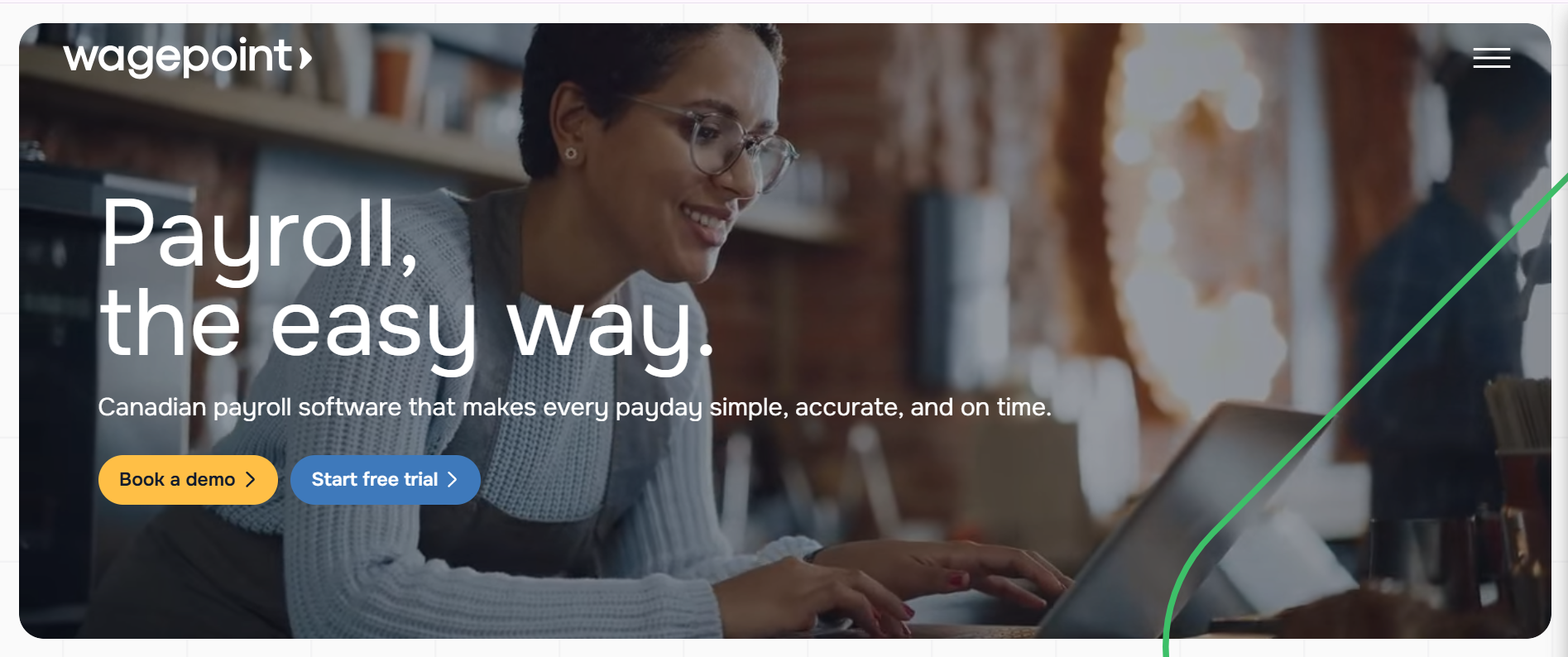
What it does well: Wagepoint keeps payroll simple. For a small Canadian business that needs to run payroll, generate T4s, handle direct deposit, and stay CRA-compliant — it does exactly that without unnecessary complexity. The interface is clean, the payroll run workflow is short, and year-end reporting is straightforward. Businesses dealing with CPP vs. EI calculations will find the process handled automatically.
Potential considerations: The simplicity that makes Wagepoint attractive for a 10-person company can become a constraint at 60. Multi-entity management is limited. If your accounting firm needs to manage payroll across multiple clients from one dashboard, the workflow gets manual quickly. Reporting stays at the payroll level — you won’t get financial statements or general ledger mapping here.
Best for: Small businesses with straightforward payroll needs and fewer than 50 employees.
May not be ideal for: Accounting firms managing multiple clients, or businesses that need payroll data flowing directly into bookkeeping workflows.
2. LedgerNext — Best for Canadian Accounting Firms and Businesses That Want Payroll and Bookkeeping in One Platform
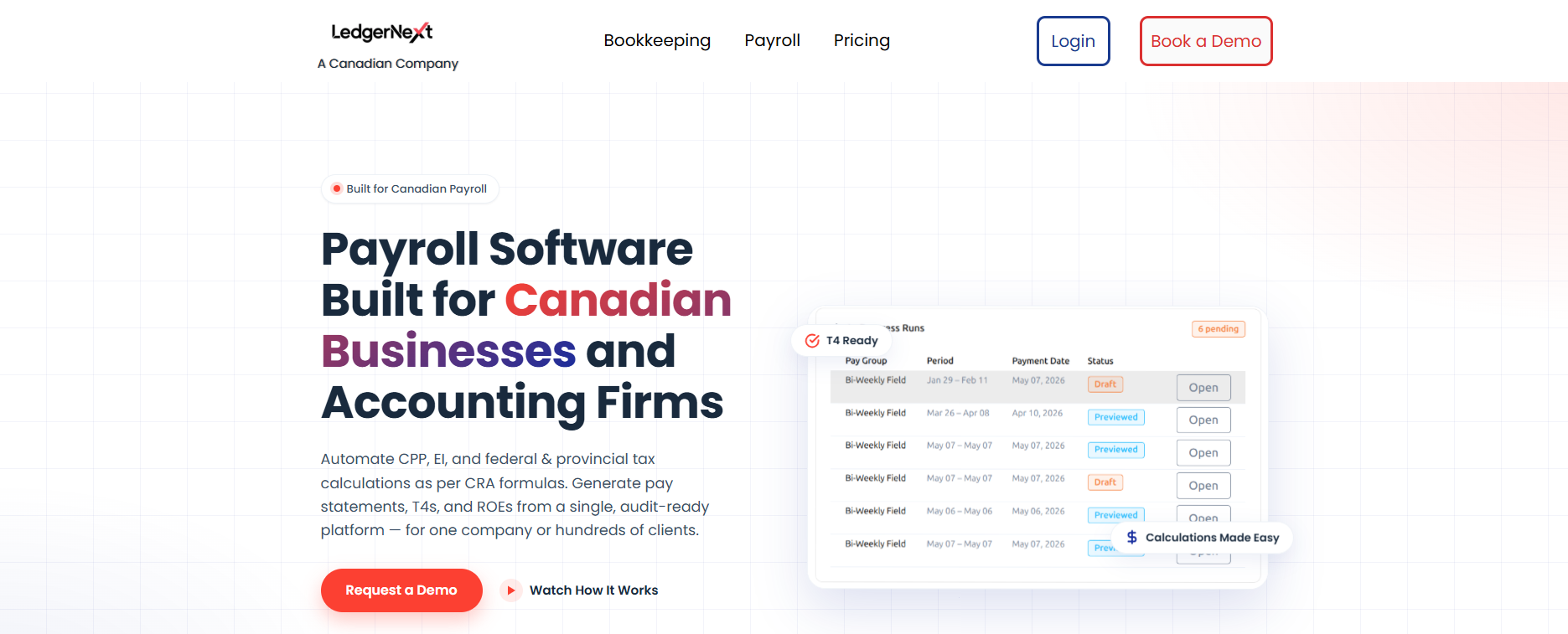
What it does well: LedgerNext approaches the problem differently than every other platform on this list. Instead of treating payroll as a standalone function, it combines payroll processing with bookkeeping workflows, bank reconciliation, and financial reporting within a single platform.
Payroll: LedgerNext handles CPP, CPP-2, EI, federal and provincial tax calculations, pay slips, T4 generation, ROEs, payroll registers, and CRA remittance summaries. This is full Canadian payroll processing — not a bookkeeping add-on.
Bookkeeping: Transaction categorization, bank reconciliation, GST/HST reporting, and financial statements are built into the same workspace. For businesses that currently run payroll in one tool and bookkeeping in another, this eliminates the export-import cycle that creates reconciliation errors. Understanding why bank reconciliation takes so long often comes down to disconnected systems.
Accounting firms: This is where LedgerNext stands apart. Multi-client payroll, multi-client bookkeeping, team assignments, client collaboration portals, and secure client workspaces are designed for firms managing dozens of client books. CPA practices handling transaction categorization across multiple clients can manage everything from one dashboard.
Reporting: Payroll reports, financial statements, GST/HST reports, and CRA-ready reporting are generated from the same data set, which eliminates the reconciliation gaps that happen when payroll and bookkeeping live in separate systems.
Potential considerations: Organizations seeking only a basic payroll processor may not need the broader bookkeeping and reporting capabilities. If you run a 10-person company and your accountant handles everything else externally, you may not use the full platform.
Best for: CPA firms, bookkeeping firms, accounting practices, and businesses that want payroll and bookkeeping managed together without juggling multiple tools.
May not be ideal for: Businesses that only need standalone payroll processing and have no interest in consolidating bookkeeping workflows.
Thinking about consolidating payroll and bookkeeping?
We built LedgerNext to handle both — payroll processing, bank reconciliation, financial reporting, and multi-client management in one workspace. Request a demo to see how it works for your firm.
3. ADP Workforce Now
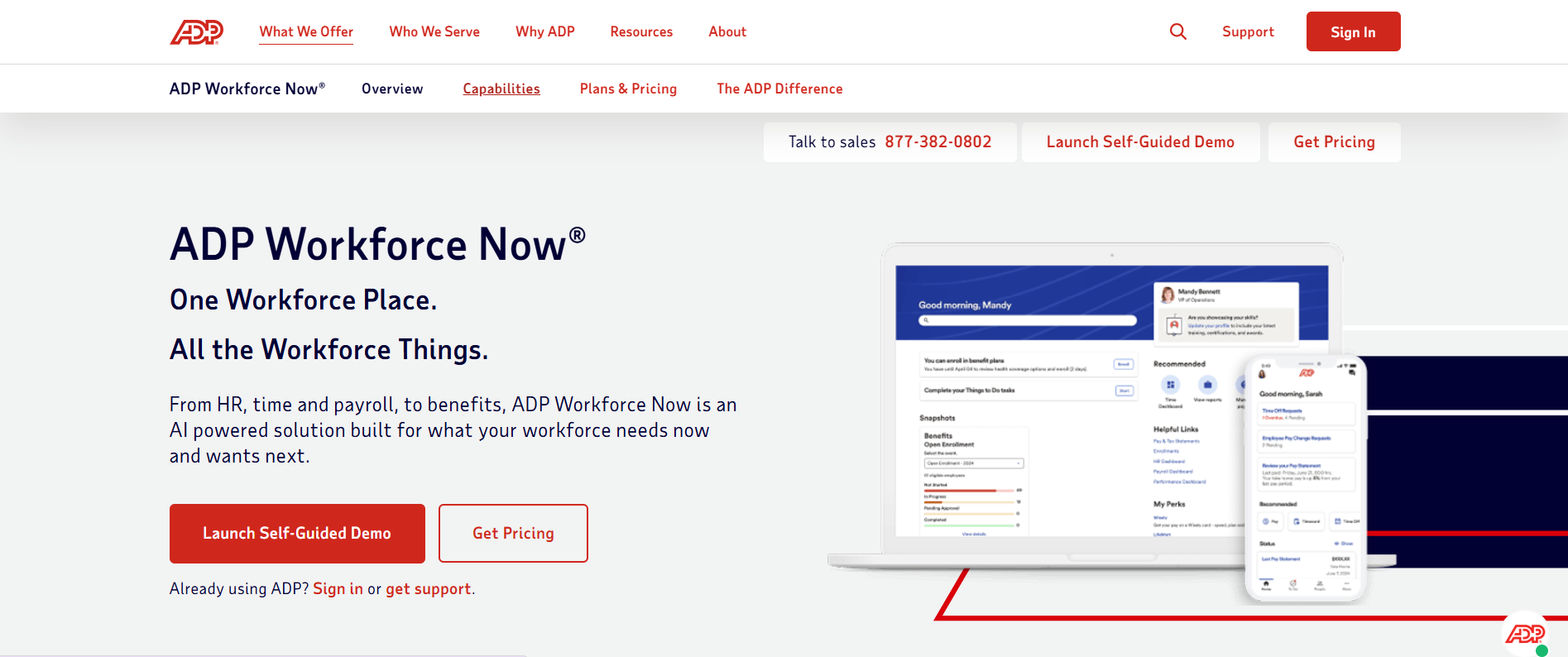
What it does well: ADP brings scale. For organizations with complex HR requirements — benefits administration, time and attendance, talent management — ADP consolidates those functions alongside payroll. The platform handles multi-province compliance well, and the reporting library is extensive. Implementation support is structured, which matters when you’re onboarding 200+ employees.
Potential considerations: ADP’s breadth comes with weight. Small businesses often end up paying for modules they don’t use, and the implementation timeline can stretch longer than expected. I’ve seen companies under 50 employees sign ADP contracts and realize six months later that they’re using 20% of the platform. The dashboard can stay grey and unresponsive during peak processing periods, which creates friction during payroll runs.
Best for: Organizations with 50+ employees that need HR, benefits, and payroll in one platform.
May not be ideal for: Small businesses, or firms looking for a lightweight payroll solution without enterprise HR overhead.
4. Rise People
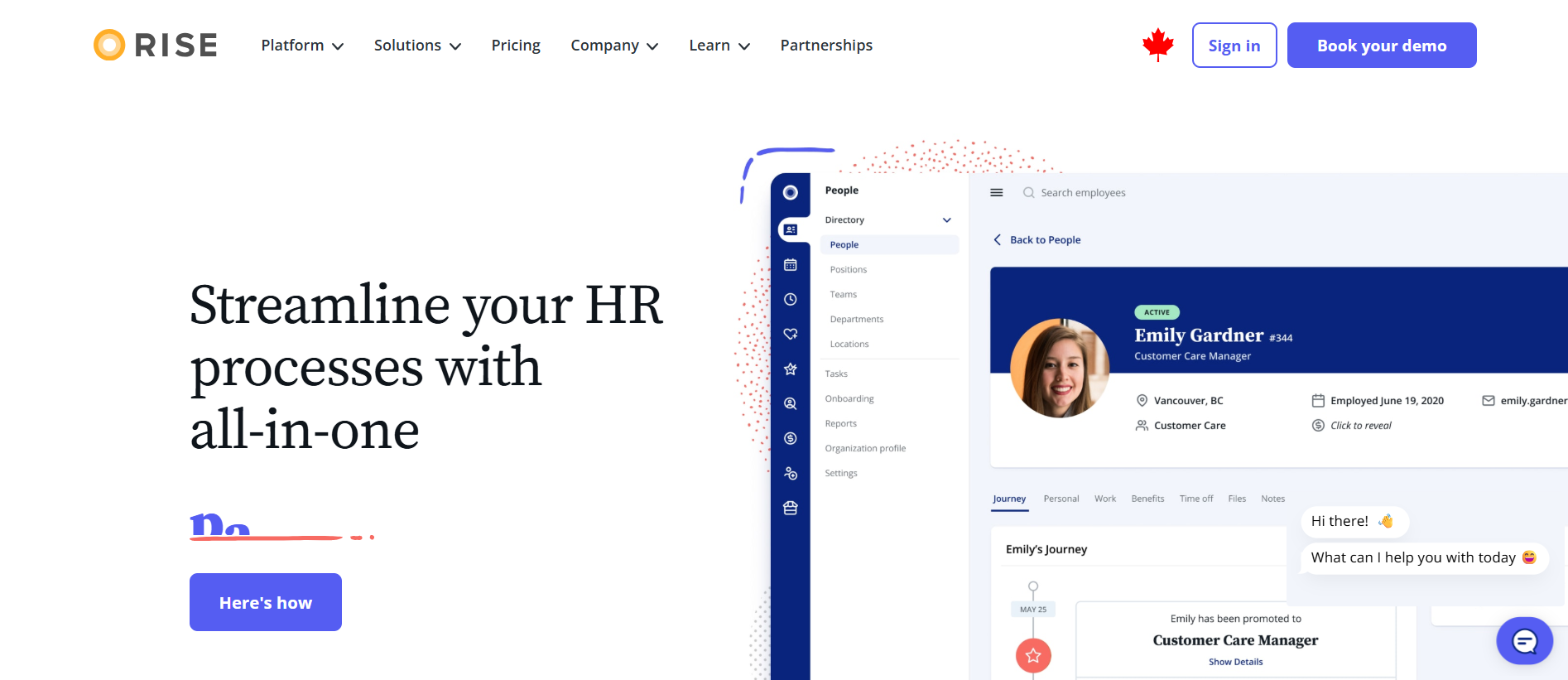
What it does well: Rise is Canadian-built and combines payroll with HR functions like benefits administration, onboarding, and employee self-service. For mid-sized Canadian companies that want an integrated people platform without the complexity of ADP or Dayforce, Rise fills a practical middle ground. The benefits integration is a genuine differentiator — employees can view pay stubs and benefits information in one place.
Potential considerations: Rise’s strength is the HR-payroll combination, which means organizations seeking only payroll processing may find themselves evaluating features they don’t need. Reporting is adequate for most mid-market needs but may not satisfy firms that require detailed payroll journal entries or general ledger mapping. Multi-client support for accounting firms isn’t a primary design focus.
Best for: Canadian companies with 20–300 employees looking for payroll plus HR and benefits in one platform.
May not be ideal for: Accounting firms managing multiple clients, or businesses that need deep financial reporting alongside payroll.
5. Dayforce
What it does well: Dayforce (formerly Ceridian) is built for large, complex organizations. Its core differentiator is real-time payroll calculation connected to scheduling, time tracking, and workforce management. For companies with hourly workers across multiple locations, the continuous calculation engine reduces end-of-period payroll surprises. The compliance engine handles multi-province and bilingual payroll requirements well.
Potential considerations: Dayforce is not a small-business tool. Implementation is measured in months, not days. The 3-year total cost of ownership is significantly higher than other options on this list, and the configuration complexity requires dedicated internal resources or a consulting partner. I’ve worked with companies that underestimated the change management effort by roughly 40%, which delayed their go-live timelines.
Best for: Enterprises with 100+ employees, multiple locations, and complex scheduling or workforce management needs.
May not be ideal for: Small or mid-sized businesses, accounting firms, or organizations that don’t need workforce management beyond basic payroll.
Which Payworks Alternative Is Right for You?
- Small Businesses
Wagepoint. Keep it simple, keep it affordable. You don’t need an HRIS at 15 employees. - Growing Businesses
Rise People if you need HR alongside payroll. LedgerNext if your growth is creating bookkeeping and reporting complexity, not just HR needs. - Accounting Firms
LedgerNext. Multi-client payroll and bookkeeping from one platform is the operational requirement most firms tell me they can’t find elsewhere. The hidden cost of manual bookkeeping across dozens of clients adds up fast. - CPA Practices
LedgerNext for integrated workflows. ADP if your clients specifically require ADP-generated reports for their own compliance. - Multi-Location Organizations
Dayforce for large-scale workforce management. ADP for mid-to-large organizations that need HR depth. - Businesses Wanting Payroll + Bookkeeping
LedgerNext. This is the specific use case it was built for.
FAQ
What is the best alternative to Payworks?
It depends on your operational needs. Wagepoint is strongest for simple small-business payroll. LedgerNext is strongest for businesses and accounting firms that want payroll and bookkeeping in one platform. ADP and Dayforce serve larger, more complex organizations.
Is Payworks still a good payroll solution?
Yes, for Canadian businesses with straightforward payroll needs. Most organizations that switch do so because their reporting, bookkeeping, or multi-client requirements have expanded beyond what a payroll-focused tool supports.
Which payroll software is best for Canadian businesses?
The best Canadian payroll software depends on business size and workflow complexity. Small businesses often start with Wagepoint. Growing companies evaluate Rise or ADP. Firms wanting consolidated payroll and bookkeeping choose LedgerNext.
Which payroll software is best for accounting firms?
LedgerNext is purpose-built for accounting firm workflows — multi-client payroll, multi-client bookkeeping, team assignments, and client collaboration in one platform.
What should businesses look for in payroll software?
CRA compliance, reporting depth, scalability, integration with your bookkeeping workflow, and total cost of ownership over three years — not just the monthly subscription price.
Can payroll and bookkeeping be managed together?
Yes. LedgerNext combines payroll processing, bank reconciliation, transaction categorization, and financial reporting within a single platform, eliminating the data gaps that occur when these functions live in separate tools.
Final Thoughts
Different payroll platforms solve different problems. The right Payworks alternative depends on whether you need payroll only, payroll plus HR, or payroll plus broader accounting and bookkeeping workflows. Start with the problem you’re actually trying to solve — the software choice follows from there.
Ready to see payroll and bookkeeping working together?
LedgerNext combines payroll processing, bank reconciliation, financial reporting, and multi-client management in one workspace — see how Canadian firms are managing both from a single platform.
✅ Built-In Bookkeeping
✅ Multi-Client Dashboard