

Most bookkeeping problems don’t start where you think they do.
They don’t start in reporting. They don’t start during reconciliation. They don’t even start at month-end, though that’s usually when someone finally notices something is off.
They start earlier. Quietly. When a transaction gets coded to the wrong account. When two team members categorize the same vendor differently. When an ambiguous deposit gets forced into an income line because nobody had time to ask the client what it actually was.
I’ve reviewed thousands of categorized transactions across dozens of client files, and the pattern is always the same: by the time the P&L looks wrong or the reconciliation won’t balance, the real damage happened weeks ago at the point of transaction entry. Everything after that is a downstream consequence.
This article breaks down exactly why transaction categorization for bookkeeping is the control layer most firms underestimate — and what to do about it before it quietly erodes your financial data quality, your team’s efficiency, and your clients’ trust in your numbers.
What Is Transaction Categorization?
Transaction categorization is the process of assigning each financial transaction to the correct account within a chart of accounts. This includes classifying deposits, payments, transfers, and adjustments into categories like revenue, operating expenses, cost of goods sold, or liability accounts. Accurate categorization creates the foundation for reliable financial statements, consistent bank reconciliation, compliant tax preparation, and meaningful client reporting. Without it, accounting records lose their integrity, and every downstream process — from month-end close to year-end filing — becomes harder to complete accurately.
Why Transaction Categorization Matters
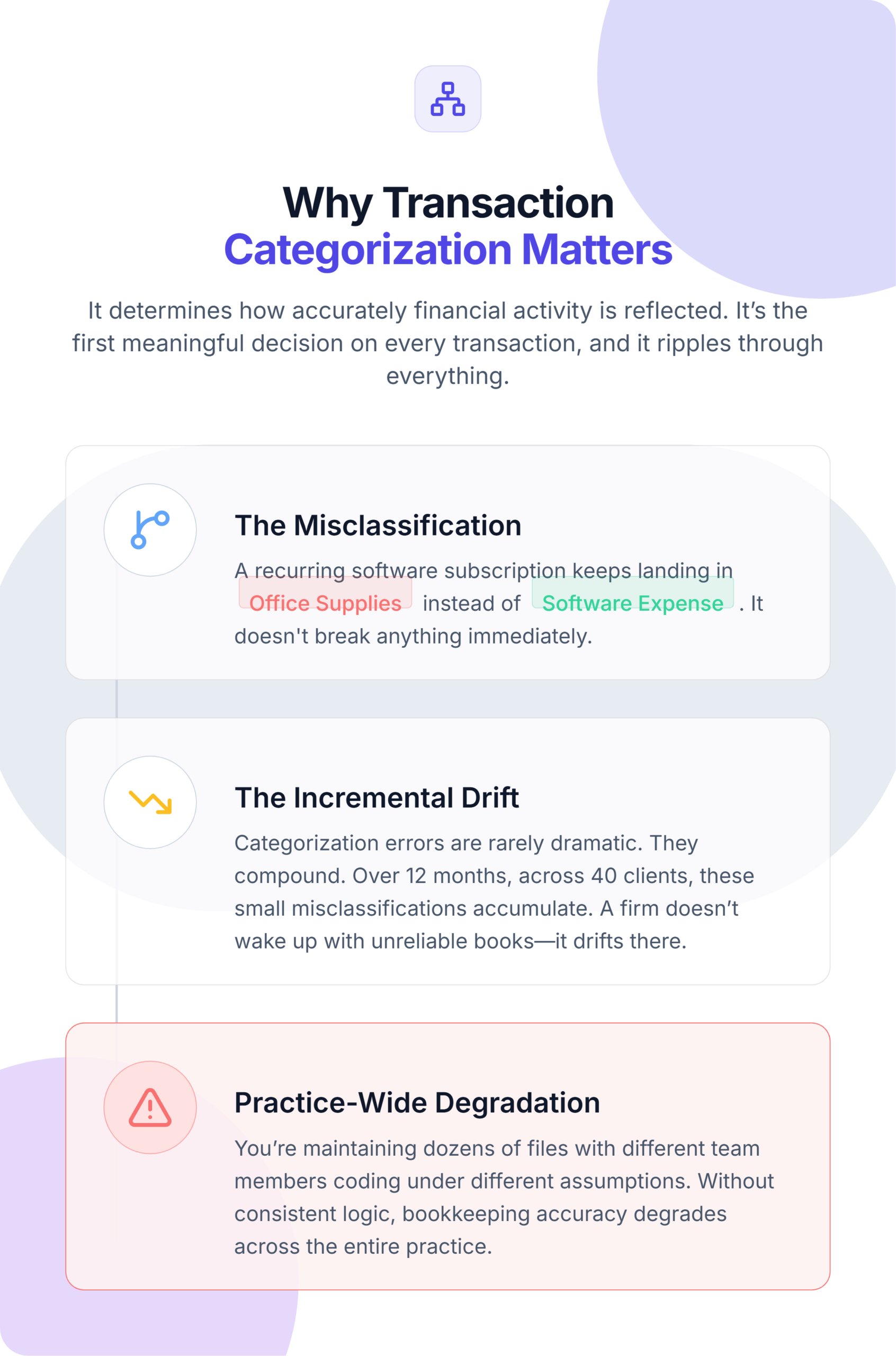
Transaction categorization matters because it determines how accurately financial activity is reflected in your accounting records, reports, and reconciliation workflows. It’s the first meaningful decision made on every transaction, and it ripples through everything that follows.
Think about it this way: a financial report is only as accurate as the categorized transactions behind it. If a recurring software subscription keeps landing in “Office Supplies” instead of “Software Expense,” your expense reporting is distorted. Not dramatically — not in a way that breaks anything immediately. But over 12 months, across 40 clients, those small misclassifications accumulate into reports that don’t reflect reality.
And that’s the problem. Categorization errors are rarely dramatic. They’re incremental. They compound. A firm doesn’t wake up one morning with unreliable books. It drifts there, one miscoded transaction at a time.
For Canadian accounting firms managing multiple client files, the stakes are higher. You’re not just maintaining one set of books — you’re maintaining dozens, often with different team members coding transactions under different assumptions. Without consistent categorization logic, bookkeeping accuracy degrades across the entire practice.
How Poor Categorization Creates Downstream Problems
Most firms treat categorization as a data-entry task. Something junior staff handle. Something that gets “cleaned up later.” But categorization isn’t just data entry — it’s the control layer that determines whether your books are trustworthy.
Here are some of the most common problems caused by inaccurate transaction categorization:
1. Financial Reports Become Less Reliable
When transactions are coded to the wrong accounts, profit and loss statements stop telling the truth. Revenue might be overstated because a liability repayment was coded as income. Expenses might be understated because reimbursements are sitting in operating expense lines instead of clearing accounts.
The reports still look clean. The totals still balance. But the story they tell about the business is wrong. And if a client makes decisions based on those numbers — hiring, purchasing, expanding — they’re making decisions based on distorted data.
This is where how clean financial data improves reporting accuracy becomes critical. Financial reporting accuracy isn’t a reporting problem. It’s a categorization problem.
2. Bank Reconciliation Takes Longer
This one is significant, and I see it constantly.
When categories are inconsistent — when the same vendor lands in different accounts across months, or when transactions are duplicated during bank feed import — reconciliation throws unexplained variances. The numbers are “almost” right. Close enough to be frustrating, but off enough that you can’t sign off.
The instinct is to blame the reconciliation process. But in most cases, the reconciliation isn’t broken. The categorization feeding into it is.
If your team is spending excessive time on reconciliation, it’s worth reading about why bank reconciliation takes so long and checking for common bank reconciliation mistakes. The root cause is often upstream.
3. Month-End Close Becomes More Difficult
Categorization inconsistencies frequently become visible during month-end reviews. That’s when the team starts pulling reports, comparing accounts, and discovering that things don’t add up.
By that point, correcting errors often requires revisiting weeks of transactions. Adjustment entries pile up. Review cycles expand. Reporting deadlines slip.
A firm following a month-end close checklist for Canadian accounting firms still can’t close efficiently if the underlying transaction coding is unreliable. The checklist helps with process. It doesn’t fix bad data.
4. Tax Preparation Becomes More Complicated
Tax-ready books require more than a balanced bank feed. They require transactions grouped by tax treatment — not just operational convenience.
When expense categorization is off, year-end review work increases substantially. The tax preparer has to reclassify transactions, verify expense eligibility, and rebuild supporting documentation. GST/HST/QST obligations become harder to calculate accurately when the underlying records don’t reflect the correct tax categories.
I’ve seen files where the books looked reconciled and the reports looked reasonable, but the tax prep still required heavy cleanup. The transactions were grouped for management reporting, not for compliance. Two different objectives, two different categorization requirements — and nobody had addressed that gap.
5. Firms Spend More Time Correcting Errors
Every miscategorized transaction creates rework. Someone has to find it, reclassify it, verify it didn’t affect other accounts, and communicate the change if the client has already seen the report.
Multiply that by hundreds of transactions across multiple clients, and you’re looking at a significant hidden cost of manual bookkeeping. The firm isn’t doing more client work. It’s doing the same work twice.
Common Transaction Categorization Mistakes
These are the patterns I see most often. Not theoretical risks — actual, recurring problems in real client files.
- 1. Categorizing Similar Transactions Differently
Two staff members code the same vendor to different accounts. No shared SOP. No category definitions. The COA has 15 expense accounts and nobody’s documented which one covers what. This is the single most common failure mode, and it’s not a software problem — it’s a process problem. - 2. Overusing Miscellaneous Categories
When someone isn’t sure where a transaction belongs, it goes to “Miscellaneous” or “General Expense.” A few of those are fine. Fifty of them at month-end is a reporting problem. - 3. Failing to Review Uncategorized Transactions
Bank feeds import transactions, but not all of them auto-categorize. The uncategorized items sit there. Nobody reviews them until close. Then they become a bottleneck. - 4. Inconsistent Team Processes
One bookkeeper codes client meals to “Meals & Entertainment.” Another codes them to “Marketing Expense.” Both are defensible. Neither is wrong in isolation. But the inconsistency makes the reports unreliable over time. - 5. Relying Solely on Manual Classification
Manual categorization works at low volume. At scale — 500, 1,000, 2,000 transactions per month — it breaks down. Not because people aren’t careful, but because human judgment varies, especially under time pressure.
Why Categorization Consistency Matters More Than Perfection
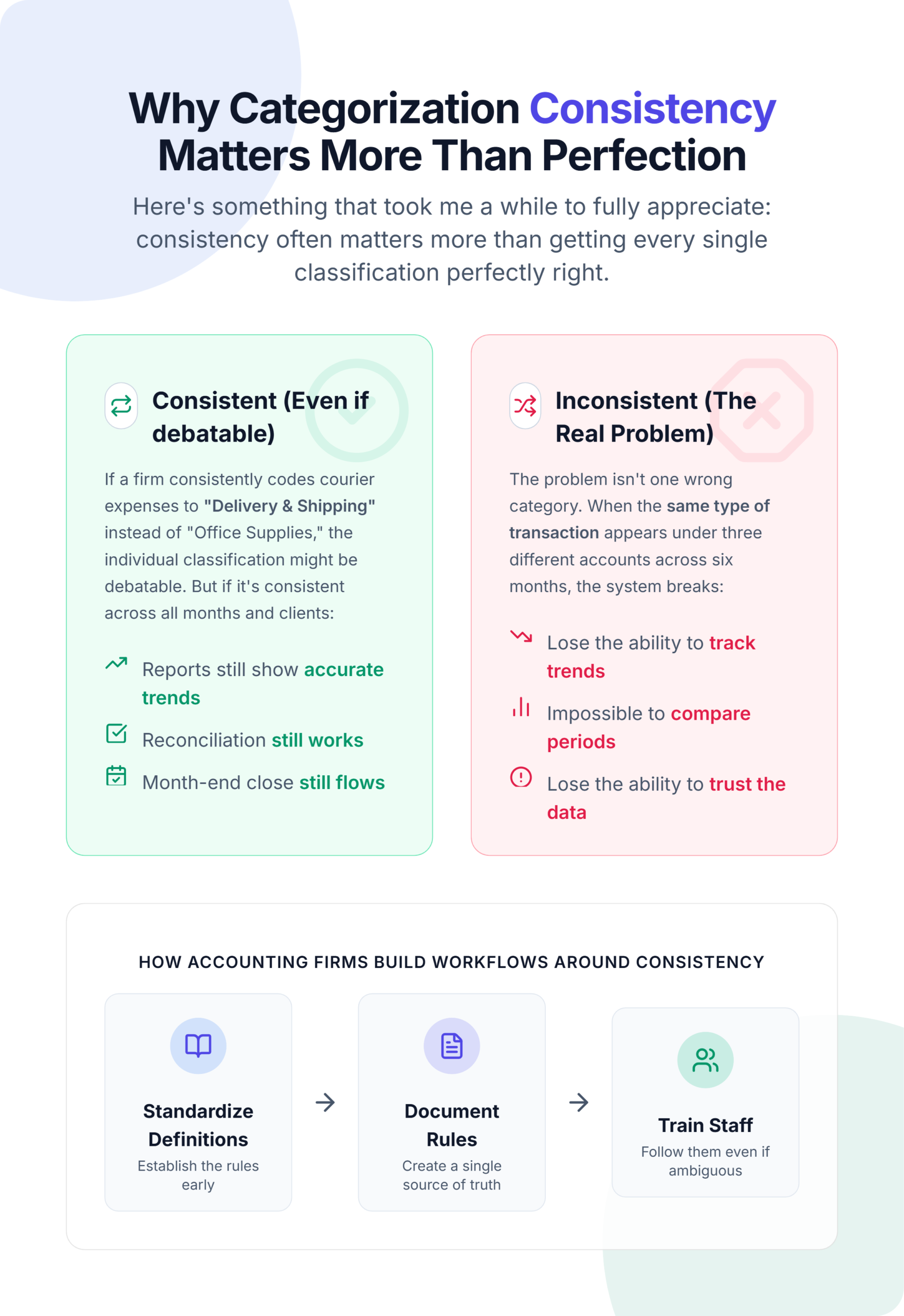
Here’s something that took me a while to fully appreciate: consistency often matters more than getting every single classification perfectly right.
If a firm consistently codes courier expenses to “Delivery & Shipping” instead of “Office Supplies,” the individual classification might be debatable. But if it’s consistent across all months and all clients, the reports still show accurate trends. Reconciliation still works. Month-end close still flows.
The problem isn’t one wrong category. The problem is inconsistent categories. When the same type of transaction appears under three different accounts across six months, you lose the ability to track trends, compare periods, or trust the data.
Accounting firms that understand this build their workflows around consistency first. They standardize definitions, document rules, and train staff to follow them — even when the “right” answer is ambiguous.
How High-Performing Accounting Firms Manage Transaction Categorization
The firms that handle categorization well don’t rely on individual judgment. They build systems.
- Standardized Rules
Every COA account has a one-line definition and examples. Staff don’t have to guess. - Review Workflows
Someone reviews categorized transactions before month-end — not after. Catching errors early is dramatically cheaper than fixing them in reporting. - Exception Handling
Ambiguous items go to a holding account or suspense workflow. They don’t get forced into a category. The team requests client clarification before final posting. A fixed question template — asking purpose, counterparty, and business use — gets better answers than open-ended emails. - Categorization Policies
Written SOPs define how common scenarios are handled. Transfers, owner draws, split-use purchases, reimbursements — all documented. - Automation Support
Rule-based automation catches recurring vendors and maps them to the correct accounts. The rule engine uses merchant description, payee, amount, and deposit/withdrawal conditions — not just description text alone.
The visual checkpoint here is straightforward: recurring merchants should auto-map to the same accounts with minimal manual overrides. If you spot the same vendor under multiple expense accounts without a documented reason, the rules aren’t standardized.
How Automation Improves Categorization Accuracy
Automation improves categorization by enforcing consistency at scale and reducing the variability inherent in manual classification.
Rule-based automation handles repetitive transactions reliably. If Adobe charges come through every month, a properly configured rule maps them to “Software Expense” every time. No variation. No judgment calls. Machine learning classification helps with noisy merchant descriptions where rule conditions alone aren’t enough.
But — and this is important — automation is only as good as the rules behind it. Vague merchant names and mixed-purpose payments still require human judgment. ML helps on noisy descriptions, but firms still need to audit exceptions. Overdependence on automation creates silent misclassifications that look fine until a report, audit, or tax filing exposes them.
The goal isn’t to remove humans from categorization. It’s to let automation handle the 80% that’s predictable so your team can focus on the 20% that requires context and expertise.
Spend Less Time on Transaction Coding
LedgerNext converts raw bank statements into categorized, tax-ready financial data using rule-based categorization built for Canadian accounting workflows. If your firm is managing multiple client files and looking for more consistent bookkeeping workflows, it’s worth exploring how the platform handles categorization at scale.
Best Practices for Accurate Transaction Categorization
- ✅ Standardize category definitions — Write one-line descriptions for each COA account so staff interpret them consistently.
- ✅ Review uncategorized transactions regularly — Don’t let them accumulate until month-end. Weekly review keeps the queue manageable.
- ✅ Reconcile frequently — Monthly reconciliation catches categorization errors before they compound.
- ✅ Document categorization rules — Written SOPs reduce variation across team members and client files.
- ✅ Review exceptions — Flag transactions that don’t match existing rules and resolve them before posting.
- ✅ Maintain supporting documentation — Especially for ambiguous items, transfers, and owner-related transactions.
Stop/Go test: Pull 5 random transactions from any client file. If 3 out of 5 are coded inconsistently, the category logic needs attention before you can trust the reports.
Frequently Asked Questions
What is transaction categorization in bookkeeping?
Transaction categorization is the process of assigning each financial transaction to the correct account in the chart of accounts. This creates the structured accounting records needed for financial reporting, reconciliation, and tax compliance.
Why is transaction categorization important?
Categorization determines the accuracy of every downstream bookkeeping process. Incorrect categorization distorts financial reports, delays reconciliation, complicates tax preparation, and increases manual rework across the firm.
How does categorization affect financial reporting?
When transactions are coded to wrong accounts, profit and loss statements and balance sheets reflect inaccurate financial positions. Expense reporting becomes unreliable, and business insights drawn from those reports are misleading.
How does categorization affect bank reconciliation?
Inconsistent or incorrect categorization creates unexplained variances during reconciliation. The bank balance may appear close to the ledger balance, but misclassified transactions prevent clean line-by-line matching.
What are common categorization mistakes?
The most frequent issues include coding the same vendor to different accounts, overusing miscellaneous categories, leaving transactions uncategorized, and lacking standardized team processes for classification decisions.
Can transaction categorization be automated?
Yes. Rule-based automation and machine learning classification handle recurring and pattern-based transactions effectively. However, ambiguous transactions and edge cases still require human review and client context.
Final Thoughts
Accurate bookkeeping doesn’t start with reporting or reconciliation. It starts the moment a transaction gets assigned to an account. Get that right — consistently — and everything downstream gets easier. Get it wrong, and you’ll keep wondering why your month-end close takes so long.
Built for Canadian Accounting Firms.
LedgerNext helps firms process bank transactions into categorized, tax-ready records with consistent rules across every client file — so the work that used to take hours of cleanup just happens.
✅ Consistent Across Every Client
✅ Tax-Ready Records