

It’s 11:47 PM on a Tuesday. You’re staring at a Trial Balance that balances perfectly—debits equal credits, everything looks clean—and yet your Balance Sheet is off by $4,200. You’ve checked the totals three times. The numbers match. So where’s the ghost?
It’s hiding in the General Ledger.
This is the moment most accountants learn—viscerally—that these two reports aren’t interchangeable. They’re fundamentally different tools with different jobs. Confusing them costs hours. Understanding them saves entire close cycles.
The Quick Verdict: The General Ledger is your investigation tool—the detailed transaction history that lets you trace, verify, and diagnose. The Trial Balance is your verification checkpoint—a summary snapshot confirming your books are arithmetically balanced before you produce financial statements. You need both. Neither replaces the other. Firms that treat the Trial Balance as proof of accuracy instead of a preliminary check are the ones burning midnight oil chasing phantom variances.
What Is the Difference Between a Trial Balance and a General Ledger?
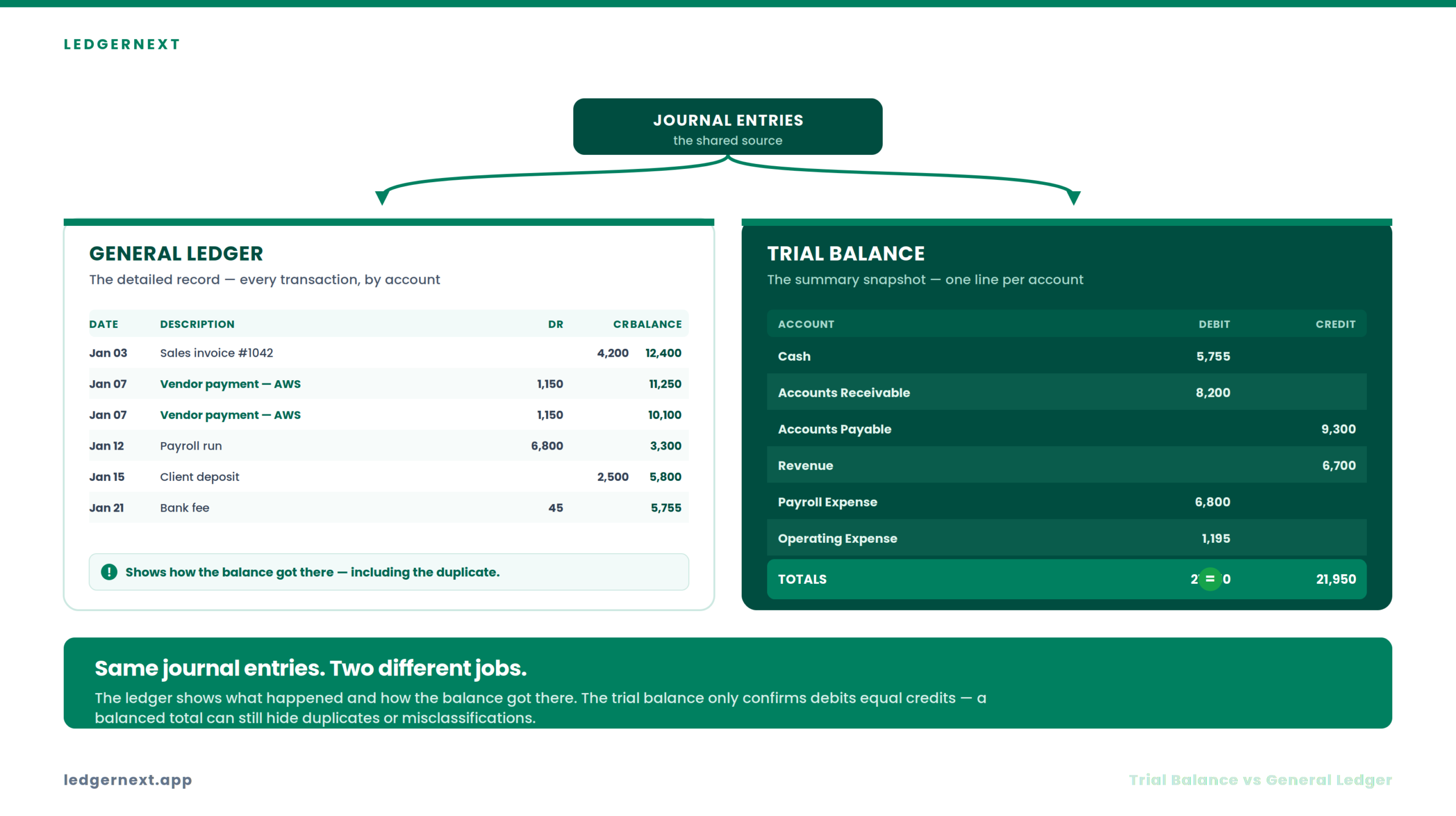
A General Ledger contains the complete, detailed record of every financial transaction organized by account—showing dates, descriptions, amounts, and running balances. A Trial Balance is a summary report listing all account balances at a specific point in time, with total debits and total credits side by side. The General Ledger provides the granular detail needed to investigate individual transactions, while the Trial Balance confirms that the double-entry system is arithmetically balanced. Both reports originate from journal entries but serve different stages of the accounting cycle. A balanced Trial Balance does not guarantee error-free books, because mistakes like duplicate entries or misclassified transactions affect both sides equally.
Understanding the Accounting Cycle
Every financial statement your clients rely on traces back to the same sequential workflow. Skip a stage, and errors compound downstream.
The flow looks like this:
→
Source Document
→
Journal Entry
→
General Ledger
→
Reconciliation
→
Trial Balance
→
Adjusting Entries
→
Financial Statements
Each stage feeds the next. A receipt triggers a journal entry. That journal entry posts to the General Ledger. The ledger accumulates account-level activity. Reconciliation validates that ledger activity against external records like bank statements. The Trial Balance then aggregates those reconciled balances into a single verification report. Only after that checkpoint should you prepare the Income Statement, Balance Sheet, or any management reports.
Operational insight: Errors don’t appear at the Trial Balance stage—they originate at the journal entry stage and travel silently through the ledger. By the time you’re looking at a Trial Balance, the damage is already embedded. This is why the most effective accounting firms review ledger activity before pulling a Trial Balance, not after.
This sequence is the backbone of what I call the RECORD Framework for Reliable Financial Reporting—a six-step discipline that prevents the most common reporting failures.
The RECORD Framework for Reliable Financial Reporting
This framework isn’t theoretical. It mirrors exactly how experienced CPAs approach month-end—and it’s the lens through which the rest of this comparison operates.
What Is a General Ledger?
The General Ledger is the master record of your accounting system. Every journal entry—whether it’s a sales invoice, a payroll run, or a bank fee—posts here, organized by account.
What you see when you open it: Individual transactions listed chronologically under each account. Dates. Descriptions. Reference numbers. Debit and credit columns. A running balance that updates with every posted entry.
What it tells you: Not just what the balance is, but how it got there. That $4,200 discrepancy from the opening scenario? The Trial Balance won’t show you the duplicate vendor payment buried inside Accounts Payable. The General Ledger will—because it shows every single line item.
Common use cases:
- Investigating unusual account fluctuations before preparing financial statements
- Tracing a specific transaction back to its source document
- Identifying duplicate entries or coding inconsistencies during transaction categorization for accurate bookkeeping
- Supporting audit requests with detailed transaction histories
Operational insight: Regular ledger reviews reduce month-end surprises dramatically. Firms that examine ledger activity weekly—rather than waiting until close—catch mispostings when they’re still easy to fix. Reviewing ledger activity by account can reveal patterns that summary reports completely obscure: a vendor being paid twice, an expense coded to the wrong department, revenue recognized in the wrong period.
Within the RECORD Framework, the General Ledger is where you Examine—the diagnostic step that separates reactive bookkeeping from proactive financial management.
What Is a Trial Balance?
The Trial Balance is a summary report that lists every account in your Chart of Accounts alongside its debit or credit balance at a specific date. Total debits should equal total credits. If they don’t, something posted incorrectly.
What you see: A two-column report. Account names on the left. Debit balances in one column, credit balances in the other. Totals at the bottom.
What it tells you: Whether your double-entry system is mechanically intact. That’s it. A Trial Balance is a verification tool, not a diagnostic one.
The friction point most people miss: A balanced Trial Balance feels reassuring. It shouldn’t. Errors of omission (forgetting to record a transaction entirely), errors of commission (posting the right amount to the wrong account), and compensating errors (two mistakes that cancel each other out) all produce a Trial Balance that balances perfectly while the underlying books are wrong.
Operational insight: The Trial Balance is a necessary checkpoint within the RECORD Framework’s Review step—but it’s a minimum standard, not a quality guarantee. Experienced accounting firms treat a balanced Trial Balance as permission to proceed, not as confirmation that the work is done.
The Trial Balance also serves as the foundation for how financial reporting helps accounting firms deliver better client advisory services. Without reliable balances feeding into your financial statements, advisory work is built on sand.
Trial Balance vs General Ledger: Key Differences
The bottom line: The General Ledger answers what happened. The Trial Balance answers do the totals add up. You investigate with the ledger. You verify with the trial balance.
How Both Reports Work Together
→
General Ledger
→
Reconciliation
→
Trial Balance
→
Financial Statements
Here’s the operational reality of this workflow during a typical month-end close for Canadian accounting firms:
Operational insight: Reconciliation is the bridge that strengthens both reports. An unreconciled General Ledger produces an unreliable Trial Balance. An unreliable Trial Balance produces financial statements your clients can’t trust. Firms that skip or delay reconciliation—and many do, especially when bank reconciliation takes too long—are building reports on unverified data.
Common Mistakes When Using Trial Balances and General Ledgers
1. Treating a balanced Trial Balance as proof of accuracy. It only proves debits equal credits. Compensating errors, transposition errors posted to wrong accounts, and completely omitted transactions all hide behind a balanced total.
2. Skipping ledger reviews before pulling the Trial Balance. If you jump straight to the summary without examining the detail, you’re trusting the output without validating the input.
3. Unreconciled accounts. Pulling a Trial Balance from unreconciled ledger balances is like checking the roof before inspecting the foundation.
4. Duplicate journal entries. These inflate both debits and credits equally—the Trial Balance still balances, but your financial statements overstate activity.
5. Incorrect account classifications. Coding an asset as an expense (or vice versa) distorts both the General Ledger and every report downstream. A well-structured Chart of Accounts—the Organize step in the RECORD Framework—prevents most classification errors before they start.
6. Outdated Chart of Accounts. When account structures don’t reflect current business operations, transactions get forced into wrong categories. Understanding rule-based vs manual categorization helps firms maintain consistency.
7. Missing adjusting entries. Accruals, deferrals, and depreciation adjustments must post before the final Trial Balance. Missing them means your financial statements don’t reflect economic reality.
Best Practices for Accounting Firms
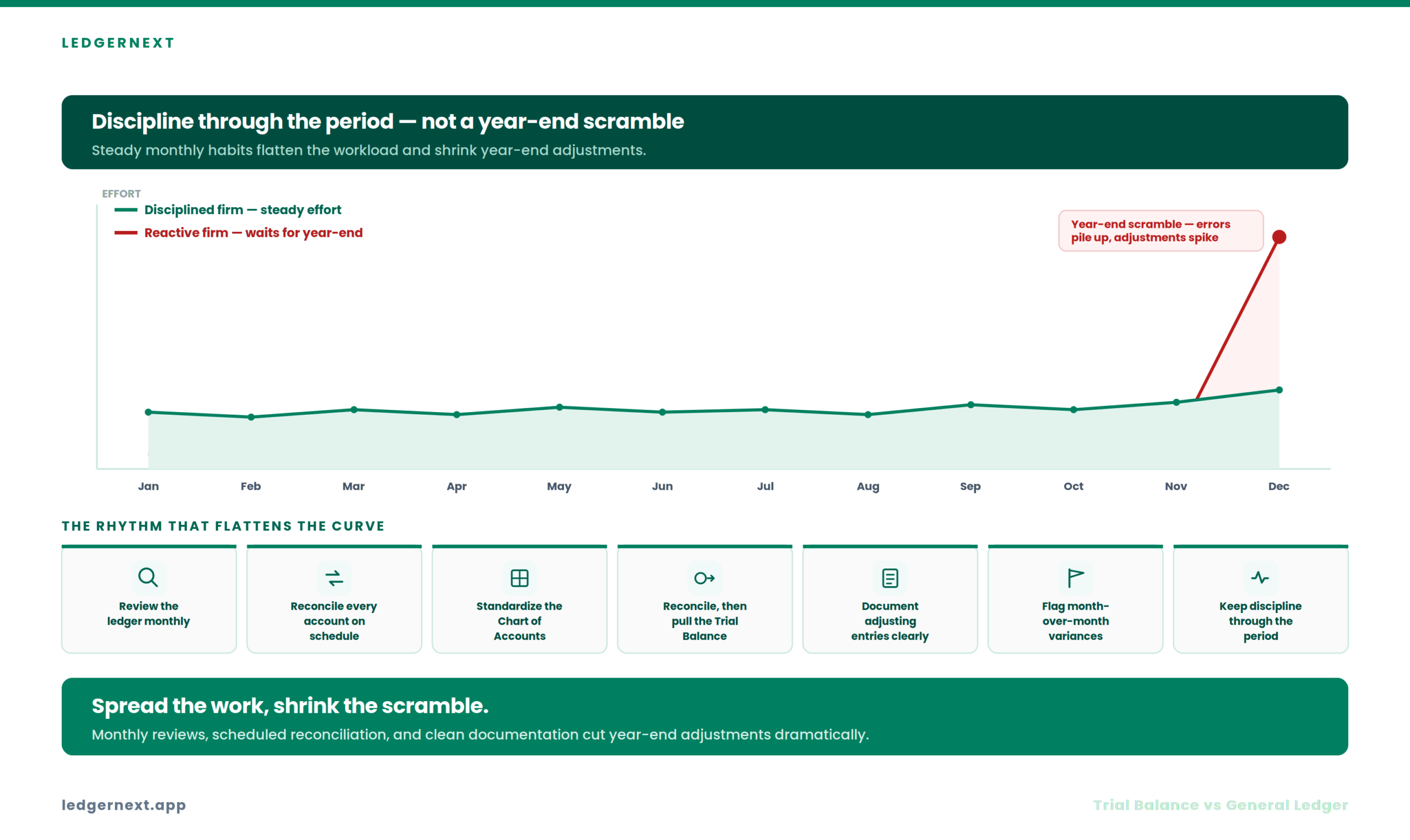
- Review ledger activity monthly, not just at year-end. Investigate unusual balance fluctuations immediately.
- Reconcile every balance sheet account on a defined schedule. No exceptions.
- Standardize your Chart of Accounts across clients where possible. Consistent account structures improve Trial Balance quality and reduce classification errors.
- Pull the Trial Balance only after reconciliation is complete. This sequence matters.
- Document adjusting entries with clear descriptions. Future-you (or the next reviewer) needs to understand why each adjustment was made.
- Implement exception analysis—flag accounts with unusual variances month-over-month before preparing financial statements.
- Maintain strong bookkeeping discipline throughout the period. This reduces year-end adjustments significantly and supports cleaner GST/HST filing.
How Technology Improves Financial Reporting Accuracy
The RECORD Framework is a discipline—but technology determines how efficiently that discipline gets executed. Manual processes introduce friction at every stage: hand-keyed journal entries create transposition errors, spreadsheet-based ledgers lose audit trails, and copy-paste Trial Balances break formulas silently. The hidden cost of manual bookkeeping isn’t just time—it’s error accumulation.
LedgerNext supports this workflow by providing:
- General Ledger reports with full transaction detail for account-level investigation
- Trial Balance reports for pre-reporting verification
- Transaction categorization that maintains consistent account coding
- Bank reconciliation tools that validate ledger balances against external records
- Financial reporting capabilities for delivering client-ready statements
- Multi-client bookkeeping support so firms apply the same disciplined process across their entire portfolio
- PDF and Excel report exports for secure documentation and client delivery
LedgerNext doesn’t replace accounting judgment—it reinforces the process that makes judgment reliable. The platform supports each stage of the RECORD Framework, from recording transactions through delivering final reports.
Run every close on verified data.
LedgerNext gives your firm General Ledger detail, Trial Balance verification, and reconciliation in one disciplined workflow—so your financial statements reflect reality, not just arithmetic.
FAQ
Can a Trial Balance be wrong even if it balances?
Yes. A balanced Trial Balance only confirms that total debits equal total credits. Errors like duplicate entries, omitted transactions, and misclassified accounts affect both columns equally and won’t create an imbalance. Ledger-level review and reconciliation are required to catch these issues.
How often should a business review its General Ledger?
Monthly at minimum. Firms that review ledger activity weekly catch mispostings faster, reduce month-end adjustments, and produce more reliable Trial Balances. Waiting until year-end turns small errors into compounding problems.
Do I need both reports, or can I use just one?
You need both. The General Ledger provides the transaction-level detail for investigation and audit support. The Trial Balance provides the summary verification needed before preparing financial statements. They serve different stages of the accounting cycle and are not substitutes for each other.
Where does reconciliation fit between these two reports?
Reconciliation happens after ledger activity is posted but before the Trial Balance is pulled. It validates that ledger balances match external records like bank statements, ensuring the Trial Balance reflects verified—not just recorded—data.
Quick Reference
The bottom line: The General Ledger tells you the story. The Trial Balance tells you whether the math checks out. Master both—using a disciplined process like the RECORD Framework—and your financial statements will reflect reality, not just arithmetic.