
It’s 4:47 PM on a Thursday. The quarterly GST/HST deadline is tomorrow. Your client just sent over a shoebox of receipts—figuratively, but also kind of literally. You open their books and find 43 transactions coded as “Uncategorized,” two months of unreconciled bank statements, and a vendor invoice marked “Exempt” that should clearly be zero-rated.
Sound familiar? I’ve been there more times than I’d like to admit.
Here’s what I’ve learned after years of preparing GST/HST returns across dozens of client files: the return itself is rarely the problem. The GST34 takes minutes to complete when the books are clean. What takes hours—sometimes days—is fixing the upstream mess that nobody dealt with during the reporting period.
GST/HST filing problems almost always begin with inconsistent transaction categorization, not tax calculation errors. The math is straightforward. The data quality? That’s where things fall apart.
This guide walks you through the complete operational workflow behind accurate GST/HST filing—from the first transaction recorded to the confirmation number on your NETFILE submission. By the end, you’ll have a repeatable framework you can apply to every client, every quarter.
What Should Be Included in a GST/HST Filing Checklist?
A complete GST/HST filing checklist should include: confirming the reporting period, verifying transaction categorization, reviewing tax codes for accuracy, reconciling all bank accounts, validating sales and purchase records, reviewing Input Tax Credits (ITCs), documenting filing adjustments, generating GST/HST reports aligned to the CRA GST34 form, conducting an internal review, retaining supporting documentation for the CRA’s 6-year rule, and filing via NETFILE. Each step should be completed continuously throughout the period—not just at the deadline.
Why GST/HST Filing Starts Long Before the Deadline
The short answer: because every transaction recorded during the period shapes the return.
Most guides treat GST/HST filing as a discrete event. Register, calculate, file, pay. But experienced firms know the return is just the output. The inputs—categorized transactions, reconciled accounts, properly coded tax treatments—accumulate over weeks or months. If those inputs are messy, the output will be too.
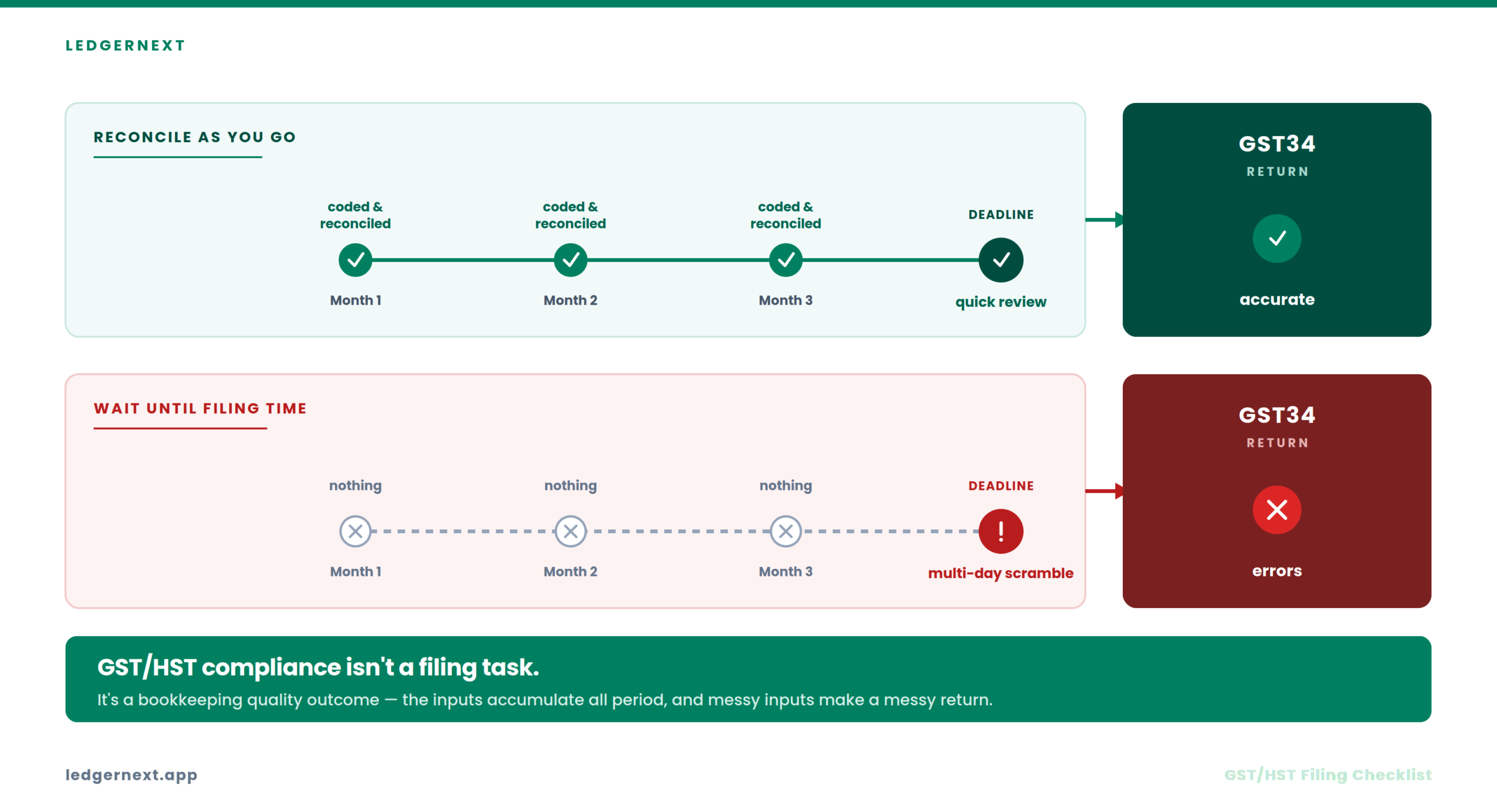
Think of it this way. When you reconcile bank accounts monthly, you catch a miscoded purchase within days. When you wait until filing time, you’re reconstructing context from three-month-old transactions with no memory of what they were. Missing tax codes are dramatically easier to correct weekly than the night before a deadline.
Month-end bookkeeping discipline simplifies quarter-end GST/HST filing. Firms that follow a consistent month-end close process find that their GST/HST prep shrinks from a multi-day scramble to a quick review.
Key takeaway: GST/HST compliance isn’t a filing task. It’s a bookkeeping quality outcome.
The GST/HST Compliance Workflow Framework
I use an 8-stage framework with my clients. I call it the GST/HST Compliance Workflow Framework, and it reframes filing as the final step in an ongoing process rather than the entire process.
1Record Every Transaction Correctly
Every sale, purchase, expense, and adjustment needs to land in the general ledger with the right account, the right amount, and the right date. A consistent chart of accounts directly improves GST/HST reporting quality because it eliminates ambiguity about where transactions belong.
What goes wrong: transactions get dumped into generic categories (“Miscellaneous Expense” is the enemy of clean tax reporting). Accurate transaction categorization is the foundation everything else depends on.
2Apply the Correct Tax Treatment
Every transaction needs the appropriate tax code—GST at 5%, HST at 13% or 15% depending on province, zero-rated, or exempt. The distinction between zero-rated and exempt supplies is one of the most common sources of CRA reassessments. Zero-rated supplies (exports, basic groceries) still get reported on Line 101. Exempt supplies (residential rent, health services) don’t generate tax at all and must be excluded from Line 103 entirely.
Visual checkpoint: Your tax code report should show zero transactions with a blank or “None” tax code. If you see blanks, stop. Fix them before moving forward.
3Reconcile Financial Records
Reconciled books reduce GST/HST adjustments because discrepancies get identified earlier. If your bank reconciliation shows unexplained differences, those differences will flow directly into your GST/HST numbers.
Bank reconciliation delays are one of the biggest bottlenecks before you can even calculate Line 103 accurately. And common reconciliation errors create downstream filing issues that are painful to untangle at deadline time.
4Review GST/HST Exceptions
Exception reports are often more valuable than summary reports because they surface problems before filing. Run a report showing transactions with missing tax codes, unusual tax amounts, or tax codes that don’t match the transaction type.
A vendor invoice for office supplies coded as “Exempt”? That’s an exception. A $15,000 equipment purchase with no GST recorded? Exception. These are the items that cause Line 103 vs. Line 101 mismatches—the “ghost error” that triggers CRA logical inconsistency flags.
5Validate Input Tax Credits
Not every GST/HST amount paid qualifies as an ITC. The vendor invoice must include the supplier’s Business Number, the GST/HST amount, and the date. If any of these are missing, the ITC is technically invalid—and the CRA can deny it on review.
Verification check: Pull 5 random vendor invoices from the period. Can you confirm the BN, tax amount, and date on each? If not, your ITC documentation process needs work.
6Generate and Review Reports
Your GST/HST summary should map directly to the GST34 form: Line 101 (total revenue from supplies), Line 103 (total GST/HST collected), Line 106 (total ITCs), and Line 109 (net tax). If Line 109 shows $0.00 but you had taxable sales during the period, something is wrong.
Financial reporting isn’t just about compliance—it’s about catching issues before they become CRA problems.
7File with Confidence
Submit via NETFILE using your Business Number with the RT0001 suffix. After submission, you must receive a 6-digit confirmation number. That number is your only legal proof of filing. Screenshot it. Save it. Email it to the client.
8Maintain Audit-Ready Documentation
The CRA’s 6-year rule means you need to retain all supporting records—invoices, receipts, bank statements, reconciliation reports, and the filed return—for six years from the end of the tax year. Businesses that maintain supporting documentation throughout the reporting period spend significantly less time responding to CRA requests.
The Complete GST/HST Filing Checklist
Here’s the operational checklist I use. It’s not glamorous, but it catches problems.
| Step | Action | Verification |
|---|---|---|
| 1 | Confirm reporting period dates and filing frequency | Matches CRA My Business Account |
| 2 | Verify all transactions are categorized | Zero uncategorized transactions in ledger |
| 3 | Review tax codes on every transaction | No missing or blank tax codes |
| 4 | Reconcile all bank and credit card accounts | Reconciliation shows $0 difference |
| 5 | Validate sales records against bank deposits | Line 101 matches revenue reports |
| 6 | Validate purchase records against vendor invoices | All invoices include supplier BN and tax amounts |
| 7 | Review ITCs for eligibility | Each ITC has valid supporting documentation |
| 8 | Document any filing adjustments (bad debts, corrections) | Adjustments recorded with date and reason |
| 9 | Generate GST/HST summary aligned to GST34 | Line 103 ≤ Line 101 × applicable tax rate |
| 10 | Conduct internal review (second set of eyes) | Reviewer sign-off documented |
| 11 | Retain all supporting documentation | Filed digitally with period label |
| 12 | Submit via NETFILE and archive confirmation | 6-digit confirmation number saved |
Stop/Go test: Before filing, can you explain the source of every number on your GST34 using your reports? If you can’t trace Line 106 back to specific invoices, you’re not ready.
Common GST/HST Filing Mistakes
These aren’t theoretical. I’ve seen every one of them cause real problems.
Incorrect tax codes. The zero-rated vs. exempt confusion alone accounts for a surprising number of CRA “missing income” alerts. Run a tax code audit before every filing.
Unreconciled transactions. If your books don’t match the bank, your GST/HST numbers are estimates, not calculations. Manual reconciliation compounds this problem.
Missing receipts. An ITC without a valid vendor invoice isn’t an ITC. It’s a liability.
Duplicate entries. Especially common when transactions are imported from bank feeds and also entered manually. The result: overstated Line 103 and inflated ITCs.
Late adjustments. Filing adjustments—like bad debt write-offs on Line 104—should be documented immediately rather than reconstructed months later. The bad debt must be written off in the books before the filing date, or the CRA rejects the adjustment.
Filing without reviewing exception reports. This is the one that gets experienced firms too. Summary reports look fine. Exception reports reveal the three transactions that will trigger a reassessment.
How Accounting Firms Can Standardize GST/HST Workflows Across Clients
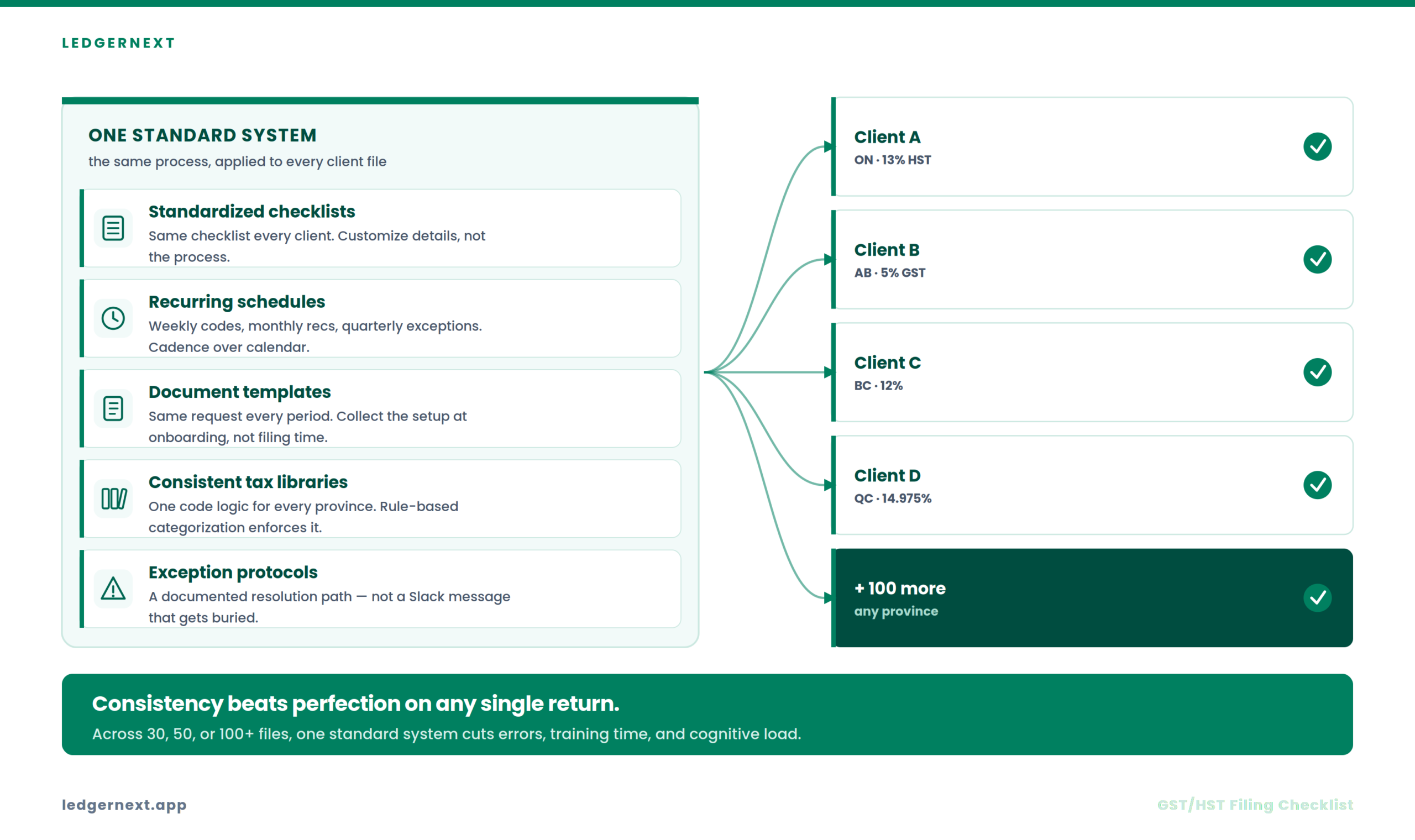
When you’re managing 30, 50, or 100+ client files, consistency matters more than perfection on any single return. Standardized tax code reviews improve filing consistency across multiple clients—and they reduce the cognitive load on your team.
What works:
- Standardized checklists. Use the same filing checklist for every client. Customize the details, not the process. Firms that build standardized workflows across clients reduce errors and training time.
- Recurring review schedules. Weekly tax code reviews. Monthly reconciliation. Quarterly exception reports. The cadence matters more than the specific day.
- Document request templates. Send clients the same document request every period. Collect GST/HST registration details, provincial tax rates, and filing frequency during client onboarding—not at filing time.
- Consistent tax code libraries. Whether a client is in Ontario (13% HST) or Alberta (5% GST), your tax code structure should follow the same logic. Rule-based categorization enforces this consistency automatically.
- Exception management protocols. When someone flags an exception, there’s a documented resolution process. Not a Slack message that gets buried.
Accurate payroll and expense classification indirectly improve GST/HST reporting accuracy too. When expenses are properly categorized in the general ledger, the tax codes downstream are more likely to be correct.
Technology’s Role in Accurate GST/HST Filing
Let me be clear: no software fixes bad processes. If your workflow is broken—if transactions aren’t categorized, reconciliations are months behind, and nobody reviews exceptions—technology just automates the mess faster.
The workflow concepts come first:
- Centralized bookkeeping so every transaction lives in one system
- Standardized tax reporting aligned to CRA forms
- Automated reconciliation to eliminate manual matching
- Audit trails that document every change
- Client collaboration tools that make document collection seamless
Once those concepts are in place, the right platform makes execution faster and more reliable.
Supporting Your GST/HST Workflow
LedgerNext is built to support exactly this kind of structured compliance process. The platform provides GST/HST summaries mapped directly to the CRA GST34 worksheet, taxable sales reports, missing tax code audit reports, province-based tax configuration, ITC tracking, filing adjustment documentation, and CRA-ready exports in PDF and Excel. For firms managing multiple clients, it centralizes bookkeeping and standardizes reporting across every file.
The point isn’t the software. The point is that when your workflow follows the GST/HST Compliance Workflow Framework—record, code, reconcile, review, validate, report, file, document—the technology simply accelerates what you’ve already designed well.
Frequently Asked Questions
How long should GST/HST filing preparation take?
For a firm with clean monthly books and consistent tax coding, quarterly filing prep should take 1–2 hours per client. If you’re spending significantly more, the bottleneck is usually upstream—unreconciled accounts or inconsistent categorization rather than the return itself.
What happens if I file GST/HST late?
The CRA charges a penalty of 1% of the amount owing, plus 0.25% for each month the return is late, up to 12 months. Interest compounds daily. Beyond penalties, late filing increases audit risk because it signals disorganized records.
Can I claim ITCs without a receipt?
No. The CRA requires valid documentation including the supplier’s Business Number, the GST/HST amount charged, and the transaction date. Without these, the ITC can be denied during a review—even if the tax was legitimately paid.
How do I handle GST/HST on interprovincial sales?
The place of supply rules determine which rate applies. Generally, the tax rate is based on where the goods are delivered or where the service is performed. Province-based tax configuration in your accounting system prevents errors here.
What’s the difference between zero-rated and exempt supplies?
Zero-rated supplies are taxable at 0%—you still report the revenue and can claim ITCs on related expenses. Exempt supplies carry no GST/HST and generate no ITC eligibility. Misclassifying between these two is one of the most common triggers for CRA reassessments.
Quick Reference: The GST/HST Compliance Workflow Framework
2. Code→
3. Reconcile→
4. Review→
5. Validate→
6. Report→
7. File→
8. Document
The firms that file GST/HST with confidence aren’t doing anything magical. They’re just doing these eight things consistently, every period, for every client.
Ready to standardize your GST/HST workflow?
LedgerNext helps Canadian accounting firms build repeatable compliance processes with CRA-ready reporting, province-based tax setup, and multi-client management—all from one platform.
So—where does your current workflow break down? Stage 3? Stage 4? Start there. Fix one stage this quarter, and the next filing gets measurably easier.