A client receives their monthly P&L, glances at the bottom line, and drops it into a folder. Three months later, they’re blindsided by a cash crunch that was visible in their reports the entire time — if anyone had walked them through what those numbers actually meant.
I’ve watched this pattern repeat across dozens of firms. The reports get produced. The reports get delivered. And then… nothing. No conversation. No interpretation. No action.
Here’s what most firms miss: financial reporting isn’t the deliverable. It’s the starting point for advisory conversations that clients will actually pay a premium for. According to Caseware’s 2024 report, 75% of firms are seeing CAS growth, and a Gusto study found 44% of business owners will pay 10–20% more for advisory services beyond compliance.
Your promise: By the end of this guide, you’ll have a repeatable framework for turning every financial report into a structured advisory conversation — and you’ll know exactly which reporting mistakes silently destroy that opportunity.
How Does Financial Reporting Support Client Advisory Services?
Financial reporting supports client advisory services by converting accurate bookkeeping, reconciliation, and payroll data into structured reports that reveal profitability trends, cash flow risks, and operational inefficiencies. When accounting firms interpret these reports — rather than simply delivering them — they help clients make informed decisions about pricing, spending, tax planning, and growth. Advisory quality depends directly on the accuracy and consistency of the underlying financial data. Firms that standardize their reporting workflows across clients can scale advisory services without proportionally increasing staff time.
Why Financial Reporting Is No Longer Just About Compliance
Client expectations have shifted from “file my taxes correctly” to “help me understand my business.” Compliance remains necessary, but it’s table stakes. Clients can get compliance work commoditized. What they can’t easily get is someone who looks at their cash conversion cycle and says, “You’re collecting receivables 15 days slower than last quarter — here’s what that means for your Q4 tax payment.”
Operational Insight: Many clients receive financial statements but never receive an explanation of what has changed since the previous reporting period. That gap between “delivered” and “explained” is where advisory value lives.
Experienced firms handle this differently. They treat every report delivery as a scheduled conversation, not a PDF attachment. The report is the agenda — not the outcome.
Stop/Go Readiness Check: Can you describe, in one sentence, the advisory question each of your top 10 clients should be asking right now? If not, your reporting workflow is producing documents, not insights.
The Financial Reporting to Advisory Framework
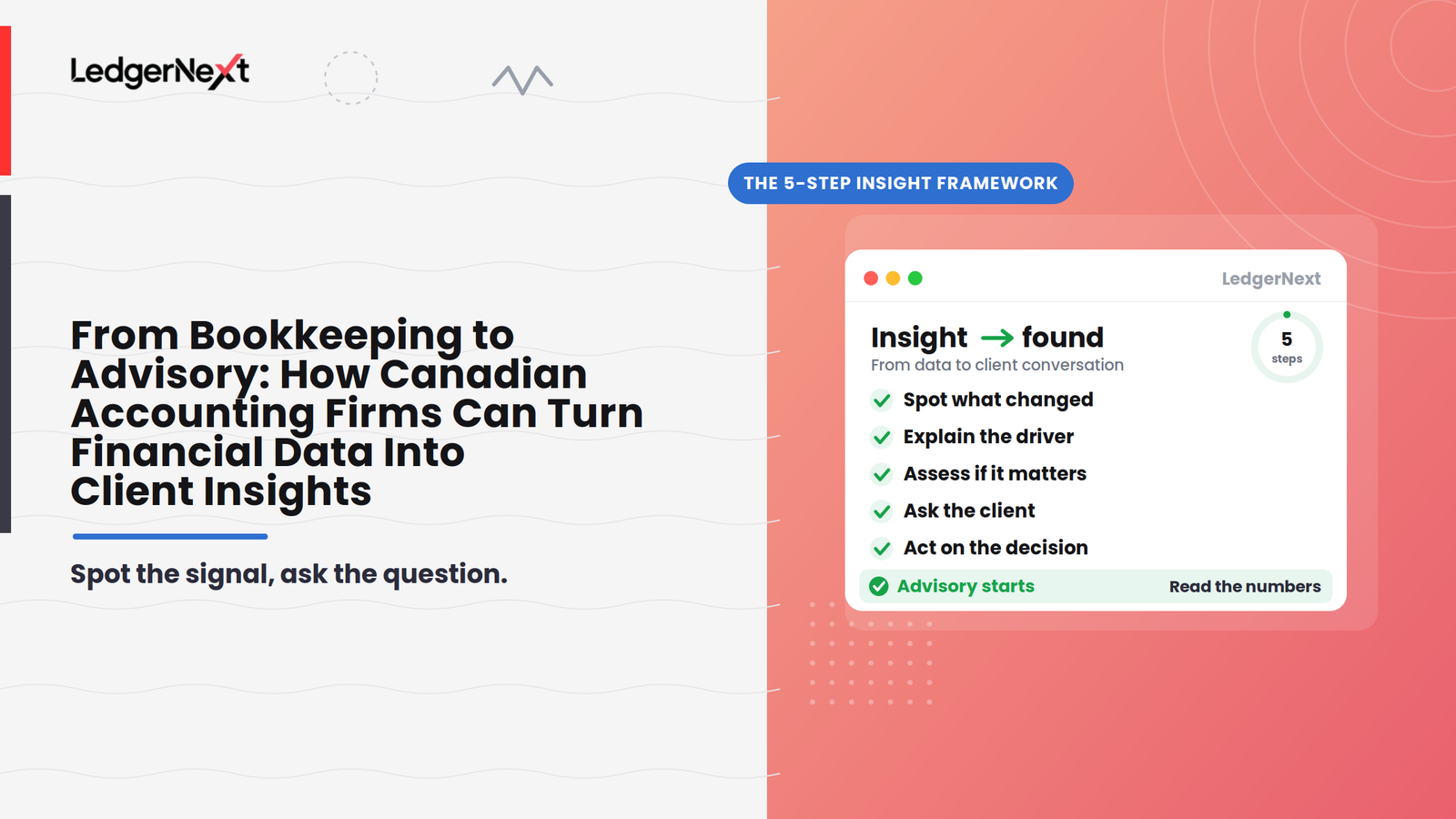
Most articles tell you to “add advisory services.” Few explain the operational sequence that makes advisory conversations reliable and repeatable. Here’s the framework I use:
| Stage | Focus | Output |
|---|---|---|
| Stage 1: Accurate Financial Data | Clean bookkeeping, correct categorization, timely reconciliation | Transaction-level accuracy |
| Stage 2: Reliable Financial Reports | Consistent P&L, Balance Sheet, Cash Flow generation | Trustworthy financial statements |
| Stage 3: Performance Analysis | Period-over-period comparisons, budget vs. actuals, variance identification | Quantified trends and anomalies |
| Stage 4: Business Insights | Interpreting what the numbers mean for this specific client | Contextualized observations |
| Stage 5: Strategic Client Advisory | Recommendations, action plans, forward-looking projections | Client decisions and outcomes |
Each stage depends entirely on the one before it. You cannot deliver Stage 5 advisory if Stage 1 data is dirty. This is why firms that rush into “advisory” without fixing their transaction categorization for accurate bookkeeping end up giving advice built on unreliable numbers.
Operational Insight: Advisory work becomes difficult when different clients receive inconsistent reporting formats. Standardizing your report structure across clients — same layout, same KPI placement, same comparison periods — reduces interpretation time for both your team and the client.
The Financial Reports Every Advisory Conversation Should Start With
Different reports answer different business questions. The mistake is dumping all of them on the client simultaneously. Here’s how experienced firms sequence them:
- Profit & Loss Statement — Answers: “Am I making money, and where is it coming from?” Start here in every advisory meeting. Clients intuitively understand revenue and expenses.
- Cash Flow Statement — Answers: “Can I pay my bills?” This is where the real advisory conversations happen. A business can be profitable on the P&L and still run out of cash.
- Balance Sheet — Answers: “What do I own, what do I owe, and what’s left?” Critical for working capital management discussions and loan applications.
- Trial Balance (internal) — Your team’s verification tool. If the trial balance doesn’t balance, nothing downstream is trustworthy.
- General Ledger — Use when a client questions a specific line item. It’s the drill-down, not the starting point.
- GST/HST Summaries — Essential for Canadian compliance conversations and cash flow planning around remittance deadlines.
Operational Insight: Cash flow issues frequently appear weeks before profitability issues become visible. Firms that lead advisory conversations with the cash flow statement — not the P&L — catch problems earlier.
| Report | Primary Advisory Question | When to Use |
|---|---|---|
| P&L | “Are we profitable?” | Every meeting |
| Cash Flow | “Can we meet obligations?” | Every meeting |
| Balance Sheet | “What’s our financial position?” | Quarterly / loan prep |
| Trial Balance | “Is the data clean?” | Internal only |
| General Ledger | “What’s behind this number?” | On-demand investigation |
| GST/HST Summary | “Are remittances accurate?” | Monthly / quarterly |
How Clean Financial Data Improves Advisory Quality
This is Stage 1 of the framework, and it’s where most advisory initiatives quietly fail.
Poor transaction categorization leads to misleading management reports. I’ve seen a client’s “marketing expense” inflate by 40% because office supplies were miscategorized — and the advisory recommendation that followed (“cut marketing spend”) was completely wrong.
The chain is straightforward:
- 1Bookkeeping accuracy → correct transaction recording
- 2Consistent categorization → reliable report line items (see rule-based vs. manual categorization)
- 3Timely reconciliation → current, not stale, financial position
- 4Accurate payroll → correct expense allocation and liability reporting
- 5Reliable reports → advisory conversations grounded in reality
Operational Insight: Timely bank reconciliation is essential because delayed reconciliations can distort management reports. A firm spending 15–20 hours monthly on manual reconciliation isn’t just losing time — they’re delivering advisory based on outdated numbers.
Small firms often underestimate the hidden cost of manual bookkeeping on advisory quality. When your team spends three hours reconciling before they can even look at the reports, advisory becomes an afterthought.
Verification Check: Pull 5 random transactions from a client’s latest report. Check them against the raw bank statement. If even 2 are miscategorized, your Stage 1 is compromised — and everything built on top of it is suspect.
Turning Reports Into Business Conversations
This is the transition from Stage 3 (Performance Analysis) to Stage 4 (Business Insights), and it’s where most firms stall.
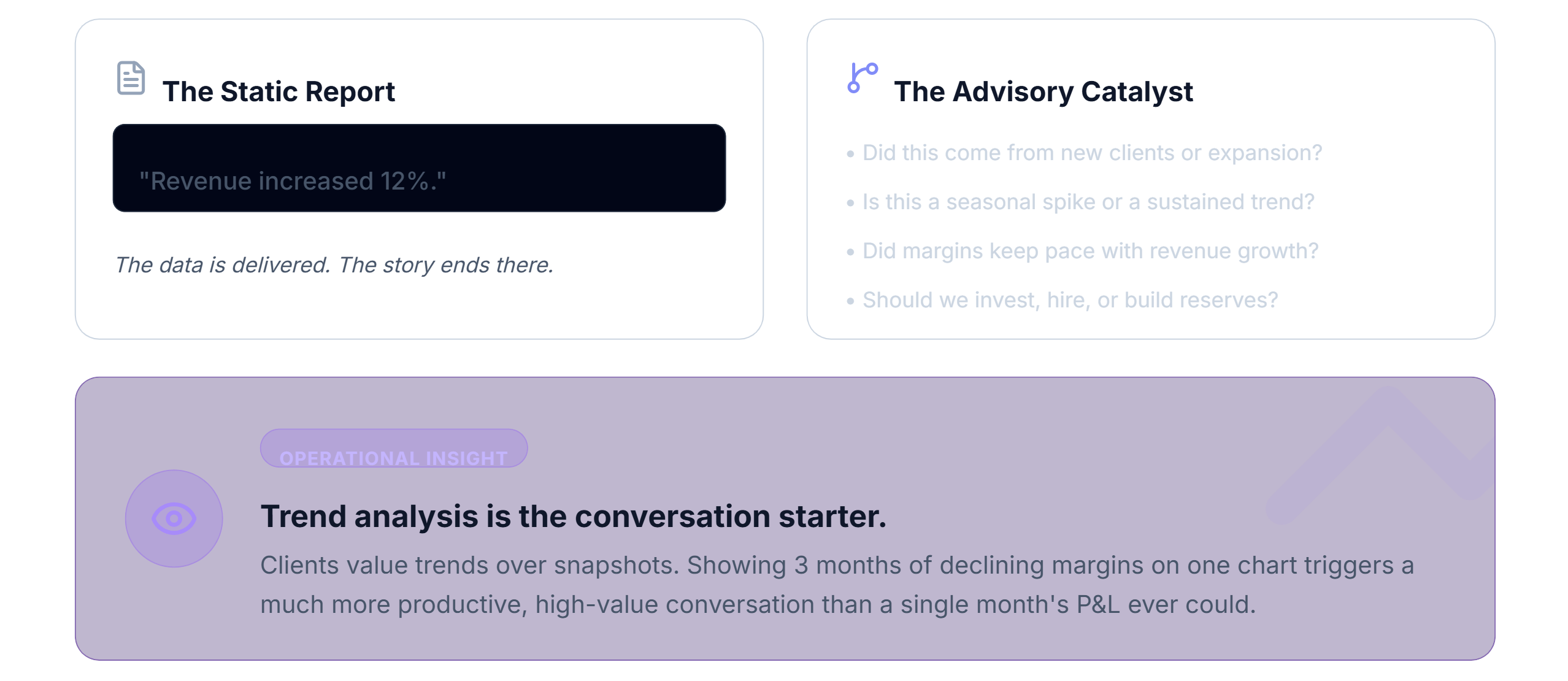
Instead of saying “Revenue increased 12%,” an advisory-focused firm asks:
- What drove the increase? New clients or existing client expansion?
- Was it seasonal, or is it a sustained trend?
- Did margins improve alongside revenue, or did costs increase faster?
- What should the client do next — invest, hire, or build reserves?
Operational Insight: Clients often value trend analysis more than individual monthly figures. Showing three months of declining gross margin on a single chart triggers more productive conversations than showing a single month’s P&L in isolation.
Questions to Ask Clients During Report Reviews
- “Which of these expenses surprised you?”
- “Did you expect revenue to look like this?”
- “Are there any upcoming expenses not yet reflected here?”
- “What business decision are you trying to make this quarter?”
That last question is critical. It reframes the entire meeting from “reviewing numbers” to “making decisions.”
Operational Insight: Advisory conversations are most effective when reports are delivered consistently rather than only at year-end. Quarterly or monthly cadence builds familiarity — clients start recognizing their own patterns.
Common Reporting Mistakes That Reduce Advisory Value
| Mistake | Why It Hurts Advisory | The Fix |
|---|---|---|
| Outdated reports (30+ days old) | Advice based on stale data | Reconcile and report within 10 business days of month-end |
| Inconsistent categorization | Same expense appears in different categories across months | Implement standardized workflows across every client |
| Incomplete reconciliations | Unreconciled items create phantom variances | Complete reconciliation before generating any advisory report |
| Too many metrics | Client overwhelm leads to disengagement | Limit to 4–6 KPIs per client, tailored to their goals |
| Historical-only focus | No forward-looking context | Add rolling forecasts or budget vs. actuals comparisons |
| Ignoring cash flow | Profitability masks liquidity risk | Always include cash flow alongside P&L |
Operational Insight: Standardized reporting formats improve client understanding because they reduce the time spent interpreting layouts. When the format changes every month, clients spend cognitive energy figuring out where to look instead of what the numbers mean.
Common bank reconciliation errors are a frequent root cause — reporting errors often originate upstream in the reconciliation process, not in the report itself.
Best Practices for Delivering Advisory-Focused Financial Reports
- 1Standardize your report package — Same reports, same format, every client, every period. Consistency builds trust.
- 2Schedule review meetings proactively — Don’t wait for clients to ask. Book recurring 30-minute reviews.
- 3Always compare periods — Month-over-month, quarter-over-quarter. Single-period reports lack context.
- 4Highlight 3 key metrics — Revenue trend, cash position, and one client-specific KPI (e.g., gross margin for product businesses, utilization rate for service firms).
- 5Explain the “why” behind every trend — Numbers without narrative are just data.
- 6Recommend one specific action — Every advisory meeting should end with a concrete next step.
- 7Document recommendations — Track what you advised and whether the client acted. This builds your advisory track record.
Operational Insight: Advisory value compounds over time. The first meeting might feel awkward. By the fourth consecutive monthly review, clients start bringing their own questions — and that’s when advisory becomes self-sustaining.
Firms preparing for year-end accounting find that consistent monthly reporting eliminates the year-end scramble entirely. There’s nothing to “catch up” on because the data has been clean all along.
Ready to standardize your reporting workflow?
Firms managing multiple clients need consistent processes across every engagement. Explore how LedgerNext supports multi-client financial reporting through integrated bookkeeping, reconciliation, payroll, and GST/HST reporting — all from a single workspace.
How Technology Supports Better Financial Reporting
The concepts matter more than any specific tool. What you need from your technology stack:
- Centralized data — Client financials accessible from one place, not scattered across spreadsheets
- Timely reconciliation — Automated matching that reduces the 15–20 hour monthly manual burden
- Consistent categorization — Rule-based systems that apply the same logic across similar transactions
- Payroll integration — Multi-client payroll management that feeds directly into financial reports without manual re-entry
- Secure client collaboration — Clients can review reports without email attachments or unsecured file sharing
- Standardized report delivery — Same output format regardless of which team member prepares it
LedgerNext is one platform built to support these workflows for Canadian accounting firms. It combines bookkeeping, payroll, transaction categorization, bank reconciliation, financial reporting, GST/HST reporting, and multi-client workspaces into a single environment. The client onboarding process is designed to collect complete financial information upfront — because accurate reporting begins at intake, not at month-end.
The emphasis here isn’t “buy software.” It’s this: your advisory capacity is directly limited by the speed and accuracy of your reporting infrastructure. Firms that can produce reliable reports in hours instead of days free up the time that advisory conversations actually require.
FAQ
How long does it take to transition from compliance to advisory services?
Most firms see meaningful results within two to three quarters. The first quarter is spent standardizing reporting workflows and cleaning up categorization. The second quarter introduces scheduled client review meetings. By the third quarter, clients begin expecting — and valuing — the advisory conversation.
What’s the biggest barrier to offering advisory services?
Dirty data. If your team spends most of their time on reconciliation and categorization cleanup, there’s no capacity left for interpretation. Fix Stage 1 of the framework before attempting Stage 5.
Do small firms have the capacity to offer advisory?
Yes. Advisory doesn’t require a large team. It requires consistent, accurate reports and a 30-minute monthly conversation. Firms increasing monthly client revenues by up to 50% through advisory aren’t necessarily large — they’re organized.
Which report matters most for advisory conversations?
The cash flow statement. It reveals liquidity risks that the P&L obscures and triggers the most actionable client conversations.
TL;DR
Financial reports aren’t the final product of accounting — they’re the raw material for advisory conversations. The quality of those conversations depends on clean bookkeeping, accurate categorization, timely reconciliation, and consistent reporting formats. Use the Financial Reporting to Advisory Framework (Data → Reports → Analysis → Insights → Advisory) to build a repeatable process. Start every client meeting with the cash flow statement, limit KPIs to what matters, and always end with one recommended action.
See LedgerNext in action
If your firm is ready to reduce manual reporting effort and spend more time on advisory, request a demo to see how the platform handles bookkeeping, reconciliation, payroll, and CRA-ready financial reporting for multi-client practices.
Multi-Client Payroll
CRA-Ready Reporting