
Your firm didn’t grow because you got faster at data entry. It grew because you delivered insight, accuracy, and trust. So why is most of your team’s week still consumed by manual bookkeeping?
Many accounting firms treat manual bookkeeping as a fixed operating cost — just part of running a practice. Transactions need reviewing, categorizing, reconciling, and reporting. That’s the work. But here’s what most firm owners miss: manual bookkeeping creates costs that extend far beyond the hours logged on data entry. As client portfolios grow, those costs quietly eat into profitability, team capacity, reporting timelines, and the quality of client service you’re able to deliver.
By the end of this guide, you’ll be able to identify exactly where manual processes are draining your firm — and what high-performing practices are doing differently.
What Is the Hidden Cost of Manual Bookkeeping?
The hidden cost of manual bookkeeping is the cumulative loss of time, accuracy, and capacity that firms absorb without realizing it. It includes hours spent on rework and error correction, delayed month-end reporting that slows client decision-making, reconciliation bottlenecks that compound across multiple client accounts, and scalability limitations that force firms to hire more staff instead of improving workflows. These costs rarely appear on a line item. They show up as missed deadlines, stressed teams, and growth that plateaus before demand does. For Canadian accounting firms managing dozens or hundreds of client books, these inefficiencies compound every single month.
Why Manual Bookkeeping Still Exists in Many Firms
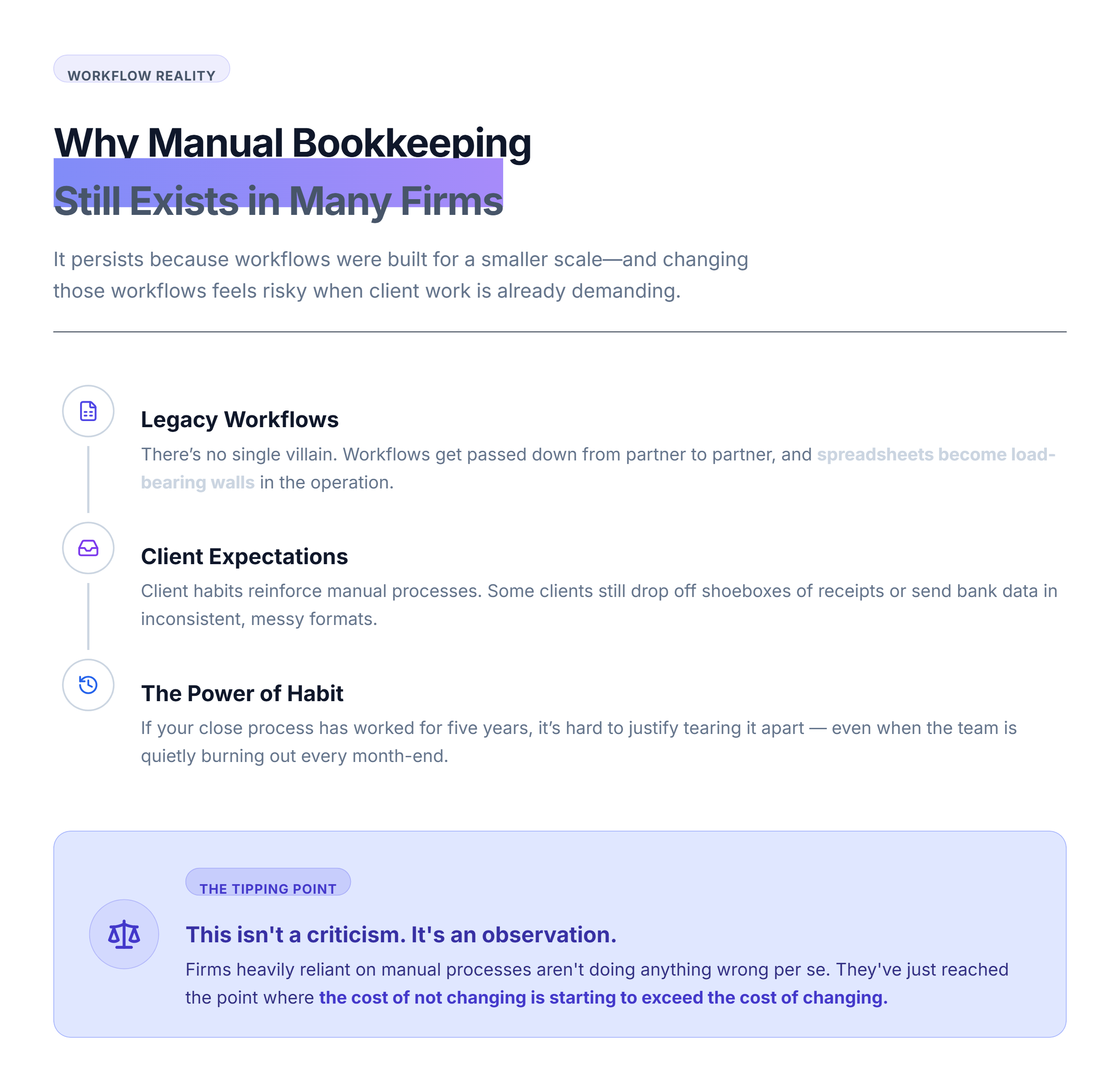
Manual bookkeeping persists because most firms built their workflows around tools and habits that worked at a smaller scale — and changing those workflows feels risky when client work is already demanding.
There’s no single villain here. Legacy workflows get passed down from partner to partner. Spreadsheets become load-bearing walls in the operation. Client expectations sometimes reinforce manual processes — some clients still drop off shoeboxes of receipts or send bank data in inconsistent formats.
And honestly? Habit plays a bigger role than most people admit. If your close process has worked for five years, it’s hard to justify tearing it apart — even when the team is quietly burning out every month-end.
This isn’t a criticism. It’s an observation. The firms that still rely heavily on manual processes aren’t doing anything wrong per se. They’ve just reached the point where the cost of not changing is starting to exceed the cost of changing.
The Hidden Costs of Manual Bookkeeping
Here are the biggest costs many firms overlook when evaluating manual bookkeeping workflows:
1. Lost Staff Capacity
Firms spend a disproportionate share of staff time on repetitive transaction work — coding, matching, correcting, re-coding. That’s time that doesn’t go toward advisory services, client communication, or practice development.
FinQuery identifies misallocation of skilled resources as one of four hidden cost categories in manual accounting. When CPA time is spent on cleanup rather than analysis, the firm is paying advisory rates for clerical work.
The visual checkpoint here is straightforward: look at your team’s weekly time allocation. If more than half is spent on transaction-level tasks, you’ve got a capacity problem wearing a bookkeeping costume.
2. Slower Bank Reconciliation
Manual categorization, missing source documents, and line-by-line review work turn bank reconciliation into a multi-hour grind per client. Multiply that across 30, 50, or 100 client accounts and you start to see why bank reconciliation takes so long for many firms.
The real friction isn’t the reconciliation itself. It’s the exception handling — those transactions that don’t auto-code cleanly and require human review. Puzzle’s research suggests that if more than 30% of transactions still need manual review after automation rules are configured, the workflow is likely misconfigured.
3. Delayed Financial Reporting
Delayed reporting is one of the most expensive hidden costs because it affects the client relationship directly. When month-end close routinely runs past the first week of the next month, everything downstream shifts: client reporting, tax prep, advisory conversations, and decision-making.
Many firms underestimate how much this matters. Month-end bottlenecks often begin weeks earlier — with unreconciled items, missing data, and accrual adjustments that weren’t handled in time.
Understanding how clean financial data improves reporting accuracy is the first step toward compressing that timeline.
4. Increased Error Rates
Manual processes create predictable error patterns: duplicate entries, categorization inconsistencies across staff members, missed transactions, and chart of accounts drift between clients.
Here’s a quick verification test from the research: sample 5 random transactions from any client book. If 3 or more require re-coding or correction, the books are still dirty. That’s not a published benchmark — it’s a practical litmus test that experienced bookkeepers use to gauge data quality fast.
GrowthForce notes that manual bookkeeping leads to extra unplanned CPA costs to catch up, clean up books, resolve discrepancies, and fix errors. Those costs are real even if they never appear on a separate invoice.
5. Reduced Ability to Scale
This is where manual bookkeeping becomes a strategic problem, not just an operational one.
Manual processes force firms to scale staffing linearly with client volume. Ten more clients? Hire another bookkeeper. Twenty more? Hire two. That math breaks down fast — especially for Canadian firms dealing with GST/HST/QST requirements, multi-province clients, and increasing regulatory complexity.
Growth often slows before demand does. Firms hit an operational ceiling not because they’ve run out of clients, but because their workflows can’t absorb more volume without breaking. As firms grow, operational inefficiencies compound faster than headcount.
If you’re wondering how accounting firms can manage more clients without hiring more staff, the answer almost always starts with workflow design — not recruitment.
Is your firm hitting a capacity ceiling?
LedgerNext was built specifically for Canadian accounting firms that need to manage more client books without scaling headcount linearly. It automates transaction categorization, speeds up reconciliation, and centralizes multi-client management from one dashboard.
6. Team Burnout During Month-End
Backlog accumulation, review pressure, and hard deadlines create a predictable stress cycle every month. Staff spend the last week of the period scrambling to close books that should have been clean days earlier.
This isn’t just a morale issue. Controllers Council research emphasizes that manual accounting leads to burnout, turnover, and compliance risk. Losing an experienced bookkeeper mid-busy-season because they’re exhausted from constant reconciliation cleanup is a cost that rarely gets tracked — but it’s very real.
7. Less Time for Advisory Services
Advisory work is almost always more valuable per hour than bookkeeping work. But manual processes consume the capacity that advisory services require.
When your team spends Monday through Thursday on transaction review and cleanup, there’s no bandwidth left for variance review, financial analysis, or strategic client conversations. The firm ends up competing on bookkeeping price instead of advisory value.
Why Manual Bookkeeping Becomes More Expensive as Firms Grow
Manual bookkeeping becomes more expensive as firms grow because transaction volume, client complexity, and review requirements increase faster than operational capacity.
Consider a practical example. A firm with 20 clients averaging 200 transactions per month processes roughly 4,000 transactions. At 50 clients, that’s 10,000. At 100, it’s 20,000 — and the complexity isn’t just volume. More clients means more charts of accounts to manage, more exception handling, more reconciliation passes, and more variance review.
Six Sigma Accounting’s 2026 analysis frames manual bank reconciliation, expense categorization, and month-end close as multi-hour tasks even for experienced staff. Those hours don’t shrink as volume grows. They multiply.
Firms frequently discover reporting issues only after reconciliation begins. That’s a late-stage symptom of a workflow that was never designed for the firm’s current scale.
Operational Signs Your Firm Has Outgrown Manual Bookkeeping
If you recognize three or more of these, your manual processes are probably costing more than you think:
- ☐ Bank reconciliation routinely takes longer than expected
- ☐ Month-end always feels rushed, regardless of preparation
- ☐ Staff spend most of their week reviewing and correcting transactions
- ☐ Client reporting is delayed by a week or more
- ☐ Onboarding new clients feels operationally difficult
- ☐ You’ve considered hiring but can’t justify the cost
- ☐ The same errors keep appearing across different clients
- ☐ Your close checklist keeps getting longer, not shorter
A useful month-end close checklist for Canadian accounting firms can help you identify which specific steps are creating the most drag.
How High-Performing Accounting Firms Reduce Manual Work
High-performing firms reduce manual work by standardizing workflows and automating the repetitive parts of bookkeeping — not by eliminating human judgment.
Here’s what that looks like in practice:
- Standardized workflows
Every client follows the same intake, categorization, and close process. No more one-off spreadsheets or custom procedures per bookkeeper. - Categorization rules
Transaction coding follows pre-built rules tied to each client’s chart of accounts. Only exceptions route to human review. - Reconciliation processes
Bank reconciliation runs against clean, pre-categorized data — not raw exports that require manual sorting. - Multi-client management
All client books are visible and manageable from a centralized dashboard, with progress tracking and status indicators. - Client collaboration
Clients provide data through structured intake — not email attachments and paper drop-offs. - Workflow automation
Recurring entries, accruals, and prepaids are handled systematically instead of manually each period.
The Role of Clean Financial Data in Firm Efficiency
Clean financial data directly impacts every downstream deliverable — reporting, reconciliation, client delivery, and tax preparation.
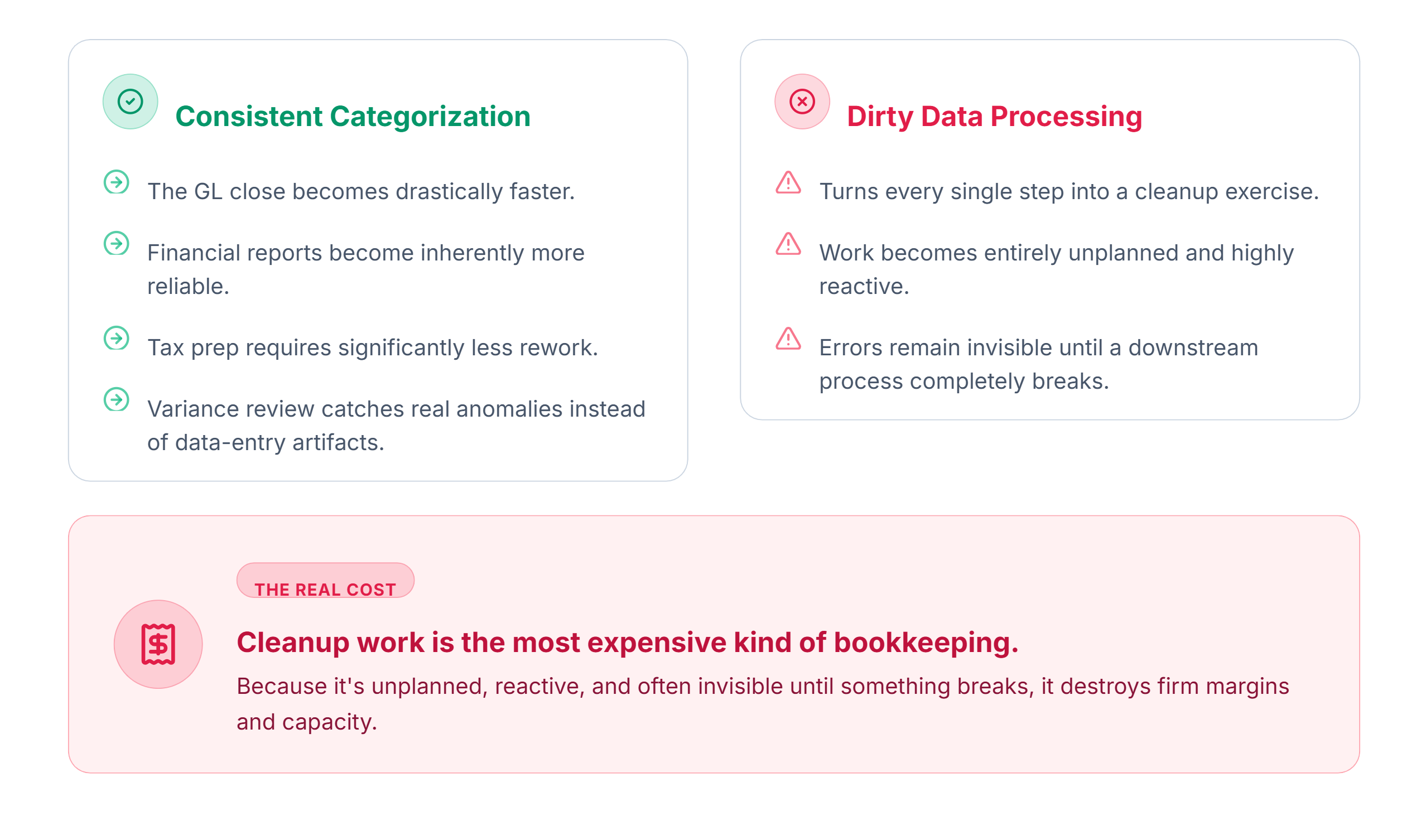
When transaction categorization for accurate bookkeeping is handled consistently, the GL close becomes faster, reports become more reliable, and tax prep requires less rework. The audit trail is cleaner. Variance review catches real anomalies instead of data-entry artifacts.
Dirty data, on the other hand, turns every step into a cleanup exercise. And cleanup work is the most expensive kind of bookkeeping — because it’s unplanned, reactive, and often invisible until something breaks.
Best Practices for Modernizing Bookkeeping Operations
If you’re ready to start reducing manual work, here’s a practical checklist:
- ✓ Standardize bookkeeping workflows across all clients
- ✓ Reduce spreadsheet dependency for reconciliation and reporting
- ✓ Improve client collaboration through structured data intake
- ✓ Reconcile more frequently — monthly at minimum, weekly if possible
- ✓ Automate repetitive transaction categorization using rule-based systems
- ✓ Centralize client management in a single platform
Frequently Asked Questions
What is manual bookkeeping?
Manual bookkeeping is the process of recording, categorizing, and reconciling financial transactions by hand or through spreadsheet-based workflows rather than automated systems. It typically involves significant human review at every stage of the bookkeeping cycle, from data entry through month-end close.
Why is manual bookkeeping inefficient?
Manual bookkeeping is inefficient because it requires staff to perform repetitive tasks that don’t scale with volume. Exception handling, re-coding, and reconciliation corrections consume hours that could be spent on higher-value work like advisory services and financial analysis.
What are the risks of manual bookkeeping?
The primary risks include increased error rates, control deficiencies, weaker audit trails, delayed reporting, compliance exposure, and unplanned CPA cleanup costs. These risks compound as transaction volume and client complexity grow.
How does manual bookkeeping affect accounting firm growth?
Manual bookkeeping forces firms to scale staffing linearly with client volume, creating an operational ceiling. Firms often plateau not because of insufficient demand but because their workflows can’t absorb additional clients without significant rework and delays.
Can bookkeeping processes be automated?
Yes. Transaction categorization, bank reconciliation, recurring journal entries, and report generation can all be automated using rule-based systems. The key is routing only genuine exceptions to human review — not using automation as a pre-check that staff still review entirely.
What is the biggest hidden cost of manual bookkeeping?
The biggest hidden cost is lost capacity. When staff time is consumed by repetitive data entry and error correction, firms lose the ability to deliver advisory services, onboard new clients efficiently, and grow without proportionally increasing headcount.
Final Thoughts
The biggest problem with manual bookkeeping isn’t the work itself. It’s the opportunities, capacity, and efficiency your firm loses because of it. Every hour spent on catch-up bookkeeping is an hour not spent on the work that actually grows your practice.
Ready to see your firm without the manual drag?
LedgerNext automates transaction categorization, speeds up reconciliation, and centralizes multi-client management — so your team spends less time on cleanup and more on the work that grows the practice.
✅ Faster Reconciliation
✅ Centralized Multi-Client Dashboard